Starship's Heat Shield: Can 18,000 Tiles Escape the Space Shuttle's Fatal Flaw?
· 34 min read
A broken heat shield doomed Columbia. SpaceX's Starship rebuilt it with a steel hull and pinned hexagonal tiles, but experts say rapid reuse is still unsolved.
Tags: Starship, SpaceX, Space Shuttle, Heat Shield, Thermal Protection System, Columbia Disaster, Reusable Rockets, Aerospace Engineering
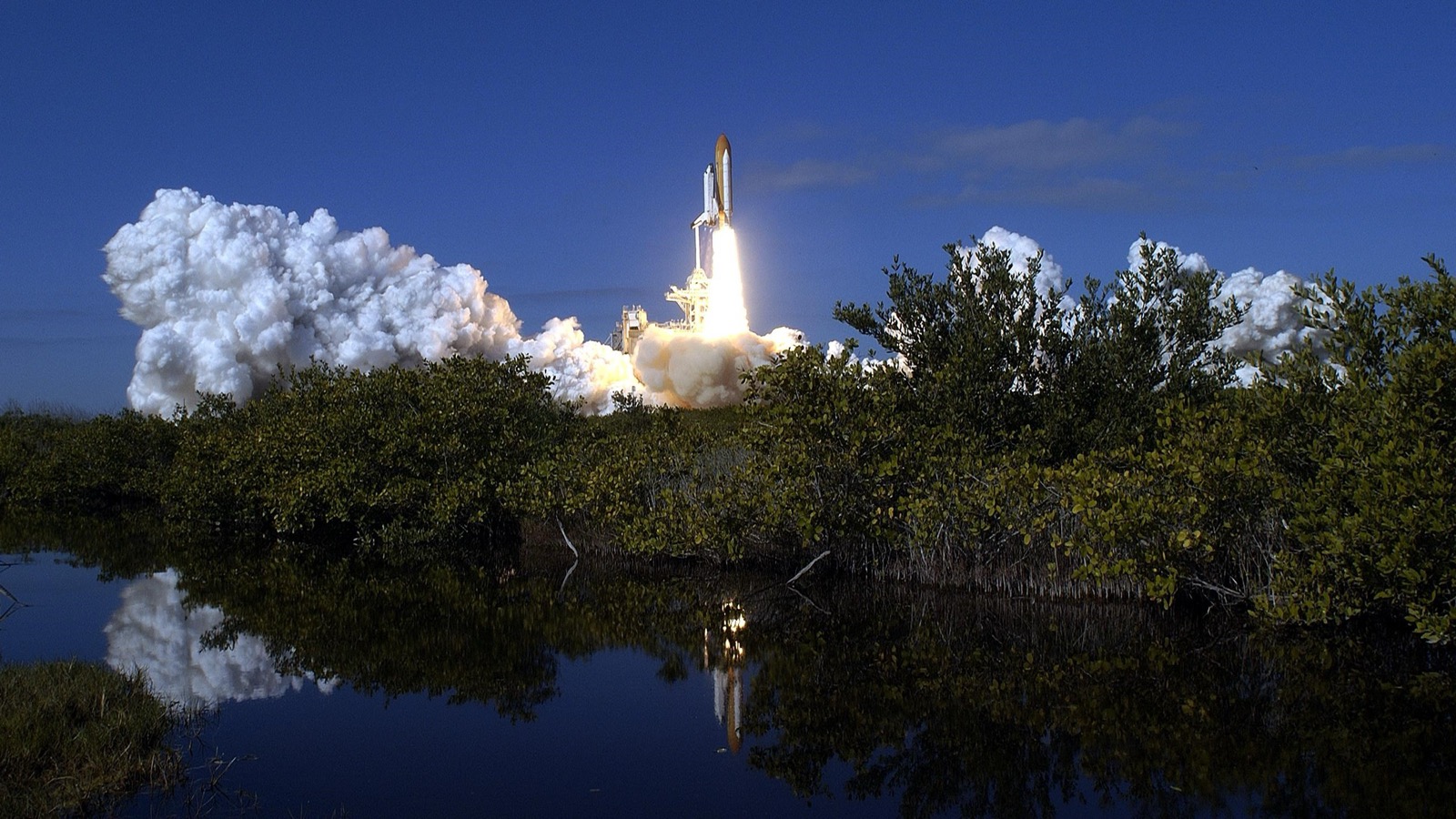 Columbia lifts off on STS-107, January 16, 2003, reflected in the water near Pad 39A. Eighty-two seconds later, a piece of foam struck its left wing. (NASA)
The tragedy of Columbia (STS-107)
I was a kid who memorized orbiter names the way other kids memorized NBA rosters. Columbia was the first to fly in space: the one that flew STS-1 in 1981, the heaviest of the fleet, the one with the black chines where its wings met the fuselage. On the morning of February 1, 2003, it was coming home from a 16-day science mission with seven people on board: Rick Husband, William McCool, Michael Anderson, Kalpana Chawla, David Brown, Laurel Clark, and Ilan Ramon.
At about 8:44 a.m. EST, Columbia hit the top of the atmosphere over the Pacific. At 8:59, Mission Control lost contact. People in Texas watched the orbiter break into a spray of bright streaks across the sky at about 200,000 feet and roughly 18 times the speed of sound. Nobody survived. And I was in tears.
The cause had been sitting in plain sight for 16 days.
At 81.7 seconds after liftoff, a briefcase-sized chunk of insulating foam, about 1.67 pounds, broke off the External Tank's left "bipod ramp," a foam fairing over the fitting where struts attach the orbiter's nose to the tank. Drag slowed the light foam almost instantly while the Shuttle kept accelerating, and it struck the lower part of Reinforced Carbon-Carbon (RCC) panel 8 on the left wing's leading edge at more than 500 mph.
Engineers saw the strike in launch video the next day and asked, more than once, for military satellites or telescopes to photograph the wing. One request reached the Department of Defense, and NASA managers cancelled it. Foam had hit orbiters many times before without disaster, and the anomaly had become routine. Sociologist Diane Vaughan had coined a phrase for this after Challenger, "normalization of deviance," and it became central to the Columbia Accident Investigation Board's (CAIB's) findings on NASA's culture.
During re-entry, hot gas entered the breach. It did not have to beat the heat shield. It went around it, into a wing built of aluminum designed to stay below about 175°C (350°F). The plasma burned through the leading-edge spar and then the wiring and structure inside. Sensors went offline one after another, the wing deformed, the flight control system ran out of authority, and the vehicle came apart.
Many people did not believe soft foam could break reinforced carbon. In July 2003, the CAIB settled it at the Southwest Research Institute in San Antonio, firing a 1.67-pound block of the same foam from a nitrogen gas cannon at a flight-flown RCC panel from Atlantis. The foam blew a hole about 16 by 17 inches. People in the room reportedly gasped.
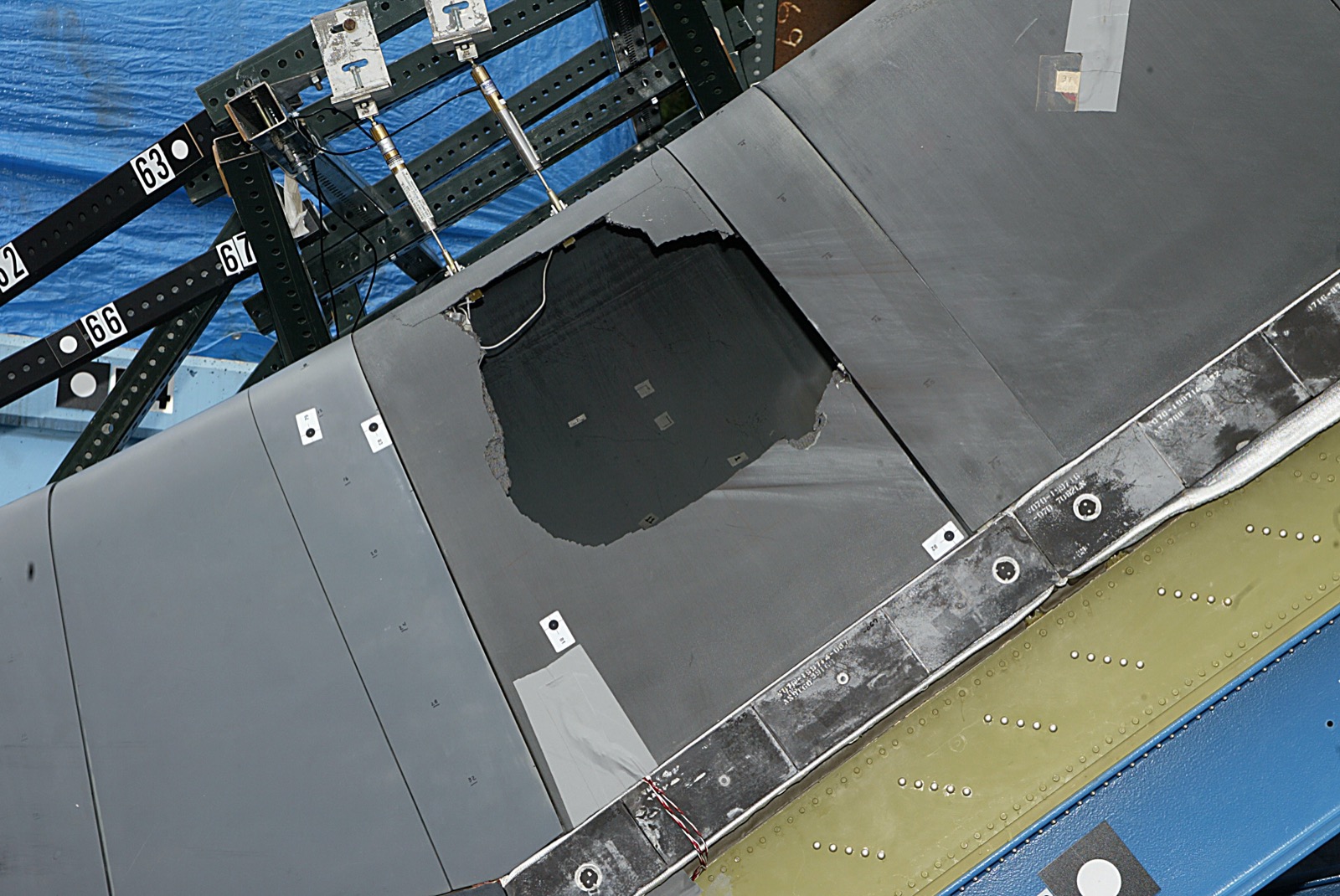 The CAIB foam impact test, July 7, 2003. A 1.67-lb block of foam fired at about 530 mph opened a roughly 16-by-17-inch hole in an RCC leading-edge panel. (NASA/CAIB)
The foam was the trigger. The real lesson was in the architecture: a thin, brittle heat shield over an airframe that could not tolerate heat at all. One breach in the wrong place was enough to lose the vehicle. Every reusable heat shield since has been designed in Columbia's shadow.
Why thermal protection is one of the hardest problems in reusable spacecraft
Start with the energy. In low Earth orbit, a spacecraft moves at about 7.8 kilometers per second. Each kilogram of vehicle carries about 30 megajoules of kinetic energy, roughly seven times the energy in a kilogram of TNT. To land, nearly all of it has to go into the air.
The vehicle does this by plowing into the atmosphere behind a shock wave. Air crossing the shock is heated so violently that oxygen and nitrogen molecules split into atoms, forming a glowing layer thousands of degrees hot. Most of the heat flows away in the wake. The small fraction that reaches the surface is still enough to destroy almost any material, and free atoms recombining on the surface dump their chemical energy straight into the heat shield.
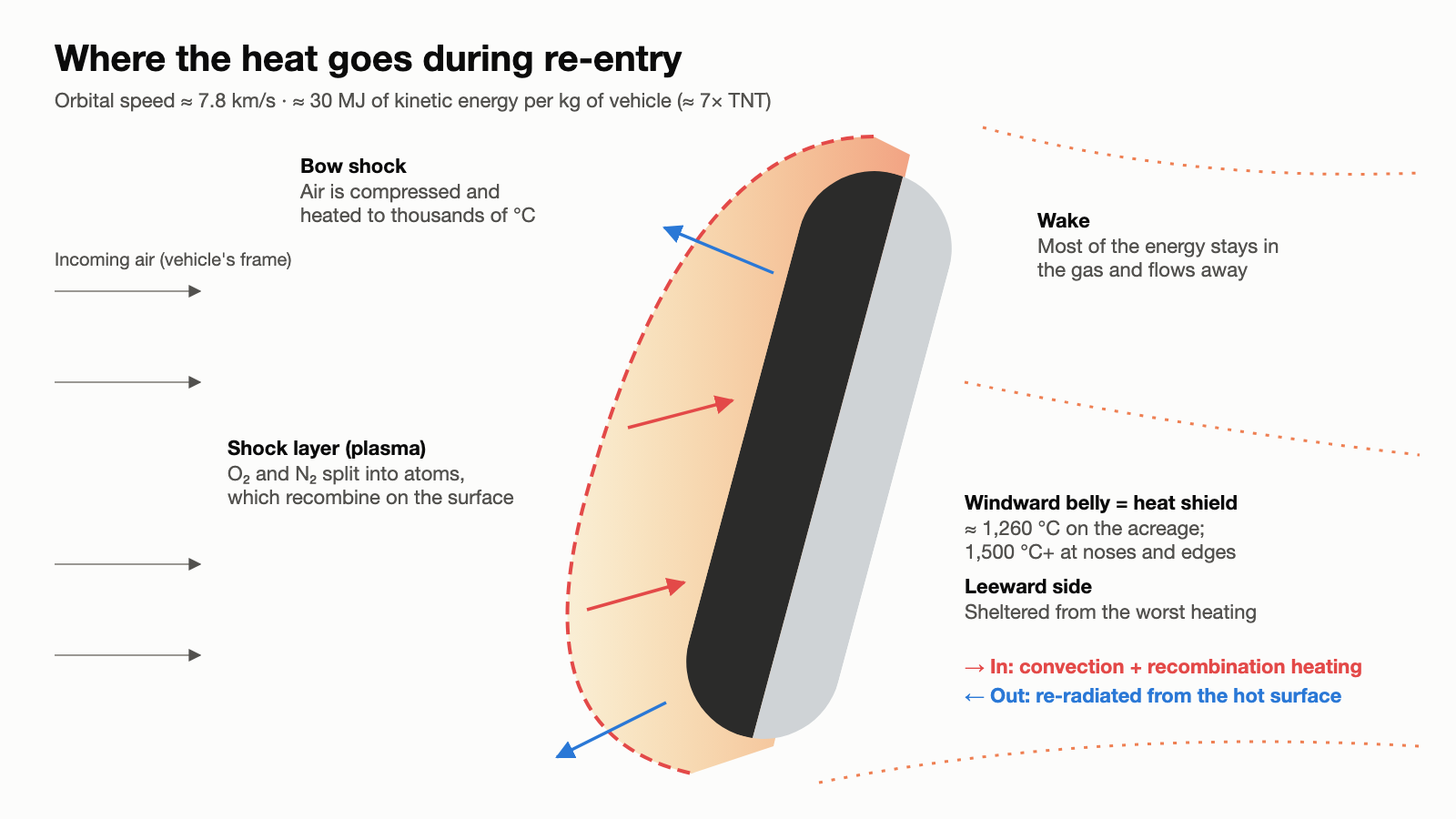 Where the heat goes during re-entry. Most of the energy is carried away in the shock layer and wake. The fraction that reaches the surface still pushes windward temperatures past 1,260°C, and higher at the nose and leading edges.
For a capsule that flies once, there is an elegant answer: ablation. Apollo, Orion, and SpaceX's Dragon use heat shields that char and erode, carrying heat away as they break down. It is very reliable, but the heat shield destroys itself and must be replaced after each flight.
A reusable heat shield gets no such option. It has to survive the heat without consuming itself, flight after flight. It has to be extremely light, because every kilogram of it is payload you never carry to orbit. It has to survive the violent acoustics and debris of launch, the cold of space and cryogenic tanks, and rain, humidity, and handling on the ground. And it has to be inspectable, because a heat shield you cannot verify is one you cannot trust.
Those requirements fight each other. Light materials are fragile. Tough materials are heavy. Good insulators are porous, and porous materials soak up water. Rigid ceramics do not stretch, and metal airframes always do. And in most places on the vehicle, there is no backup.
What did the Space Shuttle do?
The Shuttle's airframe was mostly aluminum: cheap, light, well understood, and completely unable to survive re-entry. The belly reached about 1,260°C (2,300°F), and the nose cap and wing leading edges went past 1,500°C. The aluminum had to stay below about 175°C. The heat shield had to hold back more than a thousand degrees in a layer only a few inches thick.
NASA's answer was a mosaic of about 24,000 tiles, plus blankets and carbon composite panels, each matched to the heating in its zone.
 The Shuttle's heat shield was a patchwork: black HRSI tiles on the belly, white LRSI tiles and blankets on the cooler upper surfaces, and RCC on the nose cap and wing leading edges. (NASA)
The tiles: 94 percent air
The black belly tiles were made mostly of LI-900: fibers of 99.9 percent pure silica glass, sintered into a block that is about 94 percent empty space and weighs 9 pounds per cubic foot, about as light as balsa wood.
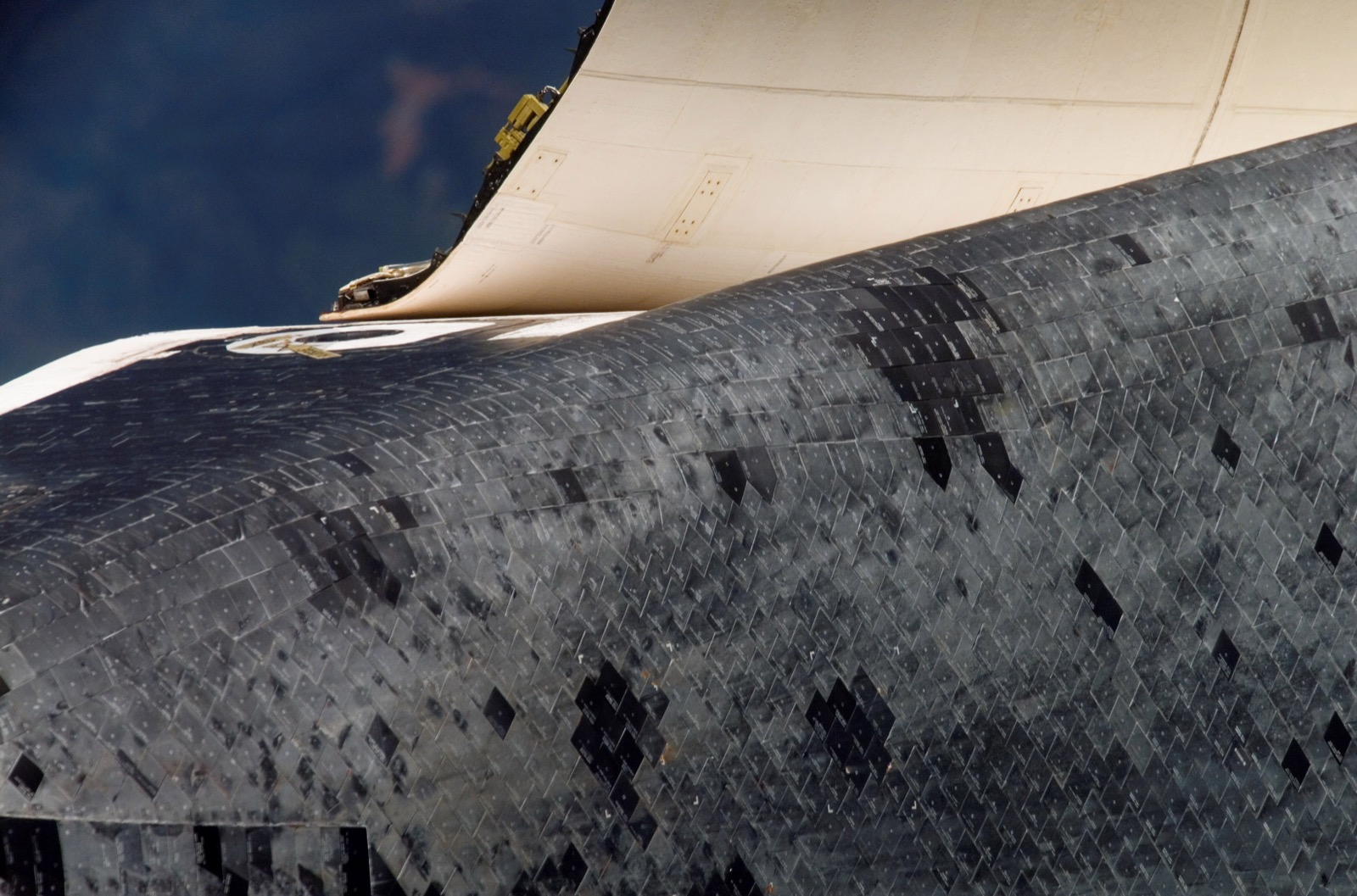 The Shuttle's belly up close: every tile individually shaped, numbered, and glued. (NASA)
That porosity made it an extraordinary insulator. In a famous demonstration, a tile heated in a 2,200°F oven until it glows can be picked up by its edges with bare fingers seconds later. The surface radiates heat away so fast, and the interior conducts it so poorly, that the corners cool almost immediately.
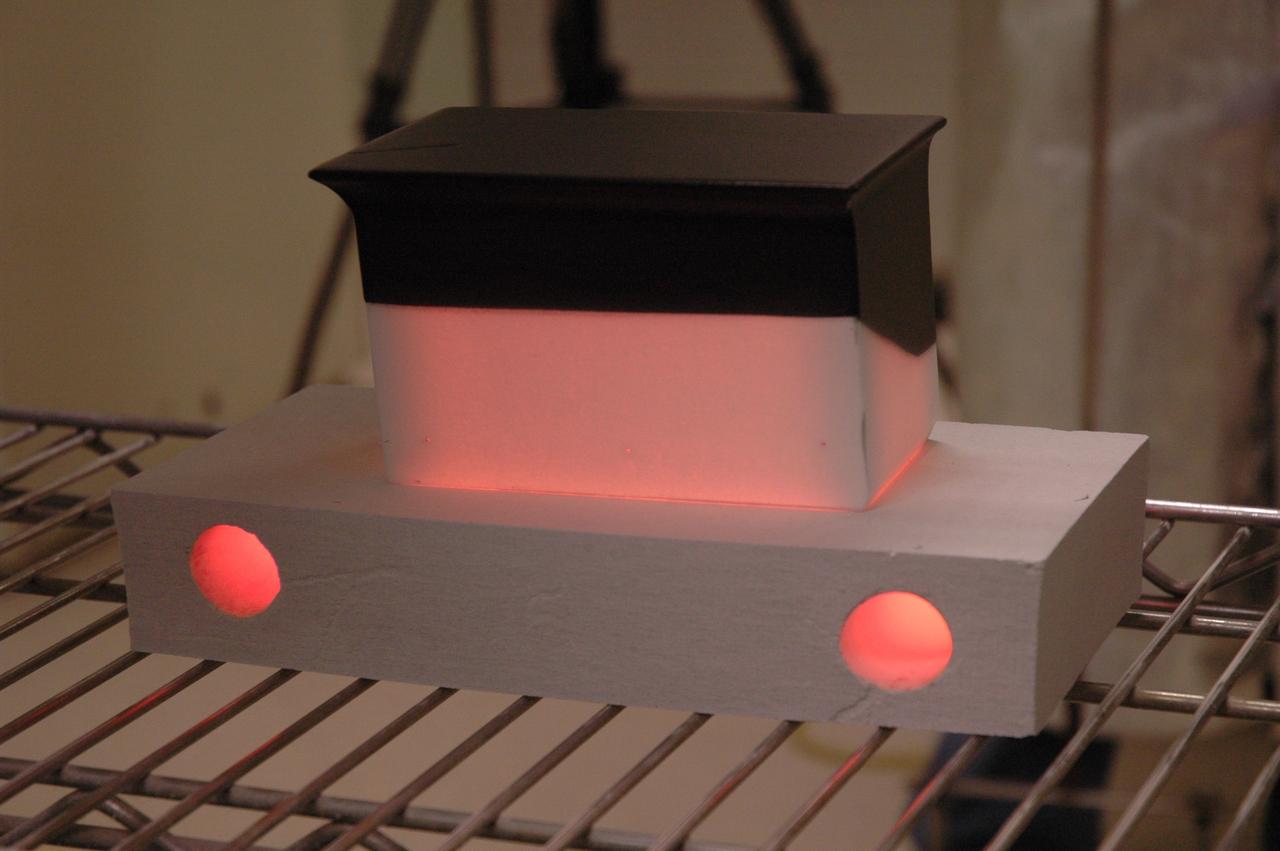 A Shuttle tile glowing after a 2,200°F (1,200°C) oven. Seconds later its corners are cool enough to touch. (NASA/Jim Grossmann)
The same porosity made it fragile. A tile could reportedly be crushed by hand, and a dropped tool could dent one. The fibers also had to be extremely pure. Impurities help silica crystallize into cristobalite, which expands far more than glassy silica and changes volume suddenly near 200°C, cracking the tile apart over repeated heating. A black borosilicate glass coating made each tile tough enough to handle and dark enough to radiate heat back into space.
The glue problem
The silica barely expanded with temperature. The aluminum underneath expanded 20 to 50 times more. Bonded directly to the skin, the tiles would have been torn apart.
So NASA put a cushion in between. Each tile was glued to a Strain Isolation Pad (SIP), a Nomex felt (the fiber in firefighters' suits), which was glued to the aluminum with the same red RTV-560 silicone adhesive. The felt stretched and sheared while the tile stayed rigid. But the felt also concentrated loads where its fibers met the tile, and tiles began pulling apart at the bond line. The fix was to densify each tile's underside with a baked colloidal silica layer. Every fix added labor and new ways to fail.
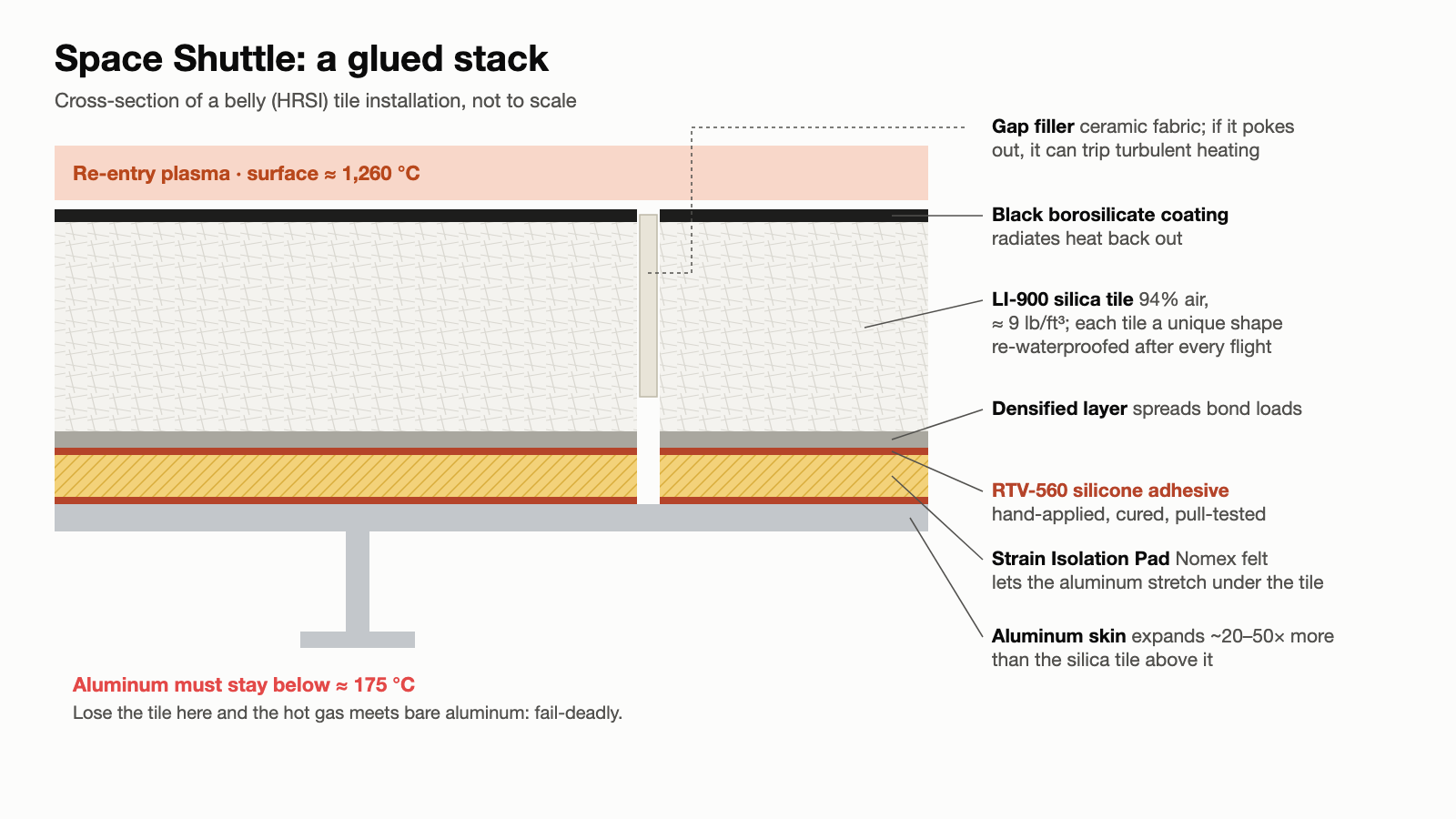 How a Shuttle tile was attached. Every layer was there to solve a problem the layer above or below it created.
Almost every tile was unique, shaped to its spot on the orbiter's compound curves and individually machined, numbered, test-fit, glued, cured, and pull-tested. Stanford risk analyst Elisabeth Paté-Cornell, who studied the tiles for NASA, later recounted that under schedule pressure at least one worker had spat into the glue to make it cure faster.
The gaps between tiles, from about 0.028 to 0.2 inches, were packed with ceramic-fabric gap fillers. When a filler worked loose and stuck out into the airflow, it could trip the smooth boundary layer into turbulence, which heats the surface far more. On STS-114 in 2005, engineers worried two protruding fillers on Discovery could raise local heating by about 25 percent, so astronaut Steve Robinson rode the station's robotic arm under the orbiter and pulled them out by hand.
And because a tile that is 94 percent air acts like a sponge, every tile had to be injected with a waterproofing chemical, DMES. Re-entry burned it out, so the tiles were re-treated after every flight.
The carbon edges
For the hottest places, the nose cap and the 22 panels along each wing's leading edge, NASA used Reinforced Carbon-Carbon: carbon fiber cloth baked into pure carbon again and again, then coated with silicon carbide so it would not burn. RCC handled the heat well. It was also brittle, and the panels formed the wing's leading edge. Those leading edges existed only because the Shuttle had to fly home on wings, and Columbia showed what happened when one broke.
What the Shuttle record shows
Across 135 flights, the heat shield was a constant source of worry:
- STS-1 (1981): Columbia returned with 16 tiles missing and 148 damaged, partly from the overpressure wave of the solid rocket boosters. NASA redesigned the pad's water sound suppression system.
- STS-27 (1988): Debris from a booster's nose cap left 707 damage sites on Atlantis's belly and one tile missing. It likely survived only because that tile sat over a thick aluminum antenna mounting plate, which partially melted and held. Commander Robert "Hoot" Gibson told his crew there was "no use dying all tensed up."
- STS-107 (2003): Columbia.
- STS-118 (2007): Foam gouged a 3.5-by-2-inch hole right through one of Endeavour's tiles. Engineers studied it with the new post-Columbia inspection boom and decided it could fly home unrepaired.
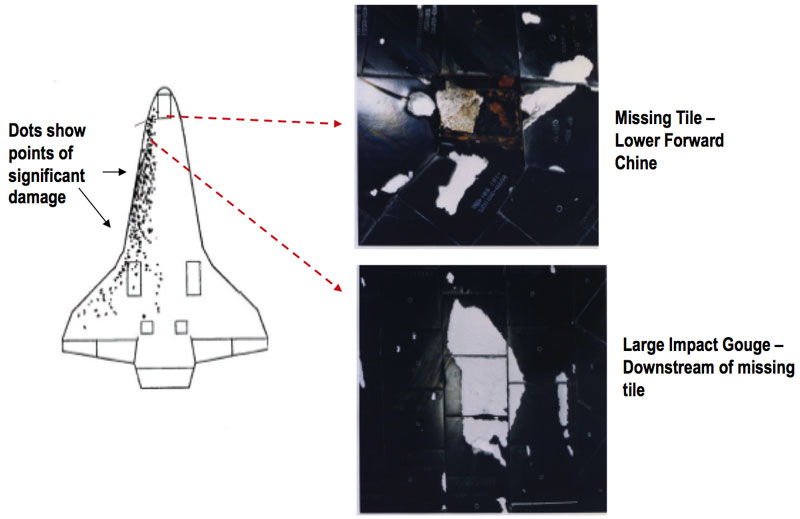 NASA's damage map of Atlantis after STS-27, the most heavily damaged orbiter ever to return safely, with inset photos of the missing tile and a large gouge. (NASA)
After Columbia, NASA added a 50-foot laser inspection boom, on-orbit repair kits, and tougher tiles in vulnerable areas. The Shuttle became safer, but not faster to turn around. The record was 54 days. The typical turnaround took months, and the heat shield was a major reason.
The Shuttle proved that a reusable heat shield was possible. It also proved that reusing one could cost nearly as much as replacing it.
What approaches is Starship trying?
SpaceX set a very different goal for Starship: full reuse, fast, more like an airliner than a museum piece. Ideally, a ship lands, refuels, and flies again within hours. That forced a rethink of the heat shield from the airframe up.
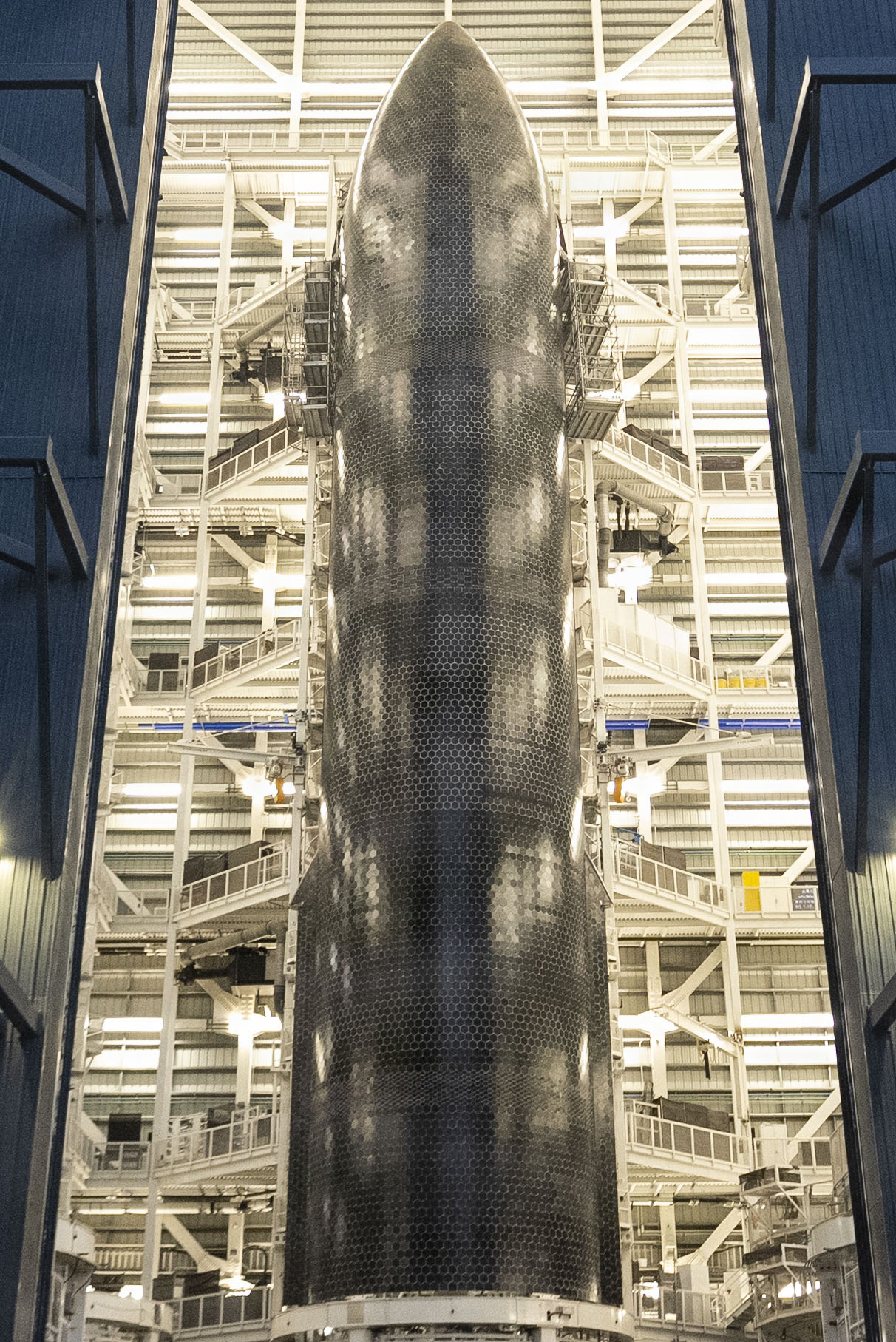 Ship 39, the first V3 Starship, inside Megabay 2 at Starbase in January 2026, covered in black hexagonal tiles on its windward side. (U.S. military photo via DVIDS, public domain)
Approach 1: Change the metal underneath
The most important thermal decision on Starship is not about tiles at all. It is the choice of stainless steel for the hull.
Aluminum is in trouble at about 175°C. Stainless steel keeps useful strength to several hundred degrees and does not melt until about 1,400°C. That changes the logic of failure. On the Shuttle, a missing tile in a hot zone could doom the vehicle. On Starship, the steel underneath gets very hot, may warp, and probably holds long enough to get home. Engineers call this the difference between fail-deadly and fail-degraded.
Steel's heat tolerance also lets the leeward side fly as bare steel and the windward tiles be thinner than the Shuttle's. And steel gets stronger at cryogenic temperatures, which suits a vehicle that is mostly propellant tank.
Approach 2 (shelved): Make the steel sweat
The first plan, floated in early 2019, was more radical: a double-walled steel hull that would "sweat" liquid methane or water through tiny pores, letting evaporation carry the heat away. This transpiration cooling has been studied for decades but has never flown on an orbital vehicle at this scale.
By March 2019, SpaceX was testing hexagonal ceramic tiles instead, keeping transpiration only as an option for spots that showed erosion. Starship has flown on tiles ever since. The idea has not died, though. In late 2024 Musk reportedly said SpaceX was reconsidering active cooling for the hottest areas, and in 2025 it flew an actively cooled metallic test tile.
Approach 3: Hexagonal tiles, pinned not glued
Today's heat shield is about 18,000 hexagonal ceramic tiles, which space fans call "bestagons." Like the Shuttle's, they are silica-based with a black coating. Almost everything else is different.
Shape. In a square grid, a seam lined up with the airflow can channel hot gas along it. Hexagons break every seam into short zigzags across the flow.
Standardization. Instead of 24,000 unique parts, most of the acreage uses the same tile, repeated thousands of times. SpaceX fires them in industrial kilns at a Cape Canaveral facility nicknamed "the Bakery," which it said in October 2025 was producing about 1,000 tiles a day, with a goal of 7,000.
Attachment. This is the biggest change. Starship's main tiles are not glued. Small steel studs are welded to the hull, which is only a few millimeters thick and doubles as the propellant tank wall. Independent hardware analysts believe SpaceX uses capacitor-discharge stud welding, which fuses a stud in milliseconds with too little heat to warp the thin steel.
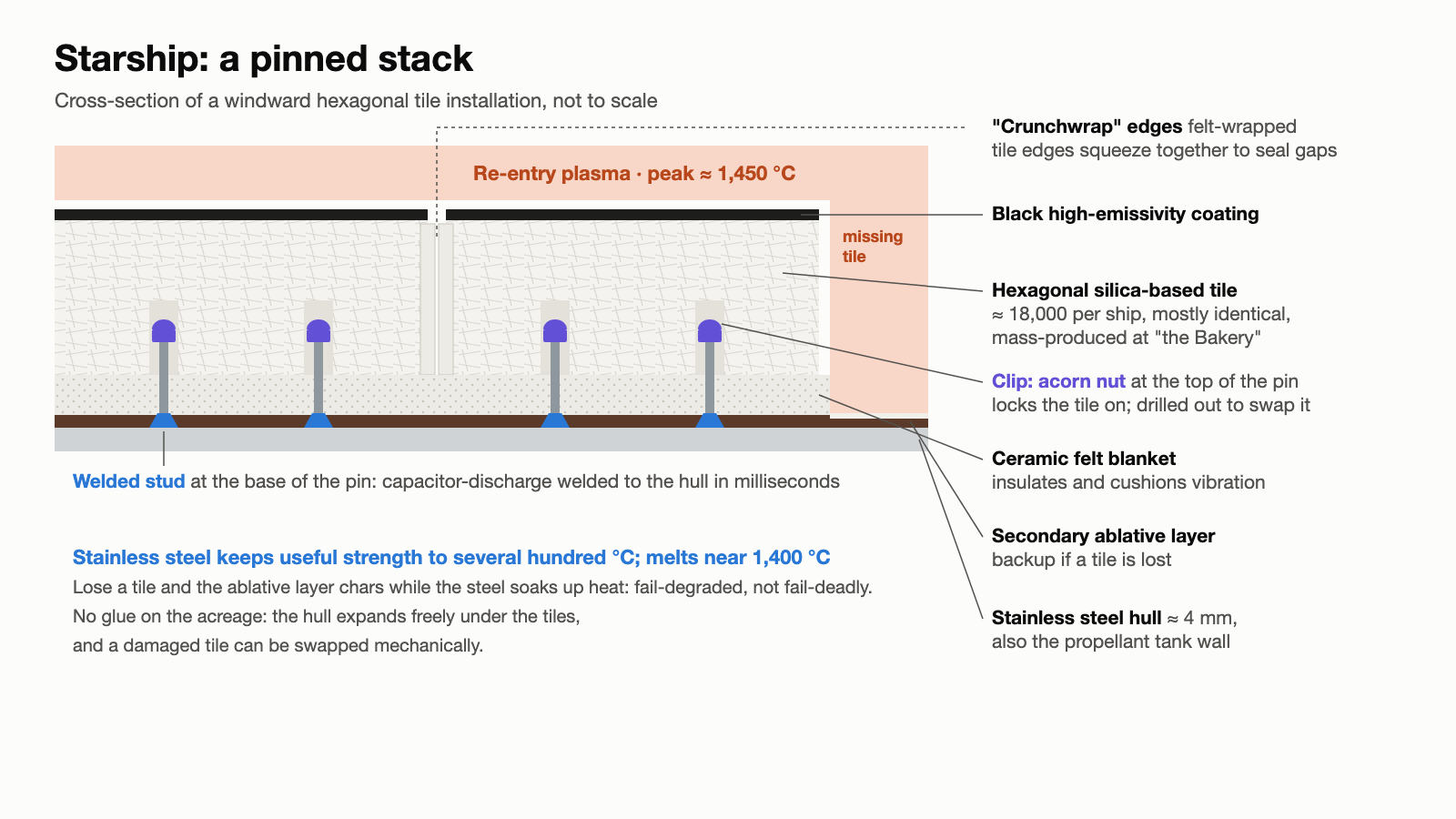 How a Starship tile is attached. Each pin is welded to the hull at its base (the stud), and the tile is locked on at the top with an acorn nut (the clip). Under the tile are a felt blanket and a secondary ablative layer. The steel hull can expand underneath without stretching the ceramic.
Each tile fits over its pins on top of a ceramic felt blanket. According to independent analyses (SpaceX has not published details), a self-locking acorn nut at the top of each pin holds the tile in place, and technicians drill small access holes to remove it. Because nothing is bonded, the steel can grow and shrink underneath while the gaps between tiles absorb the difference. That solves the Shuttle's expansion problem mechanically, and turns replacement into a swap instead of a re-glue.
Approach 4: Build in a backup
After Columbia, perhaps the most important idea in reusable heat shields is this: assume a tile will fail, and decide what happens next.
Since Flight 4, Starship has carried a secondary ablative layer under its tiles, made of an undisclosed material. If a tile is lost, this layer chars away to protect the steel for the rest of re-entry. And SpaceX tests it on purpose. On several flights it has deliberately removed tiles, including from some of the hottest parts of the ship, and flown anyway. Shuttle engineers could only model that kind of test. They could never fly it.
Learning by burning: Flight 4 to the first orbit
Starship's heat shield is being developed in public, with cameras pointed at the damage.
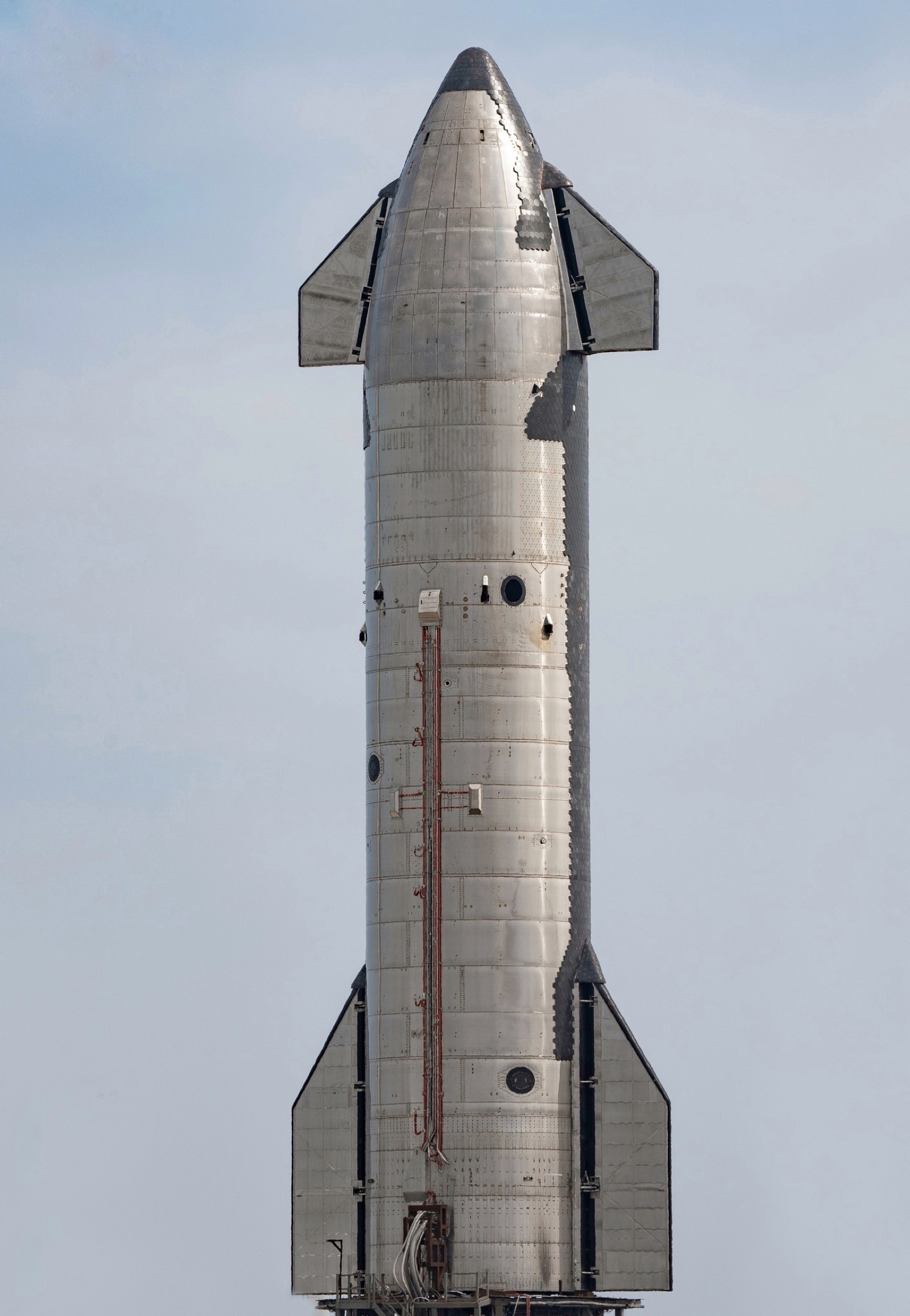 The trouble spots: Starship's flaps, where moving hinges meet the fixed tiled hull. On Flight 4 in June 2024, plasma burned into the forward flap hinge during re-entry. ("Starship S20" by DimaLopatin1999, CC BY-SA 4.0, resized)
- Early flights (2023–2024): Tiles fell off during ascent. Around flap hinges and stiffening ribs, where standard hexagons did not fit, SpaceX had used custom-cut tiles glued in place, and those areas were among the trouble spots. The Shuttle's oldest problem had returned exactly where the new approach had not been applied.
- Flight 4 (June 2024): Plasma burned into the forward flap hinge, melting away pieces of the flap on live video. The ship still made its landing burn and splashdown because the steel took long enough to burn through.
- Upgrades (late 2024–2025): A new heat shield brought tiles Musk said were about twice as strong, with the ablative backup behind them. Block 2 ships then swapped many glued tiles for pinned ones, including "tiny tiles" between stiffening ribs and along flap edges. After Flight 10 it added "crunch wrap": felt wrapped around tile edges, squeezed between neighbors to seal the gaps.
- Flight 10 (August 2025): Besides deliberately removed tiles, the ship flew experimental metallic tiles, including one actively cooled. Orange streaks in the footage were the metal oxidizing ("rusting," Musk said), a sign that bare metal has its own problems in the hottest flow.
- Flight 12 (May 2026): The first V3 ship brought a new tile layout and better attachment clips. It also released two camera-carrying satellites to photograph its own heat shield in orbit, an early test of fast pre-re-entry inspection. Damage afterward looked light compared with earlier flights.
- Flight 13 (July 2026): Ship 40 splashed down softly, tipped over, and, for the first time, did not explode. It was towed to safety and shipped back to Starbase, giving SpaceX its first close look at tiles that had survived a real re-entry. In August, Musk told investors he would consider the heat shield problem "solved at this point."
- Flight 14 (September 2026): Starship reached full orbit for the first time. Its heat shield added extra tile retention, barriers against plasma flowing behind the tiles, and curved tiles to cut gap heating, and it carried two tiles recovered from Ship 40, the first Starship tiles known to fly through re-entry twice.
The pattern is clear. The broad acreage of hex tiles is now well understood. The hard parts are the edges: hinges, joints, curves, and transitions. And the real test has not happened yet: catching a ship, inspecting it, and flying the same heat shield again. As of this writing, SpaceX plans to try catching both booster and ship with the launch tower on Flight 15, no earlier than early November 2026.
Comparing the two approaches
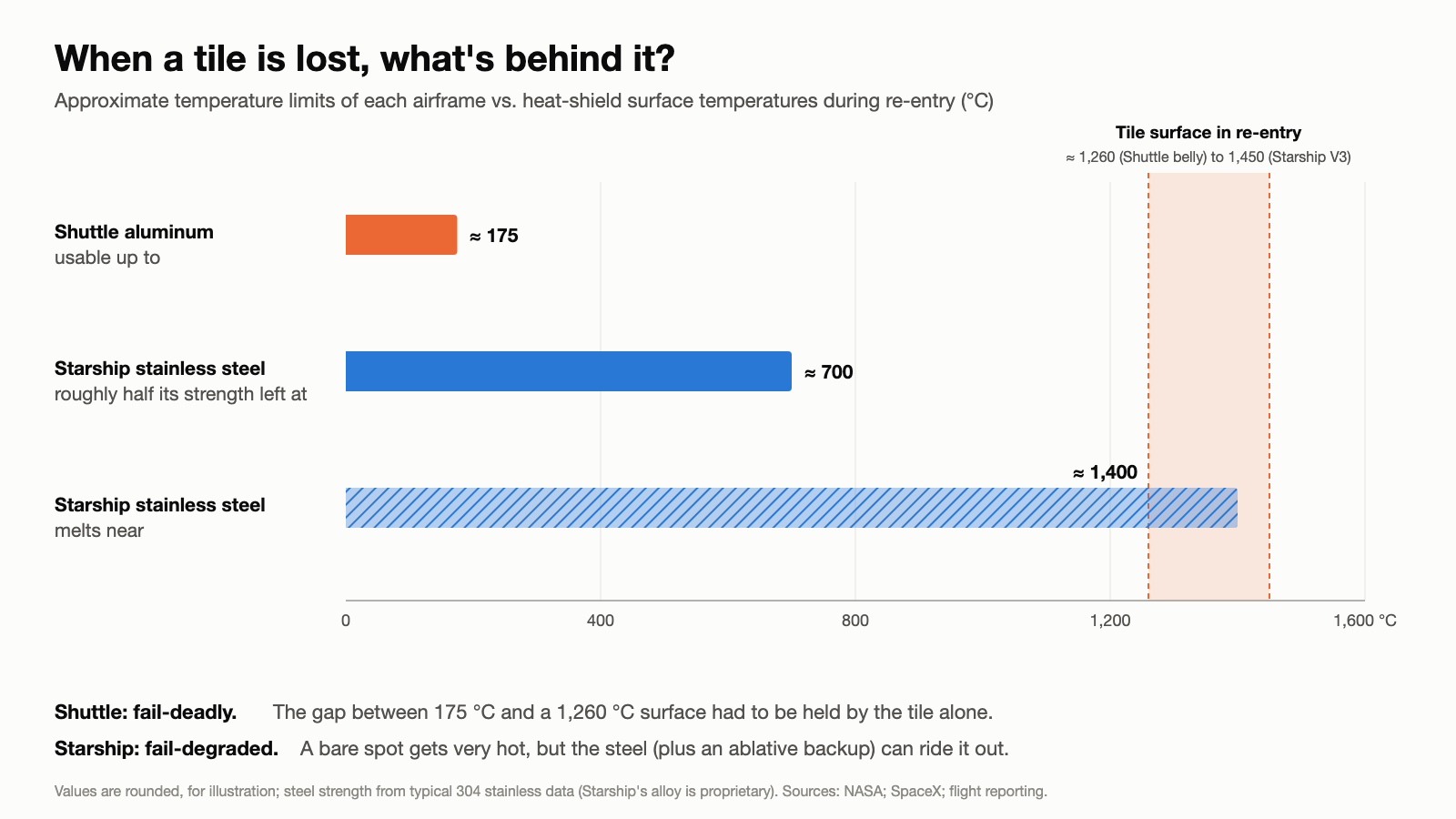 The biggest difference between the two designs may be what is left behind a tile once it is gone.
An airplane versus a rocket: the shape sets the problem
The two vehicles come home in completely different ways, and that shapes their heat shields as much as any material choice.
The Shuttle was a glider. With no engines to use after re-entry, it had to fly to a runway like an airplane and touch down on wheels at more than 200 mph. That meant big delta wings, a tail, elevons, a body flap, and landing gear. The U.S. Air Force also wanted it able to land about 1,100 nautical miles to one side of its orbital track. Delta wings gave it that "cross-range," at the price of a long, lifting glide: nose-high at about 40 degrees, roughly half an hour from the top of the atmosphere to the runway. Every airplane part had to be protected: thin wing leading edges hot enough to need RCC, control surfaces with hinges and seals, and landing gear doors cut right into the belly tiles. Each opening and edge was another way in for hot gas. During Columbia's re-entry, sensors in the left main landing gear wheel well picked up rising temperatures as hot gas worked its way through the wing.
Starship is a rocket that falls. It has no wings, no wheels, and no runway. It enters belly-first at a steep angle, often described as about 60 degrees, and uses that broad belly mostly as a brake. Four flaps steer it, much like a skydiver uses arms and legs. Near the ground it flips upright, relights its engines, and lands vertically. SpaceX already catches Super Heavy boosters with the launch tower's "chopstick" arms and plans to catch ships the same way.
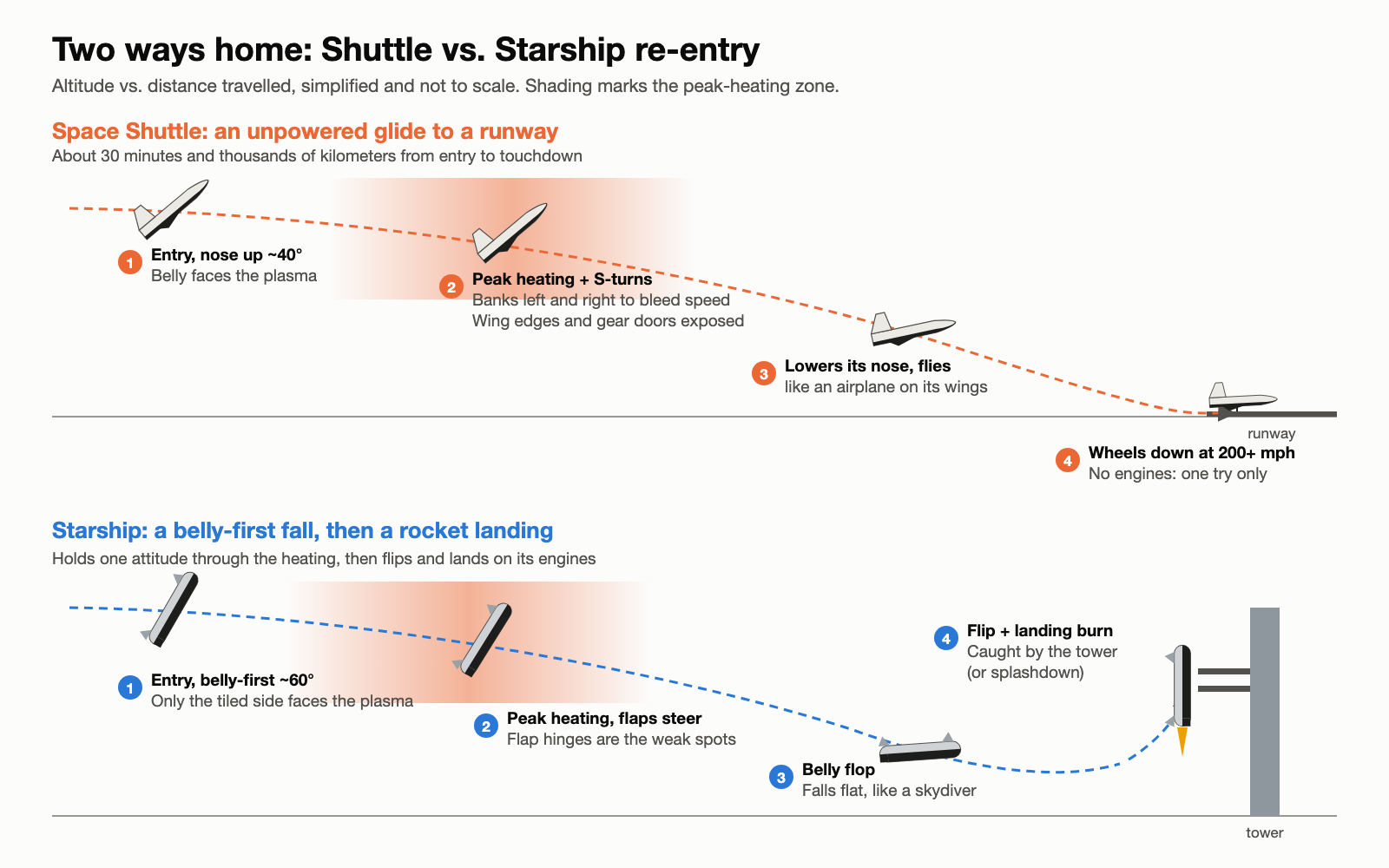 Two ways home. The Shuttle flew a long, lifting glide that exposed its wings, control surfaces, and gear doors to the heat. Starship holds one belly-first attitude through peak heating, then lands like a rocket.
That changes the thermal problem in three ways:
- Fewer holes in the shield. No landing gear means no gear doors in the windward tiles, and no wings means no long, thin leading edges. The hottest surface is a broad, gently curved belly that can be covered with mostly identical hexagons.
- Only one side gets hot. Because Starship holds the same belly-first attitude throughout re-entry, the leeward side can stay bare steel. The Shuttle's glide and complex shape meant it needed protection over almost its whole skin.
- New weak spots of its own. The flaps and their hinges are Starship's version of the Shuttle's edges and doors. That is exactly where Flight 4 burned through. Catching a ship also requires hardpoints on its sides, and on Flight 6 SpaceX removed tiles at locations being studied for catch hardware to see how those areas would behave.
The price is fuel. A glider lands for free, while Starship has to carry propellant all the way down for its flip and landing burn. But that propellant buys a simpler shape to protect, and the Shuttle showed how dearly a complicated shape can cost.
| Space Shuttle | Starship | |
|---|---|---|
| Coming home | Winged glider, lands on a runway at 200+ mph | Belly-first fall, flip, vertical landing or tower catch |
| Openings and edges in the shield | Wing leading edges, control surfaces, landing gear doors | Flaps and hinges, catch hardpoints |
| Airframe | Aluminum, limit about 175°C | Stainless steel, useful to several hundred °C |
| Tiles | About 24,000, nearly all unique | About 18,000, mostly identical hexagons |
| Attachment | Glued to a felt pad glued to the hull | Clipped onto welded steel studs over felt |
| Backup if a tile is lost | Essentially none | Ablative layer plus steel hull |
| Heat shield mass | About 8.6 t, whole vehicle (Columbia) | About 10.5 t, windward side only (Block 1) |
| Tile replacement | Days of manual work, including glue cure | Designed for fast mechanical swap |
| Reflown | 135 missions across five orbiters | Two individual tiles so far |
| Turnaround | Months (record: 54 days) | Not yet demonstrated |
In most rows, Starship wins. A steel airframe is the biggest single safety improvement in reusable heat shields since the Shuttle, and pinned attachment removes the Shuttle's most labor-intensive, failure-prone step.
The caveat is reuse itself. Only one Starship, Ship 40, has been recovered intact, and no ship has flown twice. The Shuttle, for all its flaws, flew its heat shields on 135 missions.
The weight question, compared fairly
Weight is where comparisons get slippery, because the two vehicles were built for different jobs. So it helps to compare them on the same measures: the hull metal, the heat shield, and how much of what each one launches is actually cargo.
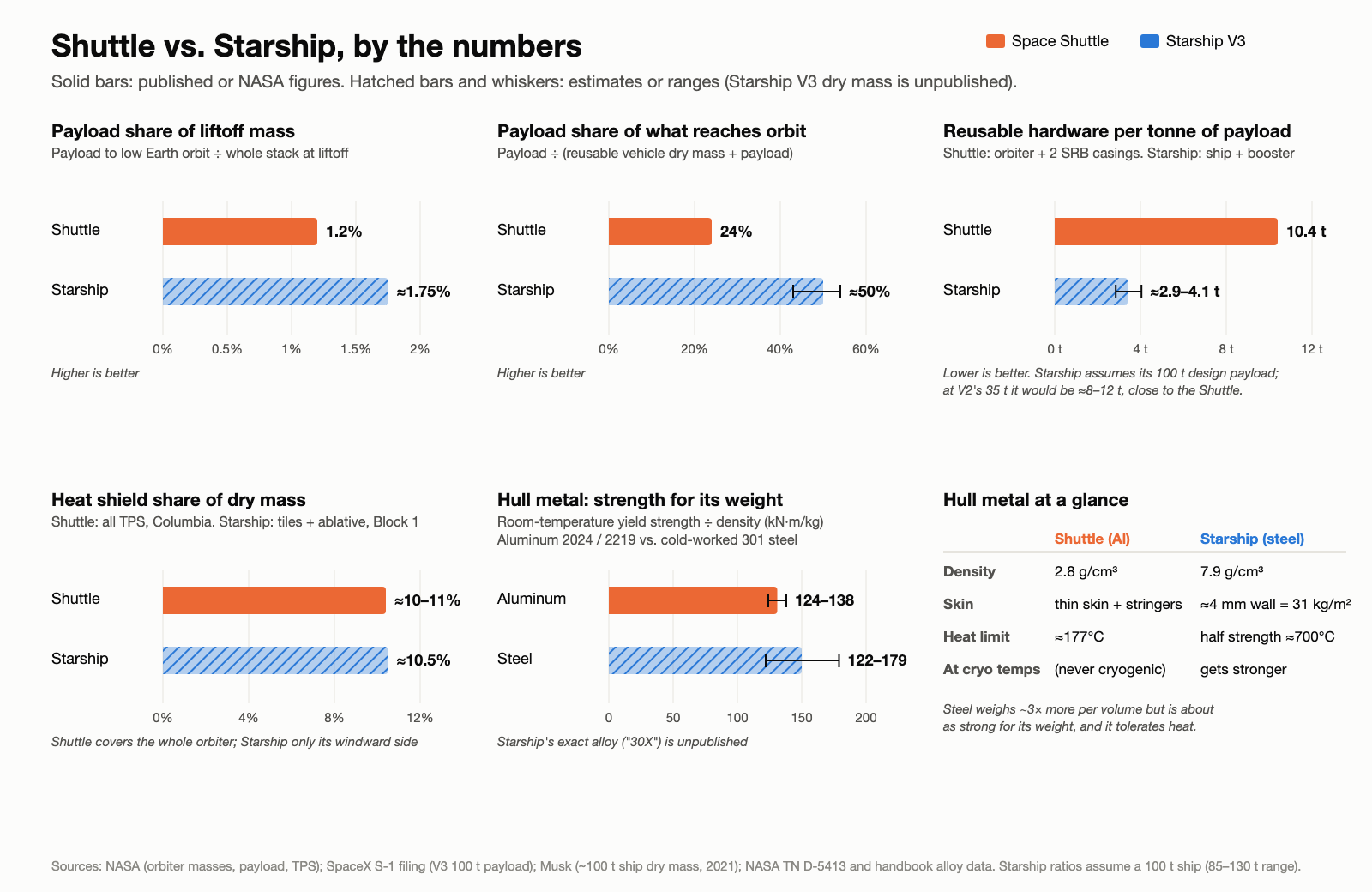 Solid bars are published or NASA figures. Hatched bars are estimates, because SpaceX has not published the dry mass of a V3 ship. All Starship ratios assume about 100 tons, within a plausible 85 to 130 tons.
The hull: heavier metal, about the same strength for its weight. Stainless steel is nearly three times as dense as the aluminum alloys in the Shuttle's airframe: about 7.9 grams per cubic centimeter versus 2.8. Starship's roughly 4-millimeter wall weighs about 31 kilograms per square meter before anything is attached to it. But cold-worked steel is also much stronger. Divide strength by density, and the Shuttle's aluminum (about 124 to 138 kN·m/kg) and cold-worked 301 steel (about 122 to 179) land in the same range. Steel pulls ahead in two places that matter for Starship: it gets stronger at cryogenic temperatures, and it keeps roughly half its strength near 700°C, where the Shuttle's aluminum was limited to about 177°C. In other words, steel is not a lighter hull. It is a hull that can do part of the heat shield's job.
The heat shield: the same share, spread differently. The Shuttle's whole thermal protection system weighed about 8.6 tons, roughly 10 to 11 percent of the orbiter's dry mass, with belly tiles at only about 9 kilograms per square meter. A Block 1 Starship's tiles plus ablative layer reportedly came to about 10.5 tons, about 10.5 percent of a 100-ton ship. The share is nearly identical. But Starship covers only its windward side, so its shield is heavier per square meter, roughly 12 to 15 kilograms by one estimate. That is the price of redundancy: felt, a backup ablator, and thousands of studs and nuts.
The payload: where Starship really differs. Here the gap opens up:
- Share of liftoff mass. The Shuttle stack weighed about 2,040 tons at liftoff to put roughly 24 tons into low orbit, about 1.2 percent. A Starship V3 stack of roughly 5,700 tons is designed to carry 100 tons, about 1.75 percent.
- Share of what reaches orbit. Of the reusable vehicle plus cargo that the Shuttle took to orbit, only about a quarter was payload. The rest was the 78-ton orbiter. For Starship, about half would be payload.
- Reusable hardware per tonne of cargo. The orbiter and two booster casings came to about 10 tons of reusable hardware for every ton of payload. Starship's ship and booster, together roughly 285 to 405 tons, would need about 3 to 4 tons per ton of cargo, but only if it carries its full 100-ton design payload. At the 35 tons claimed for the previous version, the figure rises to about 8 to 12, close to the Shuttle's. Much of Starship's advantage is a bet on sheer size.
Why this still is not perfectly fair. The orbiter carried a crew cabin, life support for up to eight people, a robotic arm, and three main engines inside its dry mass. Starship's dry mass includes its own propellant tanks, while the Shuttle threw its External Tank away on every flight. Starship's 100-ton payload is a design target, not yet demonstrated. Its figures leave out the propellant it must save for landing. And Shuttle payloads are quoted to a low 28.5-degree orbit; to the space station, it carried about a third less.
Even with those caveats, the pattern is clear. Both vehicles spend about a tenth of their dry mass on thermal protection. Starship spends more on its hull and gets more back in cargo, so the same few tons of heat shield serve a far larger payload. SpaceX's answer to heat shield mass has been to build a bigger rocket rather than a lighter shield, betting that on a fully reusable vehicle, extra propellant is far cheaper than heat shield refurbishment.
Criticism and future directions
The "dead end" argument
In November 2024, Musk set the bar himself. A fully and immediately reusable heat shield, he wrote, was "the biggest technology challenge remaining for Starship," and the "acid test" is to land, refill, and launch again with no refurbishment or laborious inspection.
By that standard, some very experienced people call Starship's tiles a dead end. Days after Flight 13, and a week before Musk called the problem "solved," three NASA veterans published an analysis of SpaceX's footage of the floating ship. Dan Rasky spent nearly four decades on heat shield materials at NASA Ames and co-invented PICA, the basis of Dragon's heat shield. Charlie Camarda is a former NASA Langley thermal-protection engineer who flew on STS-114, the first mission after Columbia. Charles Miller led NASA's transition team for the Trump-Vance administration and co-founded Lynk Global, a satellite-to-phone company and Starlink rival, a potential conflict of interest worth noting.
Only a handful of tiles were lost, they said, but dozens to hundreds more appeared cracked or chipped, and white streaks at tile boundaries suggested hot gas was still getting into the gaps. "Starship's current thermal protection system is a dead-end for all missions that require full and rapid reusability," Rasky told Ars Technica. In their view, the design is an incremental improvement on Shuttle-era ideas.
Their case is simple. Ceramic is brittle. A V3 Super Heavy produces roughly 18 million pounds of thrust, and its acoustic energy can crack ceramic before the rocket clears the tower. Ice falls from frosted tanks, and micrometeoroids hit in orbit. Eighteen thousand tiles means eighteen thousand things to inspect. If even a few dozen need replacing after every flight, that is a maintenance operation, not an airliner turnaround. It matters most for Starship's lunar lander, which must be refueled in orbit by a series of tanker flights. If each tanker needs days of tile work, the whole Artemis architecture slows down.
Supporters answer that the critics lean too hard on the Shuttle. A broken Starship tile is a maintenance item, not a death sentence. Tiles are standard parts, swapping them is mechanical, and machine vision can scan a hex grid far faster than people could inspect 24,000 unique pieces. And the progress from Flight 4 to Flight 14 has been real and visible.
My take is that both sides are right about different things. Brittleness is fundamental and cannot be fully engineered away. But Starship has made tile failure survivable, and a survivable failure can be managed with process and automation. The open question is economic, not physical: can inspection and replacement get fast and cheap enough?
What comes next
- Tougher tiles and hybrid shields. NASA Ames' TUFROC pairs a toughened, oxidation-resistant carbon-based cap with an insulating silica base. It has survived long, repeated arc-jet runs at about 1,600°C with no significant degradation and flies as the wing leading edges of the X-37B spaceplane. NASA estimates a TUFROC part costs about $50,000 and takes two months to make, against about $5 million and a year for equivalent Shuttle RCC. Sierra Space's Dream Chaser, not yet flown, is designed to use a TUFROC-derived nose cap and leading edges. Cheap mass-produced tiles on the acreage, with tough composite pieces at the nose, hinges, and edges, may be the most practical next step.
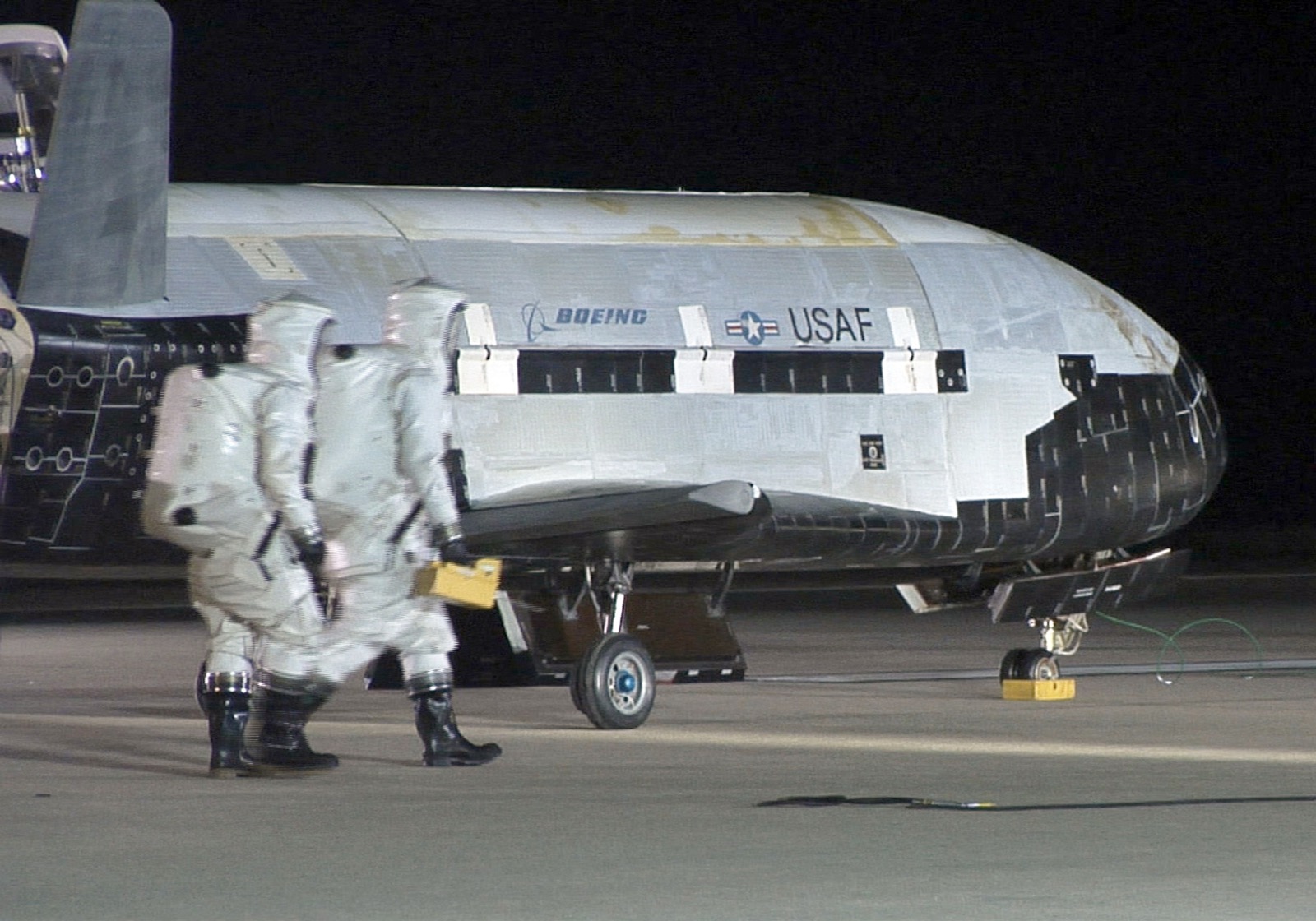 The X-37B, a reusable uncrewed spaceplane whose wing leading edges use TUFROC, after its first landing in 2010. (U.S. Air Force)
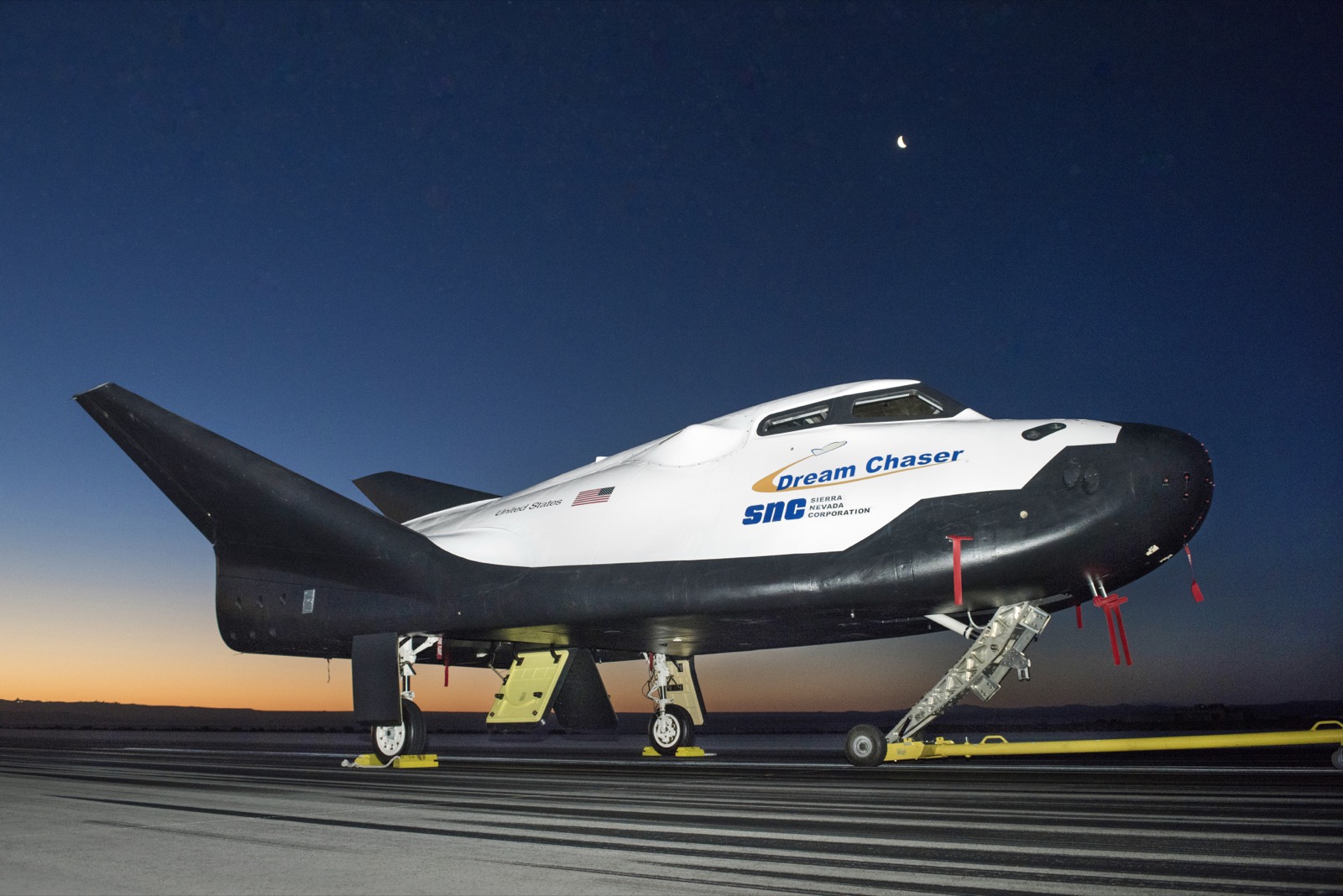 Sierra Space's Dream Chaser, a reusable spaceplane designed to use TUFROC-derived materials on its nose and leading edges. (NASA/Ken Ulbrich)
- Integrated thermal protection systems. Instead of tiles over a hull, the skin is the structure: metal or ceramic-composite panels that carry loads and insulate at once, with fewer parts and fewer seams.
- Active cooling. Stoke Space is building a fully reusable upper stage that cools a metal heat shield on its base with its own liquid hydrogen, much as a rocket nozzle cools itself. SpaceX's actively cooled test tile shows it is keeping that door open too.
- Research funding. The critics' main request was for NASA to restart serious research into orbital re-entry heat shields. The U.S., they wrote, "stopped investing in new/better TPS over two decades ago," and nearly everything flying today traces back to the Shuttle, X-33, and National Aerospace Plane programs of 30 to 40 years ago.
- Inspection as a core technology. The least glamorous answer may matter most: robots, cameras, and embedded sensors that can check every tile in hours. If the Shuttle's problem was that it was too hard to verify, the solution may be to make verification nearly automatic.
Coda
Every time I watch a Starship come out of the plasma, I think about Columbia. Columbia's black chines and Starship's black hexagons are two answers to the same question, and the second has learned from the first.
The Shuttle's engineers did something extraordinary. They built a reusable heat shield out of glass fibers and felt when nobody knew whether that was possible, and it flew 135 times. Their mistake was not in the materials science. It was in the system: a brittle shield on an airframe with no tolerance for heat, run by a culture that had learned not to look closely at a known problem.
Starship's engineers are correcting that mistake in steel, designing a vehicle where a missing tile is a maintenance item rather than a crisis, and then flying with missing tiles to prove it. That is a real advance.
But the hardest part is still ahead. No one has yet built a heat shield that can come back from orbit, get a quick look, and fly again the next day. Until then, re-entry will remain the moment when everything has to work.
I hope we get there. And I hope that when we do, the engineers who make it happen remember the seven people who flew Columbia home.
Sources and further reading
- Columbia Accident Investigation Board, Report, Volume I (August 2003)
- NASA, Foam-on-tile impact modeling for STS-107
- Wikipedia, Space Shuttle thermal protection system and LI-900
- NASA, Flight experiment verification of Shuttle boundary layer transition
- NASA Kennedy Space Center, Orbiter Thermal Protection System fact sheet
- Paté-Cornell, chapter in Accident Precursor Analysis and Management (National Academy of Engineering, 2004)
- Paté-Cornell and Fischbeck, Risk management for the tiles of the Space Shuttle, Interfaces 24(1), 1994
- National Academies, Chapter 4: Thermal Protection System
- Wikipedia, STS-27; AmericaSpace, "Dying All Tensed-Up"
- NASA Ames, TUFROC Thermal Protection System and Advanced Lightweight TUFROC (2024)
- Ringwatchers, Just Don't Melt: Flight 5's Upgraded Heat Shield, The Bestagons, and The Tilewatchers: Ship 37's Tile Experiments
- NASA History, The Flight of STS-1 (delta wing and cross-range design choice)
- NASA, Shuttle entry aerodynamics and the 40-degree angle of attack
- Everyday Astronaut, Starship and its belly flop maneuver
- Spaceflight Now, SpaceX targets Starship Flight 6 launch (tiles removed at catch-hardware locations)
- Engadget, SpaceX tests heat shields that will stop its Starship from burning up (March 2019)
- Wikipedia, SpaceX Starship (heat shield and dry mass figures)
- NASA, The Space Shuttle (orbiter, tank, and booster masses) and Historic American Engineering Record, Space Shuttle Program (orbiter weights and airframe materials)
- SpaceX, Form S-1 registration statement (2026; Starship V3 payload)
- NASA, TN D-5413: tensile properties of cold-reduced 301 stainless steel at cryogenic temperatures
- Wikipedia, Starship flight test 10, Starship flight test 12, and List of Starship launches
- Gizmodo, Starship V3's heat shield was the real star of Flight 12 and Starship's heat shield looked great after Flight 13, but experts spotted something troubling
- Ars Technica, Experts warn current Starship heat shield tech is a "dead end" for rapid reuse (July 27, 2026)
- Miller, Rasky, and Camarda, Some Thoughts on Starship V13 Flight: Starship's Current TPS is a "Dead-end" to Full-and-Rapid-Reusability (LinkedIn, July 28, 2026)
- Starlust, Elon Musk may consider Starship's heat shield problem "solved," but experts think it's a "dead end"
- Phys.org, Starship's first orbital flight put its heat shield to the test (September 2026)