SpaceX Wants to Be Your Phone Company. It Just Hired Qualcomm to Build the Radios.
· 35 min read
The company that put thousands of routers in orbit is now coming down to earth: steel towers, rooftop leases, zoning boards and all. Here's what's planned, how 5G works, and why the hard part isn't the rockets.
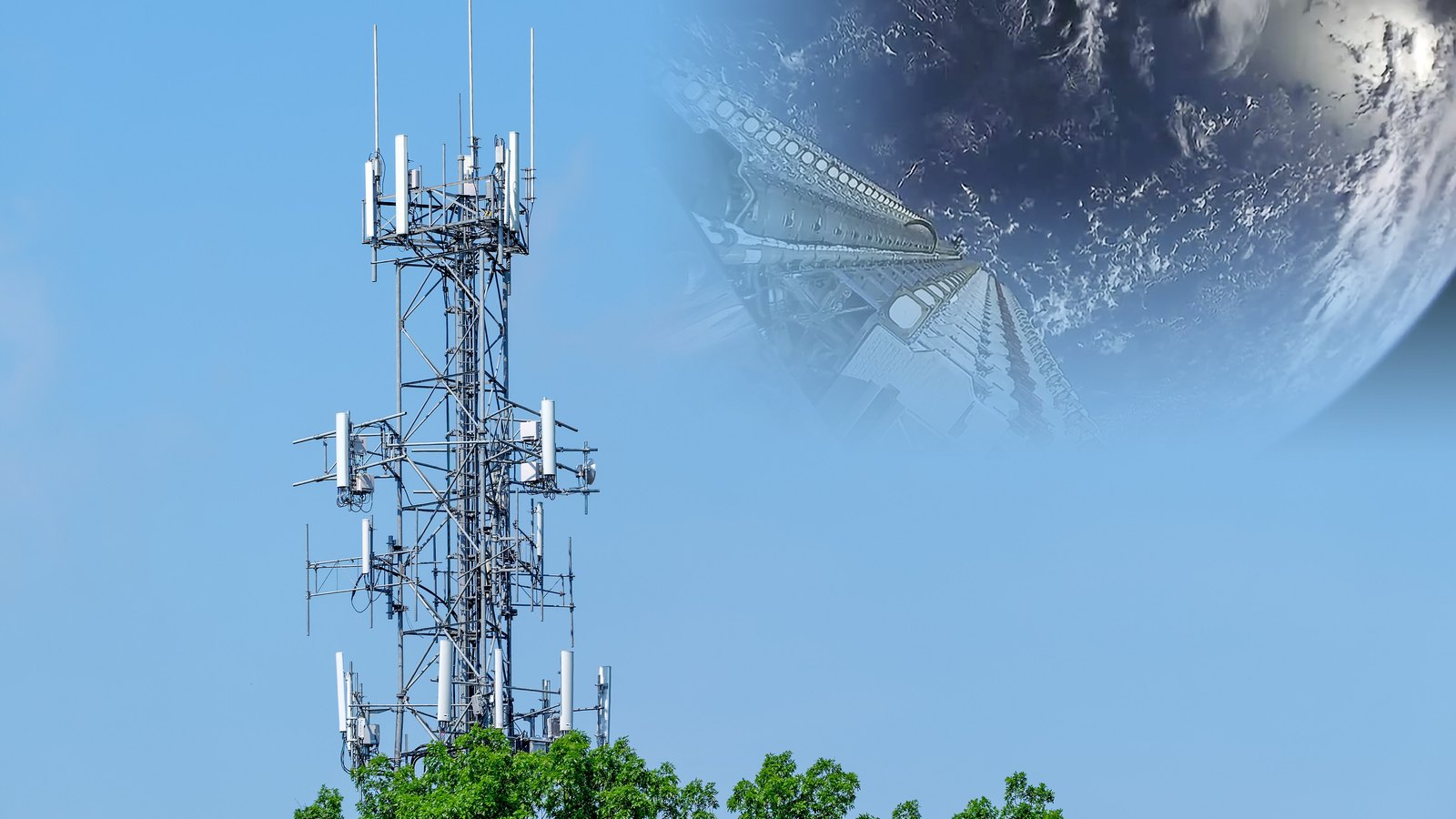
Back in February 2020, I wrote a parody called "SpaceX Starlink Master Plan", in the voice of a certain CEO. It copied the "trickle-down" structure of Tesla's master plan, in four steps:
- Build a bulky, expensive terminal for professionals.
- Use that money to build a rooftop consumer terminal.
- Use that money to build "a low cost and high volume mobile phone."
- Build an interstellar communication system for Mars and beyond.
Fake-Elon also bragged that Starlink could beat 5G because the carriers "need to deploy a lot more cell sites," while Starlink doesn't "need to pay site rentals and backhaul." For the astronomers, he promised to paint every satellite chroma green "so they can be easily removed in photoshop."
Six and a half years later, steps 1 and 2 happened, if not quite in that order (consumers came first): millions of pizza-box dishes, on roofs and on boats. Step 3 took a turn I didn't see coming. SpaceX never built a StarPhone; it made every phone a StarPhone, beaming signals straight to the one already in your pocket. And now comes the twist the parody never imagined: SpaceX is about to pay site rentals. Lots of them.
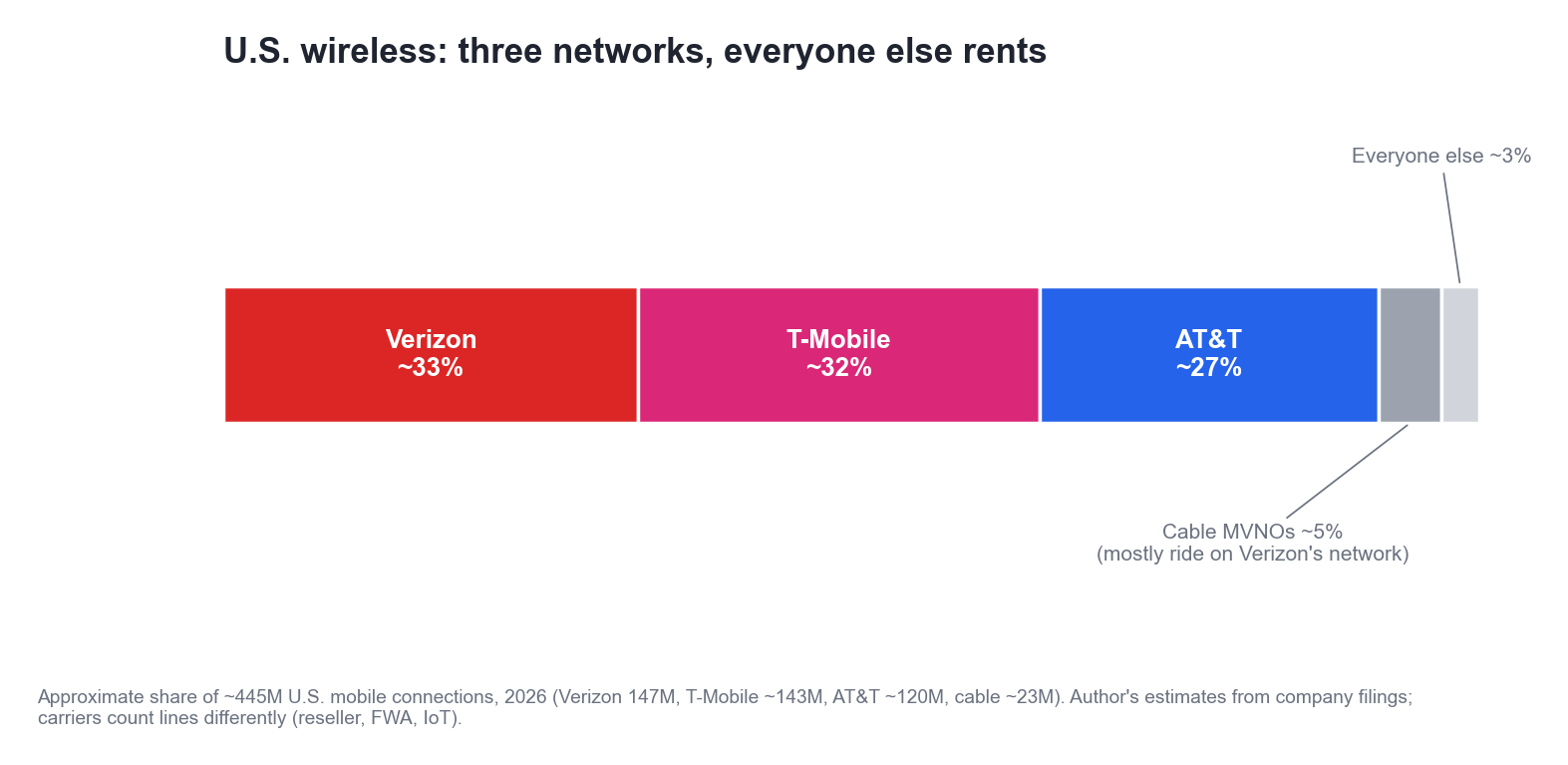
For about 30 years, American mobile service has worked like this: three giant companies own the networks (the airwaves, the radios bolted to the towers, and your monthly bill), and everyone else rents from them. Not even the giants own most of the towers anymore. Over a decade ago they sold or long-term leased them to landlords like American Tower and Crown Castle, and now pay rent like everybody else. Upstarts have tried to break in. Most have ended up as footnotes, or as a Boost Mobile ad.
Now a rocket company wants a go. On November 4, 2026, SpaceX and Qualcomm announced a multi-year deal under which Qualcomm supplies the core radio silicon and software for a nationwide terrestrial 5G network under the Starlink Mobile brand. SpaceX already has phone service coming down from orbit. This time the plan is phone service coming across, from tens of thousands of ordinary cell sites. Construction starts in 2027; when you can actually get service from them, nobody has said.
So: what exactly was announced, how does the technology work, and how many billions of dollars and zoning hearings stand between SpaceX and your SIM card?
1. The Announcement: Starlink Gets a Ground Game
What SpaceX said
The short version:
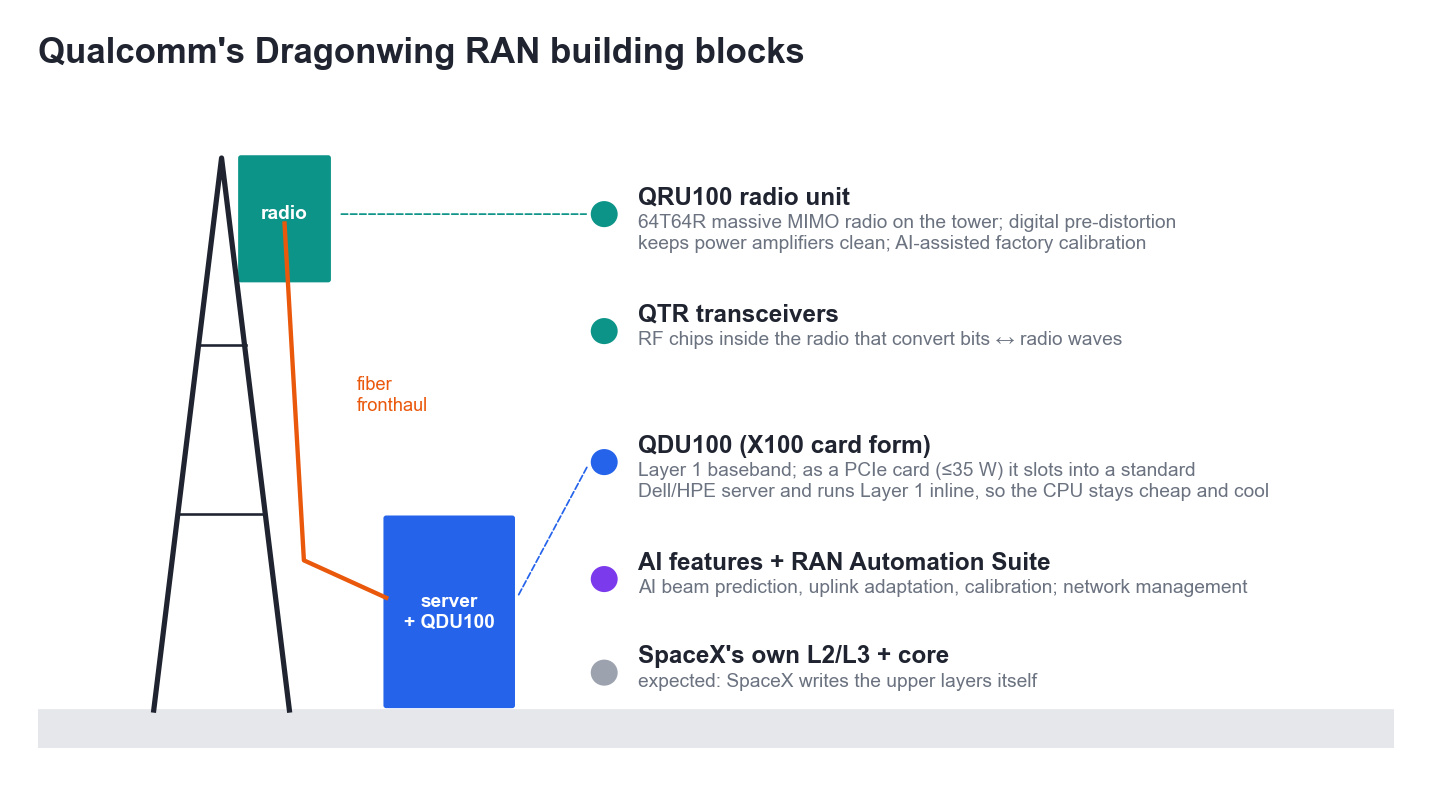
- Qualcomm supplies the guts of the radio access network (RAN): the radio-unit and baseband platforms (chips plus reference designs) and the commercial-grade Layer 1 software, all from its Dragonwing cellular infrastructure line. SpaceX builds the actual boxes around them. Neither company disclosed the dollar value.
- Scale: "Tens of thousands of sites," according to the announcement, and Qualcomm executive vice president Durga Malladi expects the rollout to "ramp up pretty rapidly." Unconfirmed press reports say SpaceX is talking to tower owners about access to as many as 80,000 sites; no tower partners have been named.
- Timing: Tower deployment starts in 2027. No launch date for terrestrial service has been given. Separately, SpaceX is targeting early 2028 to switch on its next-generation "full 5G quality" satellite service.
- Ambition: a genuine fourth national carrier that owns its own network, not just another reseller.
Malladi called it "huge," and agreed with Light Reading that it's Qualcomm's biggest network deal since 3G. For a company best known for the modem in your phone, that's a big deal.
Wait, what's Dragonwing?
Dragonwing, launched in February 2025, is Qualcomm's brand for its industrial, networking and infrastructure silicon, the chips that go into things other than phones.
The Dragonwing toolbox (the deal announcement names the QRU100 and QDU100 platforms specifically):
| Component | What it is | Where it lives |
|---|---|---|
| QRU100 | Radio unit platform supporting 64T64R massive MIMO (64 transmit, 64 receive paths) | Up on the tower, behind the antenna |
| QDU100 / X100 | Distributed-unit Layer 1 baseband platform; its card form, the X100, is an inline PCIe accelerator (35 W max) that slots into ordinary Dell or HPE servers | In a cabinet at the base of the tower or a nearby edge site |
| QTR transceivers | The RF transceiver chips that turn bits into radio waves and back | Inside the radio |
| AI features + RAN Automation Suite | AI beam prediction, uplink tuning and factory calibration built into the platforms, plus a separate network-management suite | Everywhere, apparently, because it's 2026 |
This gear has been deployed before, though not at this scale. Vietnam's Viettel runs Qualcomm-based radios across "a few thousand sites," and Qualcomm chips have shown up inside radios from NEC and Mavenir (which has since quit making radios). SpaceX is about to become its first customer at continental scale.
Qualcomm handles the physical layer, the hard real-time signal math. SpaceX is expected to write its own Layer 2, Layer 3 and core network software on top. As Malladi put it, "They still have to do the Layer 2, the Layer 3, and so on." That's very SpaceX: buy the chips and own the software, the same way it treats rocket engines and satellite buses.
The airwaves SpaceX has lined up
Radios are useless without airwaves, and in about 13 months SpaceX has agreed to spend roughly $28 billion on spectrum (not all of it paid yet):
- EchoStar (September 2025): about 50 MHz of 2 GHz AWS-4 and H-Block spectrum for about $17 billion (half cash, half SpaceX stock), plus roughly $2 billion of EchoStar's debt interest. In November 2025 SpaceX added a 15 MHz uplink-only AWS-3 slice (1695–1710 MHz) for about $2.6 billion in stock, for a total of roughly $19.6 billion. The FCC approved the deal in May 2026 and allowed the spectrum to be used from space, on the ground, or both, which SpaceX CFO Bret Johnsen calls crucial. The final closing, when SpaceX actually pays, is expected around late 2027.
- Grain Management (October 2026): up to 14 MHz of paired, nationwide 800 MHz low-band spectrum for a reported $8 billion (terms undisclosed; FCC approval pending). These airwaves started life at Nextel, passed to Sprint and then T-Mobile, which sold them to private investor Grain for about $3.6 billion ($2.9 billion in cash plus Grain's 600 MHz licenses) in a deal that closed in August 2026. Grain flipped them to SpaceX two months later for more than double that, which suggests either very good timing or a buyer in a hurry.
SpaceX is also reportedly (per the Washington Post) in talks to buy Boost Mobile from EchoStar. That would bring an existing customer base, retail distribution, and wholesale roaming deals with AT&T and T-Mobile, two carriers that have so far shown little interest in signing anything directly with Elon Musk.
2. The State of American Wireless: Three Giants and a Rounding Error
The incumbents
The U.S. market is a mature three-way oligopoly. Verizon, AT&T and T-Mobile together serve the overwhelming majority of American phone lines, each with roughly 120 to 147 million connections. Cable companies (Comcast's Xfinity Mobile, Charter's Spectrum Mobile, about 23 million lines combined) have become the fastest-growing challengers, but they cheat a little: their consumer service runs on Verizon's network as an MVNO, and they push as much traffic as possible onto their own Wi-Fi (plus some CBRS small cells).
A quick scorecard:
- T-Mobile: the 5G speed leader, thanks to Sprint's mid-band spectrum. It holds "nearly 400 MHz" of airwaves. Remember that number.
- Verizon: the coverage champ, finally growing again (406,000 postpaid phone adds in Q3 2026).
- AT&T: betting on fiber-plus-wireless bundles, and swapping its Nokia gear for Ericsson's.
AT&T and Verizon each plan to spend $16–24 billion on their networks in 2026, and T-Mobile about $10 billion. That's the annual fee for staying in this business.
Pay more, get… about the same
A three-way oligopoly is a comfortable place to be, if you're one of the three. Americans pay some of the highest mobile prices in the developed world:
| Market | Avg. mobile revenue per user, per month (2023) | vs. Europe | Major mobile network operators |
|---|---|---|---|
| United States | €41.7 (about $45) | 2.8x | 3 |
| South Korea | €26.0 | 1.8x | 3 |
| Japan | €22.6 | 1.5x | 4 |
| Europe (average) | €14.8 | 1.0x | Typically 3–4 per country |
Source: Connect Europe, State of Digital Communications 2025.
Notably, South Korea also has just three carriers and still charges far less, so the number of players isn't the whole story. Scale, geography and decades of regulatory choices all play a part.
That pricing turns into money. The Big Three post EBITDA margins in the mid-30s percent, which makes them some of the most profitable mobile operators anywhere. European carriers, squeezed by cutthroat competition, have spent the past decade complaining about the opposite problem.
What do Americans get for the premium? A good network, but not a world-beating one. Opensignal's Global Network Excellence Index ranked the U.S. 14th in the world in late 2025, behind South Korea, among others. Ookla's Speedtest index has put U.S. median mobile download speeds somewhere between 9th and 13th in recent months, far behind the Gulf states and South Korea. And the rural dead zones are still there. In fairness, covering a huge, sparsely populated continent costs more than wiring Seoul. But that gap between price and performance is exactly the opening a fourth carrier is looking for.
The cautionary tale named Dish
The last company to try building a fourth facilities-based network was Dish (later EchoStar). Regulators made it the designated fourth carrier as a condition of the T-Mobile–Sprint merger, which closed in 2020. It built what it billed as the world's first cloud-native Open RAN 5G network and hit its 2023 coverage milestone of 70% of the population (its later deadline was pushed back). Then in 2025 it agreed to sell its spectrum to AT&T and SpaceX, and it is now moving Boost customers onto AT&T's network as a hybrid MVNO. Its wireless unit filed for Chapter 11 in mid-2026.
So the most recent attempt to build a new U.S. carrier ended with a handful of companies dividing up its airwaves, and SpaceX was one of the buyers.
Where Starlink 5G could fit
SpaceX isn't going to out-Verizon Verizon in midtown Manhattan in 2028. It's going after the problems the incumbents have never fully solved:
- Dead zones. Highways through the Mojave, national parks, farmland, the stretch of interstate where your podcast always cuts out. The carriers' coverage maps are generous, and the reality is patchier. Towers rarely pay for themselves out there; SpaceX's satellites can cover those gaps without them.
- Seamless ground-to-space handoff. Today, satellite texting from T-Mobile's T-Satellite or Apple's Globalstar-based service (Amazon is buying Globalstar) is a separate, slower mode you drop into. SpaceX wants a single network where your phone moves from tower to satellite and back without you noticing.
- Price disruption. Starlink already rattled the broadband market. A carrier with no legacy network and no union-negotiated copper plant to maintain could undercut the incumbents on price, or charge a premium for "never lose signal."
The incumbents, for their part, sound unbothered. "The physics just don't allow direct-to-cell to be a substitute product," said T-Mobile's (outgoing) CFO Peter Osvaldik in September. Verizon CEO Dan Schulman said Starlink "just can't compete without a terrestrial network in urban and suburban." Hence the towers.
3. A Primer on Cellular, 5G, and Phones That Talk to Space
Cellular in one paragraph
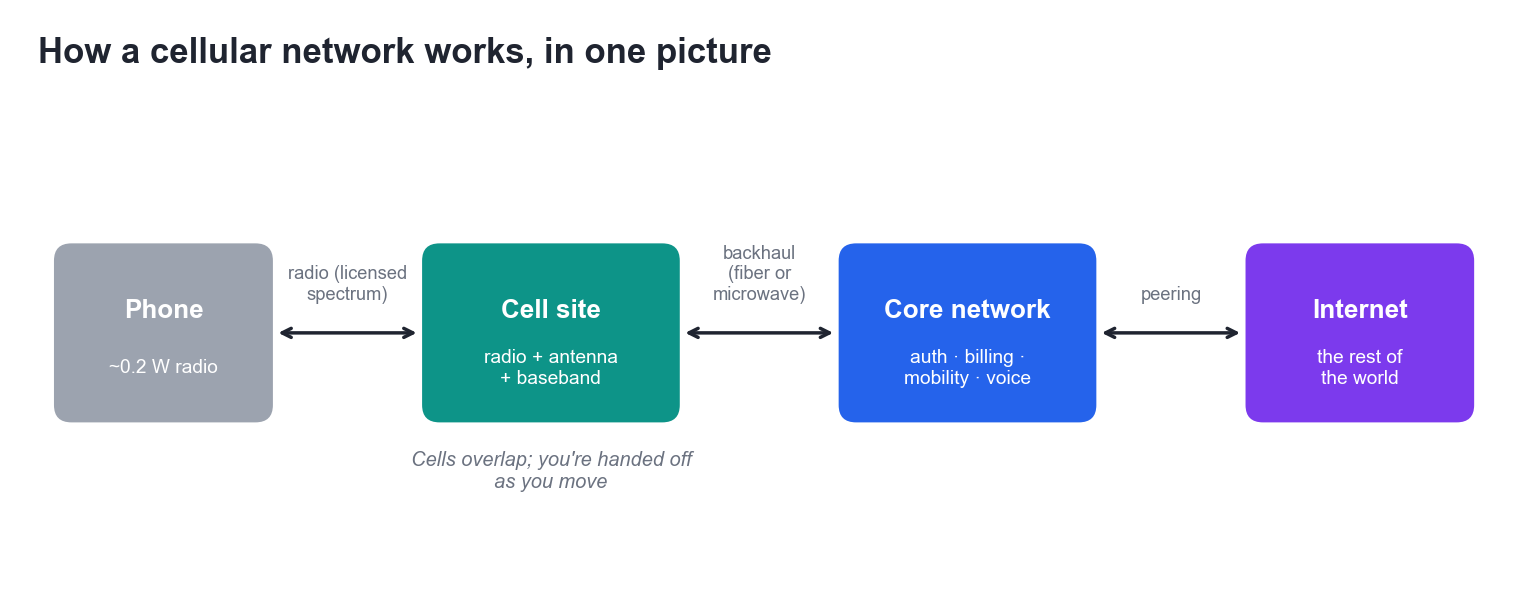
A cellular network divides the world into cells, areas each served by a base station. Your phone talks to the nearest one over licensed radio spectrum. The base station passes your data back over backhaul (fiber, or a microwave radio link) to the operator's core network, which handles authentication, billing, mobility, and the connection to the internet. When you move, the network hands you off to the next cell. Every generation since the 1980s (1G analog voice, 2G digital voice and SMS, 3G mobile data, 4G LTE mobile broadband, 5G) has been a better trick for packing more bits into the same air.
What actually makes 5G faster
5G New Radio (NR) isn't magic. It uses three broad levers:
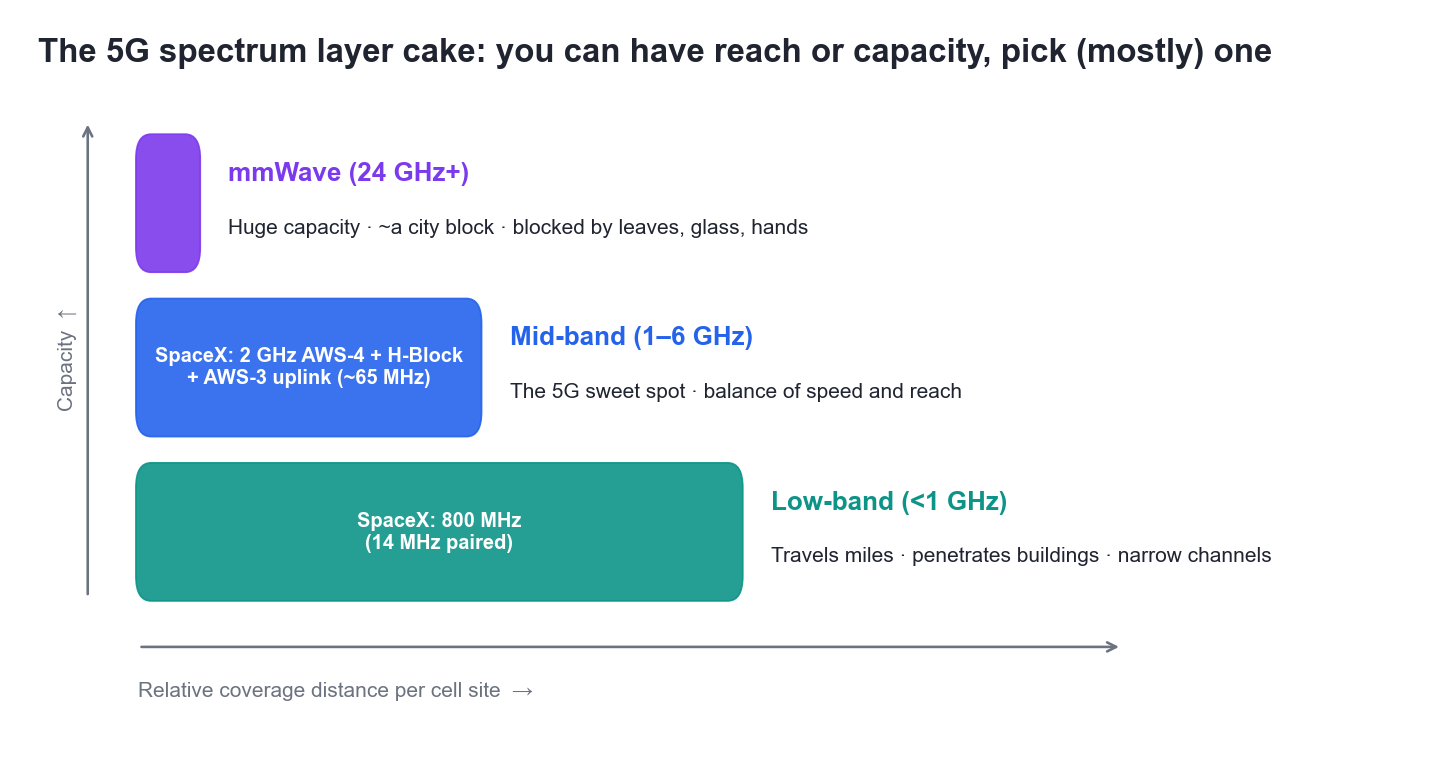
1. More spectrum, in three flavors. Radio physics forces a trade-off: lower frequencies travel farther and go through walls, while higher frequencies carry more data but give up at the first pane of low-E glass.
- Low-band (<1 GHz): the coverage layer. Goes for miles and works deep indoors. Spectrum is scarce, so channels are narrow. SpaceX's 800 MHz lives here.
- Mid-band (roughly 1–7 GHz): the "Goldilocks" layer, a usable mix of reach and capacity. This is where 5G mostly lives. SpaceX's 2 GHz AWS-4 lives here.
- High-band / mmWave (24 GHz+): blazing fast, with a range of about a city block, and blocked by leaves, rain, and your own hand. Mostly found in stadiums and press releases.
2. Denser modulation. Every radio symbol encodes bits through combinations of amplitude and phase. Since 3GPP Release 17, 5G's downlink supports up to 1024-QAM, meaning 10 bits per symbol, but only when the signal is clean enough. It's like a crowded restaurant: the quieter the room, the faster you can talk.
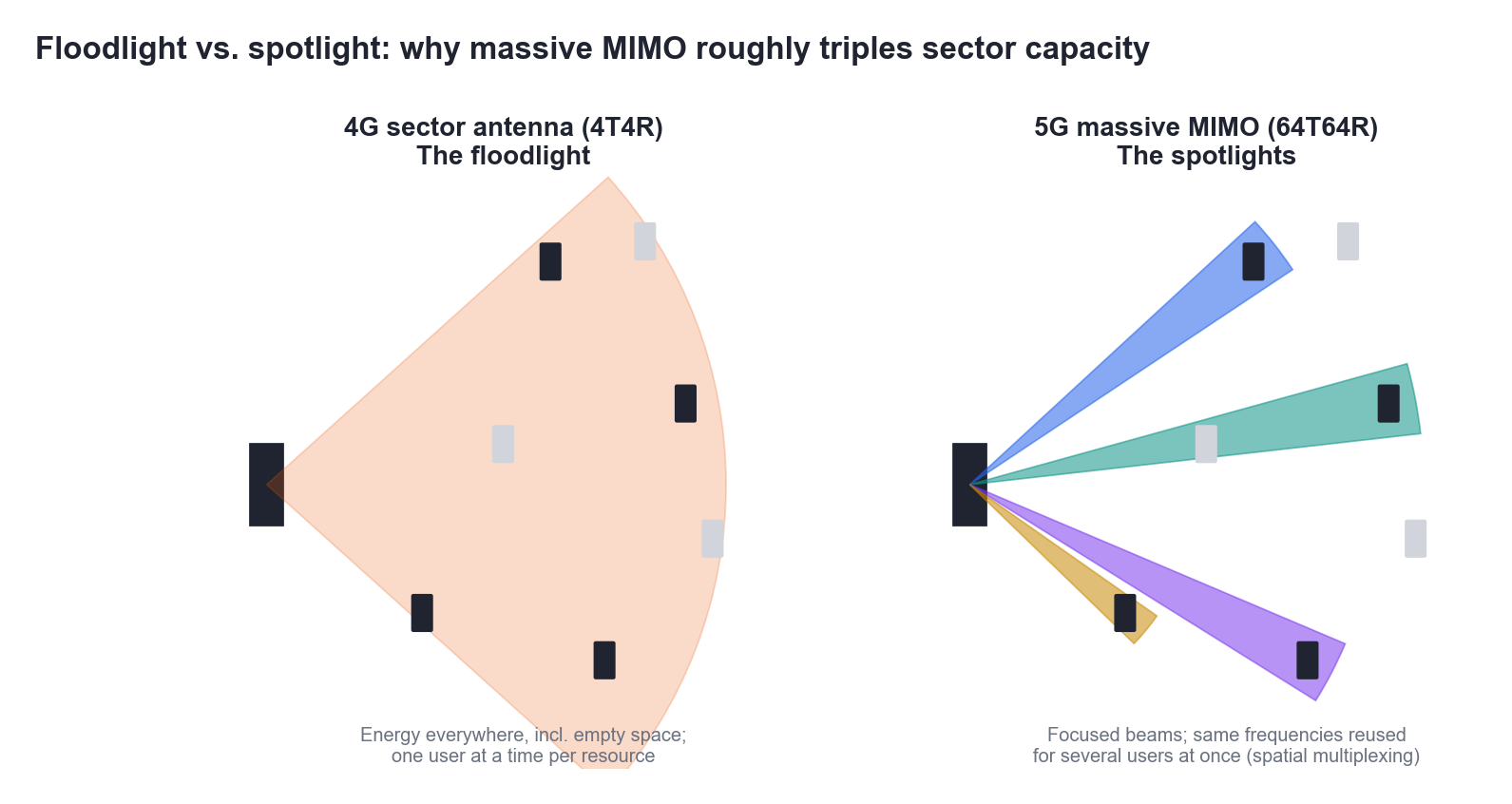
3. Massive MIMO and beamforming. This is the big one. An old 4G antenna is a floodlight: it sprays energy across a whole 120° sector. A 5G massive MIMO panel such as Qualcomm's 64T64R has dozens of small antenna elements. By adjusting the phase of each element's signal, the base station makes the waves add up in some directions and cancel in others. That produces focused beams aimed at individual phones.
Once you can aim beams, you can reuse the same frequencies for several users at the same time, as long as they're in different places. This is spatial multiplexing. Vendor and industry estimates suggest a 64T64R sector can carry roughly 3x the capacity of a 4T4R sector on the same 100 MHz, and give users at the cell edge a signal boost of around 9 dB.
There's a catch that matters a lot for SpaceX. Most massive MIMO deployments use TDD spectrum, where uplink and downlink take turns on the same channel, which makes it easy for the base station to learn the radio channel. SpaceX's spectrum is all FDD: paired blocks with separate uplink and downlink channels, plus an uplink-only slice, and no TDD at all. Massive MIMO is harder to do well on FDD, and the FDD deployments out there today are mostly 32T32R. "If they're spectrum constrained, which they are, then this FDD massive MIMO is the way to get the capacity but especially the coverage benefits," says Omdia analyst Gabriel Brown. Qualcomm's pitch is that it can make 64T64R work well on SpaceX's 2 GHz FDD bands. A lot depends on that being true.
Plus the 5G stuff you've heard about. A standalone 5G core makes network slicing possible (virtual private networks with guaranteed performance), lower latency, and better handling of huge numbers of IoT devices. These matter for enterprises and are mostly invisible to people scrolling TikTok.
Now contrast that with a cell tower in orbit
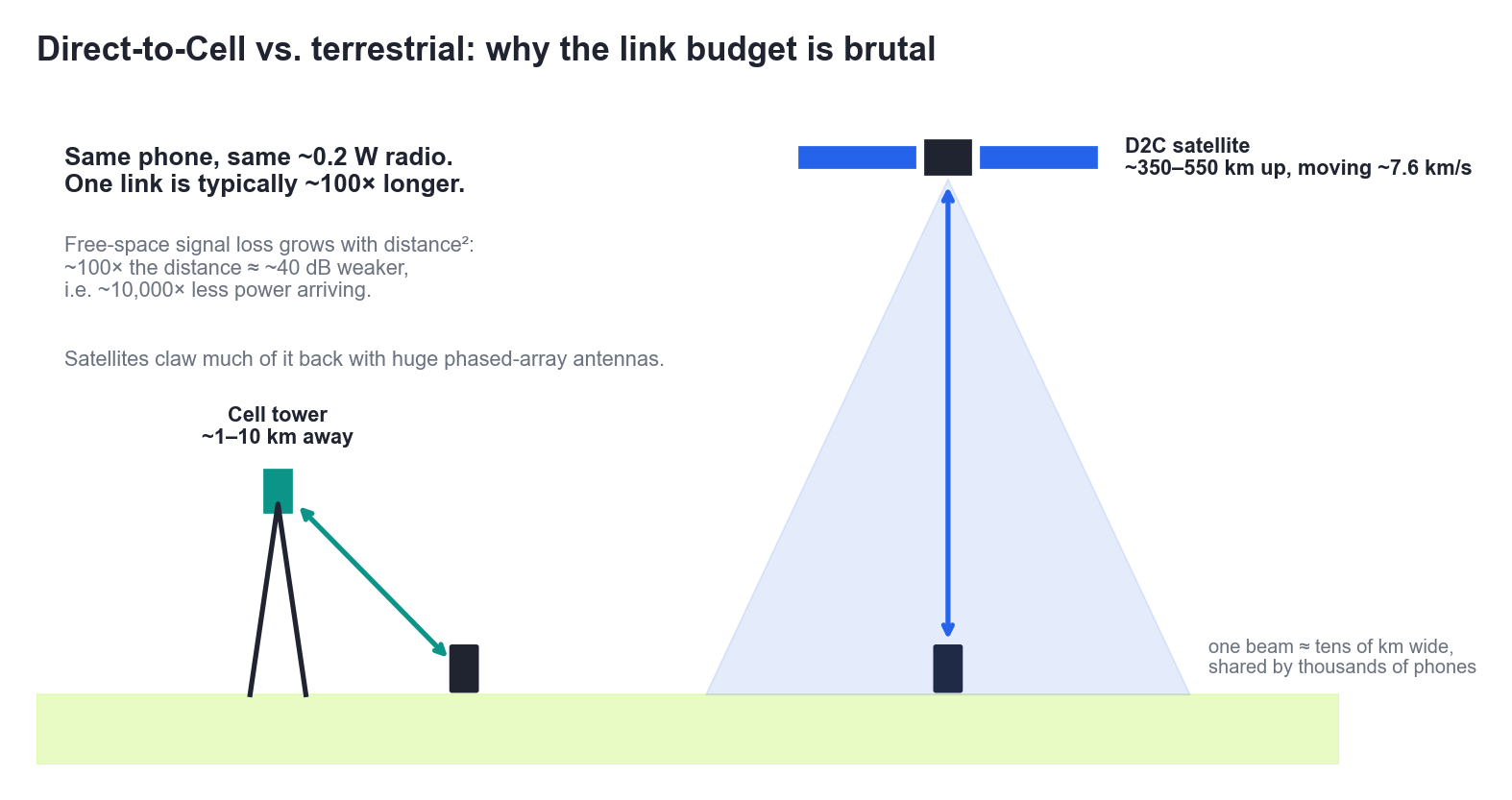
SpaceX's existing Direct-to-Cell satellites (about 650 launched since January 2024) work on a seemingly impossible premise: talk to an unmodified smartphone from hundreds of kilometers up.
Here is what they're up against:
| Terrestrial 5G tower | Direct-to-Cell satellite | |
|---|---|---|
| Distance to phone | ~0.5–10 km | ~350–550 km (and more at an angle) |
| Phone transmit power | ~0.2 W | Still ~0.2 W. Your phone didn't get stronger |
| Cell size | A neighborhood | A beam tens of kilometers wide |
| Users sharing a cell | Hundreds | Potentially thousands (illustrative) |
| Indoors? | Yes, especially low-band | Mostly no; you need sky view |
| Moving parts | None; the tower stays put | Satellite moves at ~7.6 km/s and the network must handle Doppler shift and constant handoffs |
| Today's experience | 100+ Mbps | Texts, low-rate data, some apps |
The satellites make up for it with brute force: huge phased-array antennas (several square meters) and very sensitive receivers, so they can pick up a phone's faint signal from orbit. Each satellite is essentially an eNodeB (an LTE base station) in space, backhauled through laser links to the rest of Starlink. That's the clever part. The phone thinks it's talking to an unusually distant tower in a roaming partner's network.
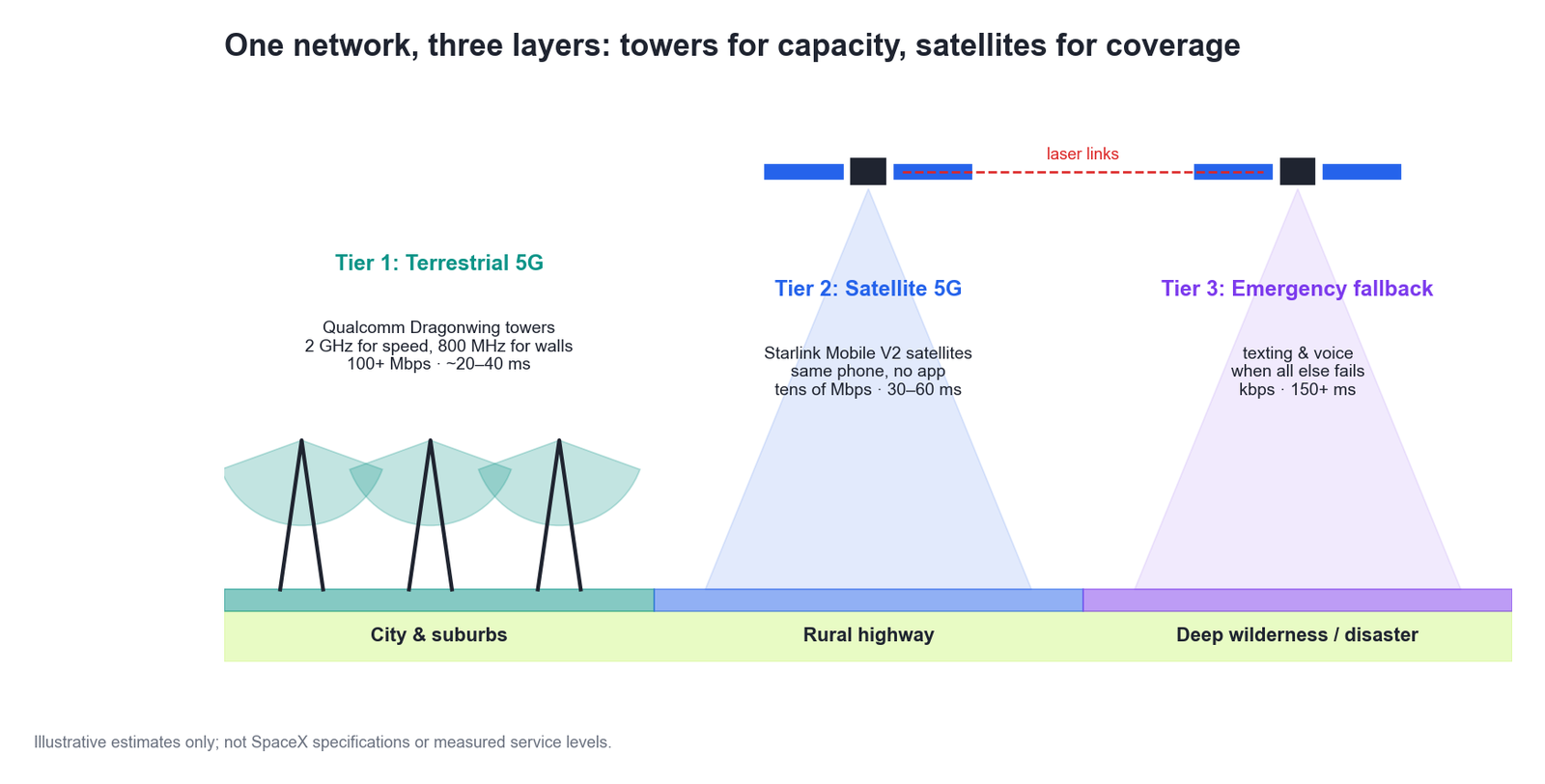
SpaceX's next-generation satellites, dubbed Starlink Mobile V2 and borrowing technology from its V3 broadband satellites, start launching on Starship around mid-2027. In October 2026 the FCC authorized a constellation of up to 15,000 of them. CFO Johnsen promises a "full 5G quality service," and SpaceX's target is up to 150 Mbps per user at peak. New 3GPP Release 19 phone modems with built-in satellite support, like Qualcomm's X105, should help. Even so, physics has a vote. A satellite beam covering a whole county is one shared cell. It will never match the capacity of a dense mesh of towers in a city.
That's the whole logic of the terrestrial plan: towers for capacity, satellites for coverage, one network for both.
4. Who Builds 5G Networks (and Why Qualcomm Is an Odd Choice)
The traditional cartel… er, "ecosystem"
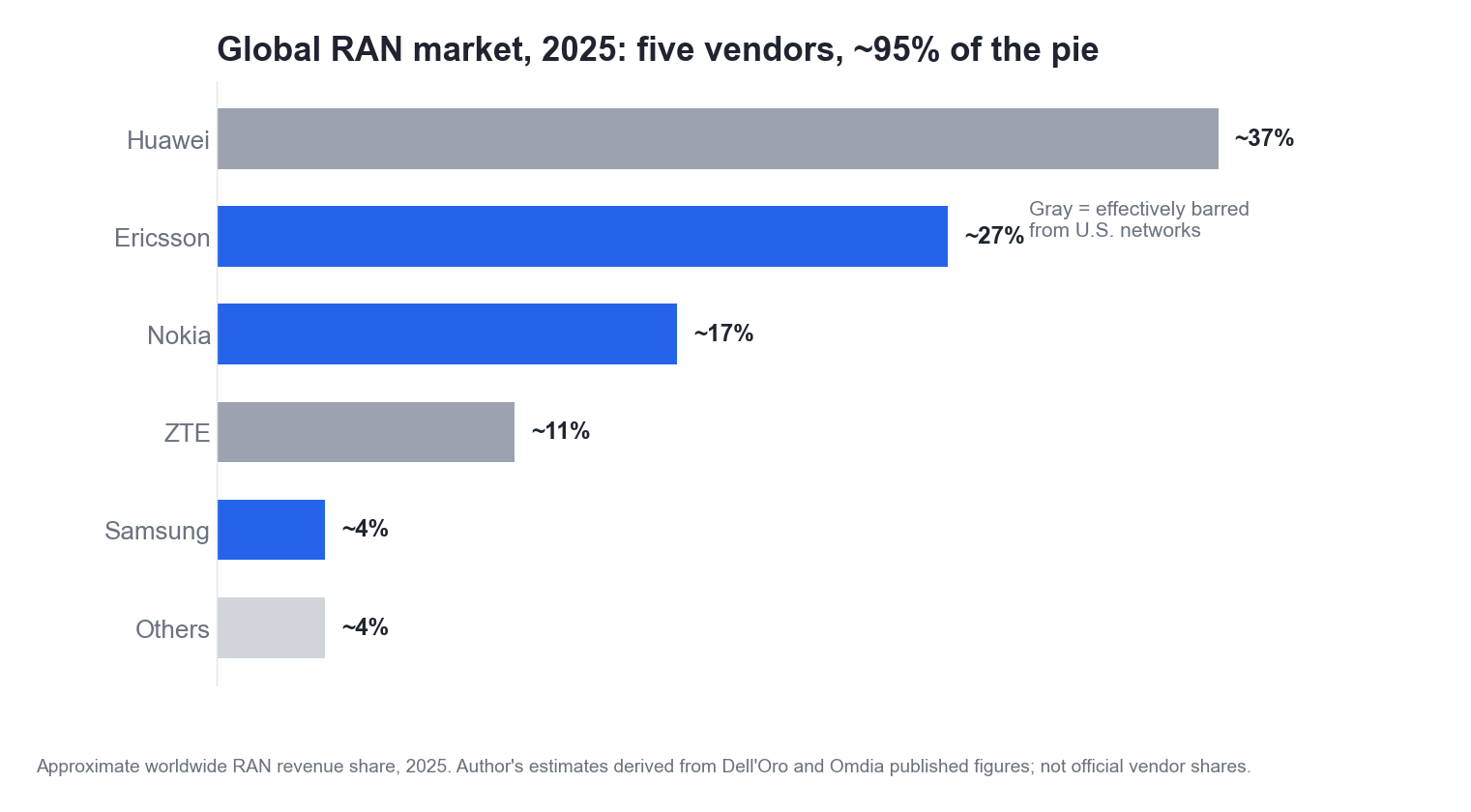
Global RAN equipment is one of the most concentrated markets in tech. According to Dell'Oro and Omdia, the top five vendors (Huawei, Ericsson, Nokia, ZTE and Samsung) took about 95–96% of RAN revenue in 2025, and Dell'Oro says market concentration hit a ten-year high.
- Huawei: the global #1. Together with Ericsson, it holds nearly two-thirds of the market. Huawei is also banned from U.S. networks for national security reasons, and rural carriers are still working through a federally funded "rip and replace" program to remove its gear (fully funded since 2025, about half done).
- Ericsson: the U.S. heavyweight, with more than 60% of North American RAN. In December 2023 it won AT&T's Open RAN contract, worth up to $14 billion. Ericsson is the vendor you hire when you want nobody to get fired.
- Nokia: #3 globally, T-Mobile's other main RAN supplier, which lost AT&T to Ericsson. It got a lifeline from NVIDIA in October 2025: a $1 billion investment to develop GPU-based "AI-RAN."
- ZTE: the other Chinese giant, also effectively shut out of the U.S.
- Samsung: the top challenger in the U.S., with a $6.6 billion Verizon contract and virtualized RAN software that runs on standard servers. It also supplied part of Dish's network.
The traditional model was vertically integrated: the radio on the tower and the baseband box at the bottom came from the same vendor and spoke a proprietary dialect over the cable between them. Once you'd picked Ericsson, you were an Ericsson shop for a decade.
Open RAN cracks the box open
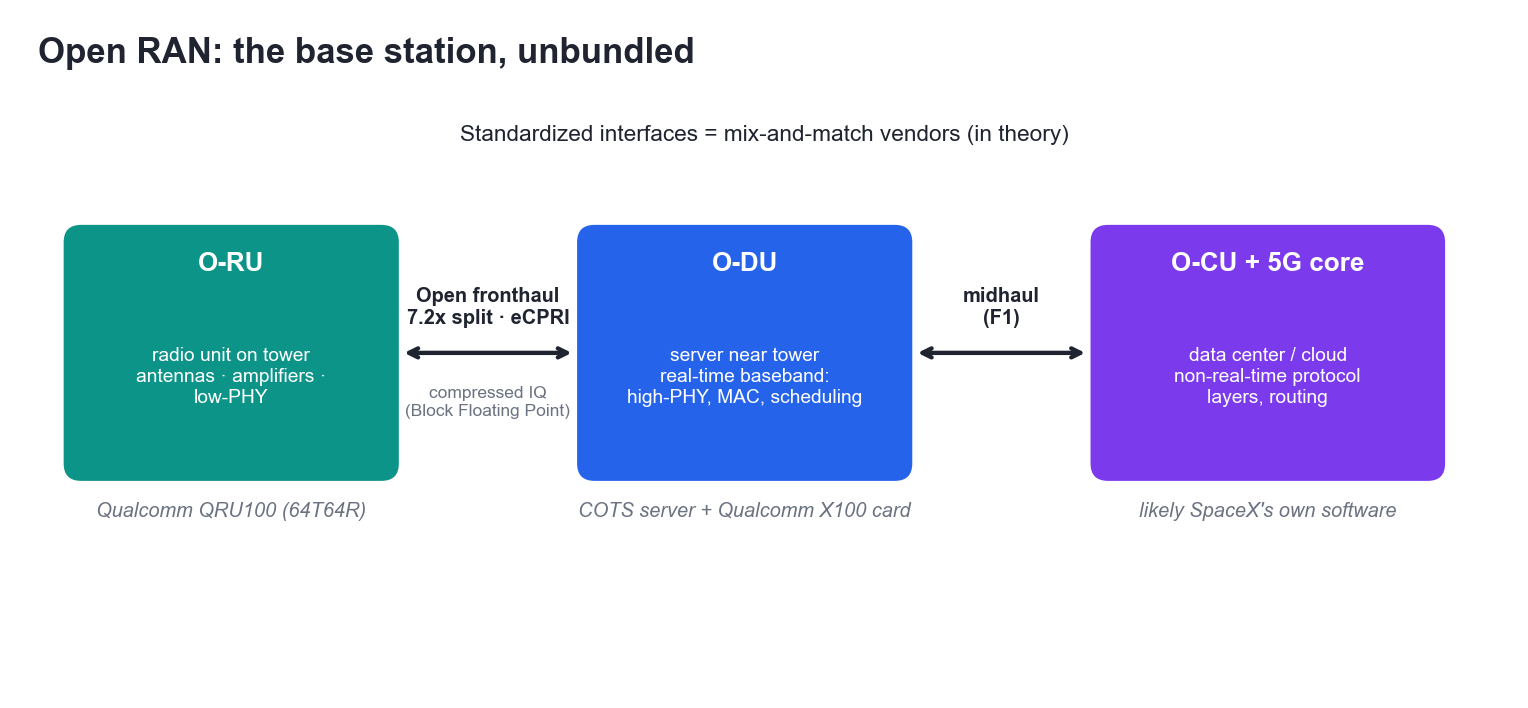
Open RAN (driven by the O-RAN Alliance) standardizes the interfaces inside the base station so operators can mix vendors. It splits the base station into three parts:
- O-RU (Radio Unit): on the tower. Antennas, amplifiers, the lowest-level signal processing.
- O-DU (Distributed Unit): an ordinary server near the tower doing real-time baseband work: scheduling, error correction, beamforming math.
- O-CU (Centralized Unit): software in a data center or cloud handling the less time-critical protocol layers.
The key standard is the 7.2x fronthaul split, which defines exactly which signal-processing steps happen in the radio and which happen in the server, connected by plain Ethernet (eCPRI). That standard is the only reason a chip company like Qualcomm can sell what is effectively a full base station design to a carrier like SpaceX without Ericsson in the room.
The challengers
- Qualcomm sells merchant silicon: chips and reference designs that radio makers (or ambitious customers) build into products. It is betting on inline acceleration, which runs the entire Layer 1 signal-processing pipeline on a dedicated DSP card (the X100) instead of bouncing data between a general-purpose CPU and an accelerator, the "lookaside" approach Intel long championed (it has since built the accelerator into its Xeon chips). Qualcomm's pitch is cheaper servers, lower power and fewer bottlenecks. The X100 card draws at most 35 W, according to Qualcomm's product brief, and at network scale every watt saved adds up.
- NVIDIA is pushing AI-RAN on GPUs through its Aerial platform: a cell site that runs the radio and AI inference on the same hardware. Qualcomm's Malladi isn't convinced: "AI-based RAN is a lot more than just throw a GPU at it, and you're done."
- Marvell and Intel supply competing baseband silicon, inline and lookaside respectively.
- Startups and software players: Mavenir (chiefly a cloud-native core and RAN software vendor, which quit making macro radios in 2025), Parallel Wireless, Rakuten Symphony (the arm that sells the software behind Rakuten's own Open RAN network in Japan), 1FINITY (Fujitsu's network business, spun out in 2025), and DeepSig (AI-native signal processing), among others.
Open RAN's track record is mixed. Rakuten in Japan and Dish in the U.S. (until EchoStar wound its network down) proved it works, though neither proved it wins. Integrating parts from multiple vendors turned out to be expensive and messy, which is why the radios and baseband in AT&T's "Open RAN" come almost entirely from Ericsson. The first third-party radio, from 1FINITY, only made its first call in 2025. SpaceX is taking a third path: one silicon vendor, its own software, and an engineering culture that would rather build than integrate.
5. The Hard Part: Building a National Network From Scratch
Rockets are hard. Getting a conditional use permit from a county planning board in suburban New Jersey may be harder. Here's what's in the way.
Cost: $100 billion, give or take a moon mission
Estimates are all over the map. BNP Paribas analyst Sam McHugh reckons SpaceX would need to spend at least $100 billion on a terrestrial network before it earns real revenue, not counting spectrum. TD Cowen says more than $80 billion, and Bernstein $50–130 billion including spectrum. LightShed thinks the initial build could be as little as $10–15 billion. Verizon's Schulman, who is not a neutral party, says $300–500 billion. Some back-of-envelope numbers show why:
- Tower rent. SpaceX doesn't own towers. It will lease space from American Tower, Crown Castle, SBA and others; the U.S. has roughly 450,000 cell sites of all kinds. Lease brokers put the ground rent that tower companies pay landowners at around $1,300–1,500/month, with urban rooftops at $4,000+. A carrier renting space on a tower typically pays more than that, and leases usually rise about 3% a year. Even at a lowball $1,500/month, 50,000 sites comes to $900 million a year before buying a single radio.
- Equipment and installation. Radios, antennas, servers, power systems, structural analysis, crane time and tower crews. This can run well into six figures for a new site, less for adding gear to an existing one.
- Power and backhaul. Electricity at every site, plus a fiber or microwave link to carry its traffic back to the core.
- Customer acquisition. Stores, marketing, handset subsidies and customer care. The incumbents spend billions a year on this alone, and most of it is money spent getting people to switch.
SpaceX has unusual advantages here: a Starlink broadband business that throws off cash, the ability to raise money at an enormous valuation, and a satellite layer that can cover rural areas, so it doesn't have to build towers everywhere the incumbents did.
But deep pockets have a lot of pockets. Since swallowing Elon Musk's xAI in February 2026, SpaceX has been pouring money into AI data centers: capital spending hit a reported $28.5 billion in the first half of 2026, more than triple a year earlier, with most of it going to AI infrastructure such as xAI's Colossus supercomputers in Memphis. Investors knocked the stock down about 13% when that number came out. Every dollar spent on GPUs is a dollar not spent on tower leases. If AI and 5G end up competing for the same budget, it's not obvious the cell towers win.
Spectrum: 80 MHz vs. 400 MHz
Here's the number from earlier. SpaceX's terrestrial holdings total roughly 80 MHz, and some of that is uplink-only. T-Mobile has nearly 400 MHz. Verizon and AT&T each have hundreds of MHz too, including wide TDD mid-band channels (C-band, 2.5 GHz, 3.45 GHz) that are ideal for massive MIMO.
Spectrum is capacity. With a fifth of the airwaves, SpaceX has to squeeze far more out of every MHz, which is why 64T64R FDD massive MIMO and Qualcomm's AI-driven beam prediction are central to the plan and not just marketing. Expect SpaceX to show up at every future FCC auction, starting with the upper C-band auction (160 MHz at 3.98–4.14 GHz), due by July 2027. (An AWS-3 re-auction already wrapped up in June 2026, raising about $3.5 billion.)
There's also a band-sharing puzzle: the same 2 GHz spectrum is supposed to serve both towers and satellites. Keeping the two from interfering, especially near the edges of tower coverage where a phone could hear both, takes careful coordination, and it's a novel problem.
Time: towers don't launch on Starship
Dish took about three years from the Sprint merger to cover roughly 70% of the U.S. population, and it struggled with indoor coverage and actual customer uptake the whole way. The physical rollout is limited by:
- Zoning and permitting: thousands of local jurisdictions, each with its own process.
- Tower crews: the pool of certified climbers is finite, and the incumbents are already booking them.
- Structural analysis: a 64T64R massive MIMO radio is heavy and catches a lot of wind. Many tower spots will need reinforcement.
- Backhaul: every site needs a fiber or microwave link, and a massive MIMO site moving gigabits needs fiber. Leasing or trenching it, site by site, is slow.
Phones: the quiet dependency
Your phone has to support SpaceX's frequencies. The good news is that much of SpaceX's 2 GHz spectrum lines up with 5G band n70 (which Dish got into recent phones, iPhones included) and band n66, and the 800 MHz block sits inside band 26, which nearly every U.S. phone supports. One snag: Apple's phones don't list the 4G LTE version of band 70. The less good news: carrier certification, eSIM provisioning, Wi-Fi calling, VoNR voice, emergency-911 location accuracy and roaming agreements are all tedious, unglamorous work, and any one of them can sink a launch. It helps that Qualcomm makes most of the modems in question.
Competition: the incumbents won't sit still
AT&T, Verizon and T-Mobile are not ignoring the sky. AT&T and Verizon have backed AST SpaceMobile, a direct-to-phone satellite rival. T-Mobile is currently Starlink's own D2C partner, which makes the relationship awkward. In May 2026 the three carriers also agreed to pool spectrum in a joint satellite venture aimed at rural dead zones. SpaceX's CFO reportedly mused that they "wanted to create a cartel, maybe." And they all have one powerful tool: price cuts, funded by networks they paid off years ago.
Execution: SpaceX hasn't fully committed
As recently as September 2026, SpaceX's CFO was publicly hedging on whether it would build a terrestrial network at all, keeping options open for an MVNO arrangement or rooftop "femtocells" next to Starlink dishes. The Qualcomm deal suggests the company has made up its mind. Still, signing a supply contract is the easy part.
6. Milestones to Watch, 2026–2036
Near term (2026–2027): Paper and steel
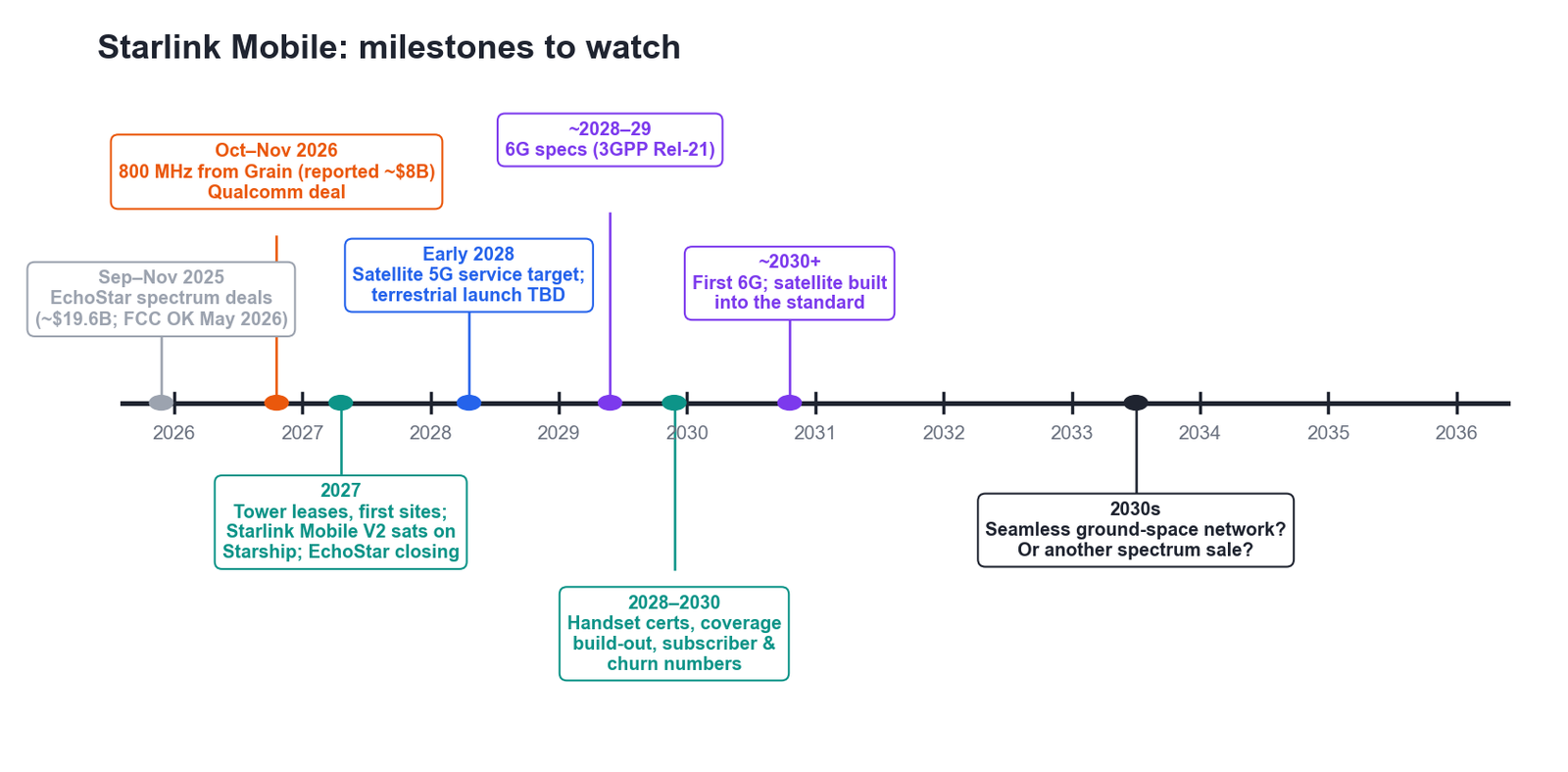
- FCC filings and master lease agreements. How many sites, which markets first, and with which tower companies. Watch for an American Tower or Crown Castle master lease announcement. It would be the first hard evidence of real scale.
- Boost Mobile acquisition. If it closes, SpaceX gets millions of customers and a roaming bridge on day one.
- Starlink Mobile V2 satellites on Starship (from mid-2027). These next-generation satellites carry the "full 5G" satellite layer. Each Starship launch matters.
- EchoStar closing (around late 2027) and FCC approval of the Grain 800 MHz deal.
- First cell sites go up (2027). Watch where the first clusters appear, and for any trial service. When drive-test data shows up on Ookla or Opensignal, the network is real.
Medium term (2028–2030): Show me the subscribers
- Commercial launch. The satellite 5G service is targeted for early 2028; watch for the terrestrial launch date. Pricing will tell you the strategy: aggressive undercutting or a premium "never offline" tier.
- Handset certification, especially iPhone. If Apple certifies a carrier, that carrier is real.
- Population coverage claims vs. reality. Can SpaceX reach 50%+ of the population with good indoor service? This is where Dish struggled.
- Subscriber numbers and churn. In wireless, adding customers gets the headlines, but keeping them is what makes the money.
- More spectrum. The upper C-band auction (2027), or more secondary-market deals.
Long term (2030–2036): The 6G turn
- 6G standards (3GPP Release 21, ~2028–2029) and first 6G deployments (~2030). Satellite links are being designed into 6G from the start, which plays to SpaceX's strengths. Qualcomm is already floating a "giga-MIMO" concept with 128 or 256 transmitters and receivers per radio, and Malladi says the deal will "lay the foundation for AI-native 6G."
- Real integration. The end goal is a single core network, one phone number, and handoffs between tower and satellite that nobody notices. If SpaceX gets there first, the dead zone stops being a fact of life and becomes a product choice.
- The market structure question. By the mid-2030s, either the U.S. has a durable fourth carrier with its own satellites, or there's one more company dividing up a former challenger's spectrum. There's not much middle ground.
The Bottom Line
SpaceX is doing something no operator has tried: building a cellular network from the sky down, with satellites for coverage, towers for capacity, and Qualcomm silicon to make the towers cheap and power-efficient enough to deploy by the tens of thousands.
The technology is plausible. The spectrum is thin but usable. The money exists, at least for SpaceX. What remains is the unglamorous work that has humbled every challenger before it: leases, permits, crews, phone certification, customer care and price wars.
SpaceX has a habit of turning "impossible" into "late, but done." Phone networks are a slower industry, measured in zoning variances instead of launch windows. Either way, the next few years will be interesting, and probably good news for anyone's phone bill.
Even if SpaceX stumbles, the industry is better off for the attempt. In 2023 I wrote an obituary, "R.I.P. 'Innovation in Mobile' (2015–2023)", blaming three killers: mergers that wiped out independent carriers, the big three swallowing the MVNOs, and spectrum priced beyond any challenger's reach. SpaceX is taking on all three. It has committed roughly $28 billion to spectrum, and, shut out as an MVNO, it is building its own network as an independent carrier. Even if it never wins, it forces everyone else to move. Maybe the obituary was premature.
In my 2020 parody, fake-Elon bragged about never paying for cell sites or backhaul. Real SpaceX is about to pay for both, which is the most grown-up thing a rocket company has ever done. Master plan amendment, Step 3b: rent the towers. If it works, your next dead zone might just be a fond memory.
The chroma-green satellites are still pending. Don't tell anyone.
References
- Zheng "Bruce" Li, "R.I.P: 'Innovation in Mobile' (2015–2023)", The Low End Disruptor (Medium), Apr 24, 2023 — https://medium.com/the-low-end-disruptor/r-i-p-innovation-in-mobile-2015-2023-54b3a66a6b1a
- Bruce Li, "SpaceX Starlink Master Plan" (a parody), HackerNoon, Feb 2020 — https://hackernoon.com/spacex-starlink-master-plan-8p573yio
- Qualcomm press release: "SpaceX Selects Qualcomm to Accelerate Starlink Mobile's Nationwide 5G Network" (Nov 2026) — https://www.qualcomm.com/news/releases/2026/11/spacex-selects-qualcomm-to-accelerate-starlink-mobile-s-nationwi
- Light Reading: "SpaceX boldly goes into 'huge' 5G network rollout with Qualcomm" — https://www.lightreading.com/5g/spacex-boldly-goes-into-huge-5g-network-rollout-with-qualcomm
- Fierce Network: "SpaceX's nationwide terrestrial 5G plans get real as Qualcomm signs on" — https://www.fierce-network.com/wireless/spacexs-nationwide-terrestrial-5g-plans-get-real-qualcomm-signs
- RCR Wireless: "SpaceX taps Qualcomm for Starlink Mobile 5G network buildout" — https://rcrwireless.com/20261104/network-infrastructure/spacex-taps-qualcomm-for-starlink-mobile-5g-network-buildout
- Quartz: "SpaceX selected Qualcomm to supply Starlink Mobile 5G technology" — https://qz.com/spacex-qualcomm-starlink-mobile-5g-network-110426
- Light Reading: "SpaceX shoots for mobile service in 2028, wavers on wireless network" — https://www.lightreading.com/satellite/spacex-shoots-for-mobile-service-in-2028-wavers-on-wireless-network
- Qualcomm Dragonwing QRU100 product page — https://www.qualcomm.com/cellular-infrastructure/products/qualcomm-qru100-5g-ran-platform
- Qualcomm Dragonwing X100 Accelerator Card — https://www.qualcomm.com/cellular-infrastructure/products/qualcomm-x100-5g-ran-accelerator-card
- Qualcomm: "How we won the acceleration architecture debate" — https://www.qualcomm.com/news/onq/2023/03/how-we-won-the-acceleration-architecture-debate
- Qualcomm: Agentic RAN management service announcement (Mar 2026) — https://www.qualcomm.com/news/releases/2026/03/qualcomm-launches-agentic-ran-management-service-and-ai-enhancem
- EchoStar: "EchoStar Announces Spectrum Sale and Commercial Agreement with SpaceX" — https://ir.echostar.com/news-releases/news-release-details/echostar-announces-spectrum-sale-and-commercial-agreement-spacex
- Spectrum Tracker: "SpaceX EchoStar Spectrum Deal: 65 MHz for Starlink D2D" — https://www.spectrum-tracker.com/news/spacex-echostar-spectrum-deal-65-mhz-for-starlink-d2d
- Grain Management: sale of 800 MHz portfolio to SpaceX — https://graingp.com/grain-management-announces-definitive-agreement-to-sell-nationwide-800-mhz-spectrum-portfolio-to-spacex/
- SatNews: "SpaceX Acquires Grain Management's 800 MHz Spectrum Portfolio" — https://satnews.com/2026/10/11/spacex-acquires-grain-managements-800-mhz-spectrum-portfolio-to-launch-standalone-starlink-mobile-carrier/
- Wccftech: SpaceX in talks to buy Boost Mobile — https://wccftech.com/elon-musks-spacex-is-in-talks-to-buy-echostars-boost-mobile-a-way-around-the-mvno-wall-built-by-att-t-mobile-and-verizon-even-amid-a-threat-of-litigation/
- Fierce Network: "SpaceX might sign deals for 80,000 towers to build a mobile network. Is it bluffing?" (BNP Paribas $100B estimate) — https://www.fierce-network.com/wireless/spacex-might-sign-deals-80000-towers-build-mobile-network-it-bluffing
- Broadband Breakfast: Analysts mull SpaceX's reported interest in 80,000 tower leases — https://broadbandbreakfast.com/analysts-mull-spacexs-reported-interest-in-80-000-tower-leases/
- AT&T Q3 2026 earnings (SEC 8-K exhibit) — https://www.sec.gov/Archives/edgar/data/0000732717/000073271726000370/t-3q2026exhibit991.htm
- Technobezz: "Verizon Adds 406,000 Postpaid Phones and Raises Its Outlook" — https://www.technobezz.com/news/verizon-adds-postpaid-phones-raises-outlook
- Connect Europe: "State of Digital Communications 2025" (mobile ARPU comparison) — https://connecteurope.org/sites/default/files/2025-01/State%20of%20Digital%20Communications%20(2025).pdf
- Opensignal: Global Network Excellence Index, Q3 2025 update — https://insights.opensignal.com/2025/10/21/global-network-excellence-index-q3-2025-update/dt
- Ookla Speedtest Global Index — https://www.speedtest.net/global-index
- Bisnow: "Elon Musk's Space Data Center Vision Collides With Wall Street's Bottom-Line Reality" — https://www.bisnow.com/news/national/data-center-capital-markets/musk-s-space-ai-dreams-collide-with-wall-street-s-bottom-line-reality
- eWeek: SpaceX acquires xAI, pursues orbital data centers — https://www.eweek.com/news/spacex-acquires-xai-orbital-ai-merger/
- Verizon Q3 2026 earnings (SEC 8-K exhibit) — https://www.sec.gov/Archives/edgar/data/0000732712/000073271226000049/a2026q3exhibit99.htm
- T-Mobile Q3 2026 10-Q (Grain 800 MHz sale terms) — https://www.sec.gov/Archives/edgar/data/0001283699/000128369926000129/tmus-20260930.htm
- EchoStar: AWS-3 unpaired spectrum sale to SpaceX (Nov 2025) — https://ir.echostar.com/news-releases/news-release-details/echostar-agrees-sell-full-unpaired-aws-3-spectrum-license
- Broadband Breakfast: FCC approves EchoStar spectrum sales — https://broadbandbreakfast.com/fcc-approves-echostar-spectrum-sales-with-escrow-requirement/
- Broadband Breakfast: EchoStar, AT&T close $23 billion spectrum sale — https://broadbandbreakfast.com/echostar-at-t-close-23-billion-spectrum-sale/
- RCR Wireless: SpaceX's 800 MHz deal with Grain — https://www.rcrwireless.com/20261009/network-infrastructure/spacex-grabs-earthquake-800-mhz-deal-as-starlink-rocks-us-telcos
- CNBC: SpaceX strikes deal with Qualcomm for mobile network infrastructure — https://www.cnbc.com/2026/11/04/spacex-strikes-deal-with-qualcomm-for-mobile-network-infrastructure.html
- DCD: T-Mobile CTO warns SpaceX it takes more than spectrum to build a network — https://datacenterdynamics.com/en/news/t-mobile-cto-warns-spacex-that-it-takes-more-than-just-spectrum-to-build-a-network
- Light Reading: T-Mobile rips into Starlink's mobile threat — https://www.lightreading.com/satellite/t-mobile-rips-into-starlink-s-mobile-threat-
- Light Reading: AT&T CEO not a big fan of SpaceX's small-cell mobile plan — https://www.lightreading.com/satellite/at-t-ceo-not-a-big-fan-of-spacex-s-small-cell-mobile-plan
- Satellite Today: FCC grants SpaceX approval for 15,000 direct-to-device satellites — https://www.satellitetoday.com/connectivity/2026/10/07/fcc-grants-spacex-approval-for-15000-direct-to-device-satellites-in-mss-spectrum/
- Satellite Today: Major U.S. carriers form D2D joint venture — https://www.satellitetoday.com/connectivity/2026/05/14/major-us-carries-band-together-in-joint-venture-to-encourage-d2d-competition/
- TV Technology: FCC raises $3.5 billion in AWS-3 auction — https://www.tvtechnology.com/regulatory-legal/fcc/fcc-raises-usd3-5-billion-in-aws-3-wireless-auction
- Broadband Breakfast: Dish Wireless and DBS file for bankruptcy — https://broadbandbreakfast.com/dish-wireless-dbs-file-for-bankruptcy/
- Insidetowers: FCC confirms Dish in compliance with 5G build commitments — https://insidetowers.com/fcc-confirms-dish-in-compliance-with-5g-network-build-commitments
- Light Reading: 2025 in review, open RAN dealt multiple blows — https://www.lightreading.com/open-ran/2025-in-review-open-ran-dealt-multiple-blows
- DCD: NVIDIA to invest $1bn into Nokia — https://www.datacenterdynamics.com/en/news/nvidia-to-invest-1bn-into-nokia/
- Qualcomm X100 product brief — https://docs.qualcomm.com/bundle/publicresource/87-79371-1_REV_B_Qualcomm_X100_5G_RAN_Accelerator_Card_Product_Brief.pdf
- 3GPP: Release 21 timeline — https://www.3gpp.org/news-events/3gpp-news/rel21-timeline
- Apple: iPhone cellular band support — https://www.apple.com/iphone/cellular/
- CTIA 2025 annual survey highlights (via Benton) — https://www.benton.org/headlines/ctia-2025-annual-survey-highlights
- Dell'Oro Group: "RAN Market Stabilized in 2025" — https://www.delloro.com/news/ran-market-stabilized-in-2025/
- Fierce Network: "Huawei, Ericsson secure nearly two-thirds of the RAN market share" — https://www.fierce-network.com/wireless/delloro-says-huawei-and-ericsson-have-nearly-two-thirds-ran-market-share
- Light Reading: "Chip choices kickstart open RAN war between lookaside and inline" — https://www.lightreading.com/semiconductors/chip-choices-kickstart-open-ran-war-between-lookaside-and-inline
- MathWorks: "What Is Open RAN (O-RAN)?" — https://www.mathworks.com/discovery/o-ran.html
- Techplayon: "O-RAN Fronthaul Split Option 7-2x" — https://www.techplayon.com/o-ran-fronthaul-spilt-option-7-2x/
- 5G6G Academy: "Massive MIMO in 5G: How 64T64R Antennas Transform Coverage" — https://www.5g6gacademy.com/learn/massive-mimo-explained
- Steel in the Air: "Cell Tower Lease Rates & Negotiation Guide (2026 Edition)" — https://www.steelintheair.com/new-cell-tower-lease-rates-negotiation-guide-2026-edition/
- Starlink: Direct to Cell — https://www.starlink.com/business/direct-to-cell
- Starlink: "Direct to Cell Service Now Available" (Feb 2025) — https://starlink.com/public-files/DIRECT_TO_CELL_SERVICE_FEB_25.pdf
- RCR Wireless: "SpaceX unveils Starlink Mobile D2D service" (Mar 2026) — https://www.rcrwireless.com/20260304/5g/spacex-starlink-mobile
- arXiv: "Comparative Analysis of Direct-to-Cell (D2C) and 3GPP NTN" — https://arxiv.org/html/2605.05843v1
Image Credits
- Hero image (composite by the author):
- Cell tower: "Cellular Telephone Tower - Knoxville, Tennessee - May 26, 2014" by David Ratledge, CC BY 4.0, via Wikimedia Commons — https://commons.wikimedia.org/wiki/File:Cellular_Telephone_Tower_-_Knoxville,_Tennessee_-_May_26,_2014.jpg
- Starlink satellites: "Starlink Mission (47926144123)" by Official SpaceX Photos, CC0, via Wikimedia Commons — https://commons.wikimedia.org/wiki/File:Starlink_Mission_(47926144123).jpg
- Charts and diagrams (U.S. market share, Dragonwing stack, cellular basics, spectrum layers, beamforming, D2C vs. terrestrial, three-tier architecture, RAN market share, Open RAN architecture, timeline): created by the author; market share figures are rounded estimates based on the sources cited

