The King Is Dead: Jensen Huang's Nvidia Ousting and the Holy Grail of Founder Control
· 14 min read
Why Nvidia's board could remove its founder CEO, and how startup founders can use dual-class shares, board seats, and voting control to protect their companies
 Nvidia's Santa Clara headquarters: the house Jensen built, and as of this week, the house he no longer runs.
The Unthinkable Happened on a Thursday
I had to read the headline three times.
This morning, November 12, 2026, Nvidia's board said Jensen Huang had resigned as President, CEO, and director, effective immediately. CFO Colette Kress is now interim CEO. The board also named Harvey C. Jones as its first-ever chair, which tells you it had been a one-man show for 33 years.
The board's word is "resigned." Most headlines went with "ousted." Days earlier, CBS had reported the board was preparing to remove him. You decide which word fits.
Here's the short version. A New York Times report alleged multiple affairs, including one with a Singapore data-center executive whom U.S. officials reportedly suspected of ties to Chinese intelligence, at a firm that bought billions of dollars of Nvidia hardware. Another alleged affair was with a senior executive who reported directly to him. Huang had already admitted infidelity in a memo to employees on November 9. Then came national-security questions, demands from lawmakers, and a stock that fell roughly 10%, wiping out hundreds of billions in market value. After that, the end came quickly.
Set the morality aside for a minute, because the board didn't need to settle it. What I want founders to notice is the mechanics.
Jensen Huang co-founded Nvidia in a Denny's in 1993. He bet the company on GPUs, then on CUDA, then on AI, and grew it into a company worth more than $4 trillion. He is about as close to a founder-god as Silicon Valley has.
And he had no structural protection whatsoever.
Nvidia has a single class of stock: one share, one vote. Its board was made up of independent directors plus Jensen, and it could remove the CEO with or without cause by simple majority. Mark Zuckerberg can't be fired. Larry Page couldn't be fired. Jensen Huang, the man who made the AI age possible, could be shown the door in a week.
If that doesn't make every founder reading this check their charter, nothing will.
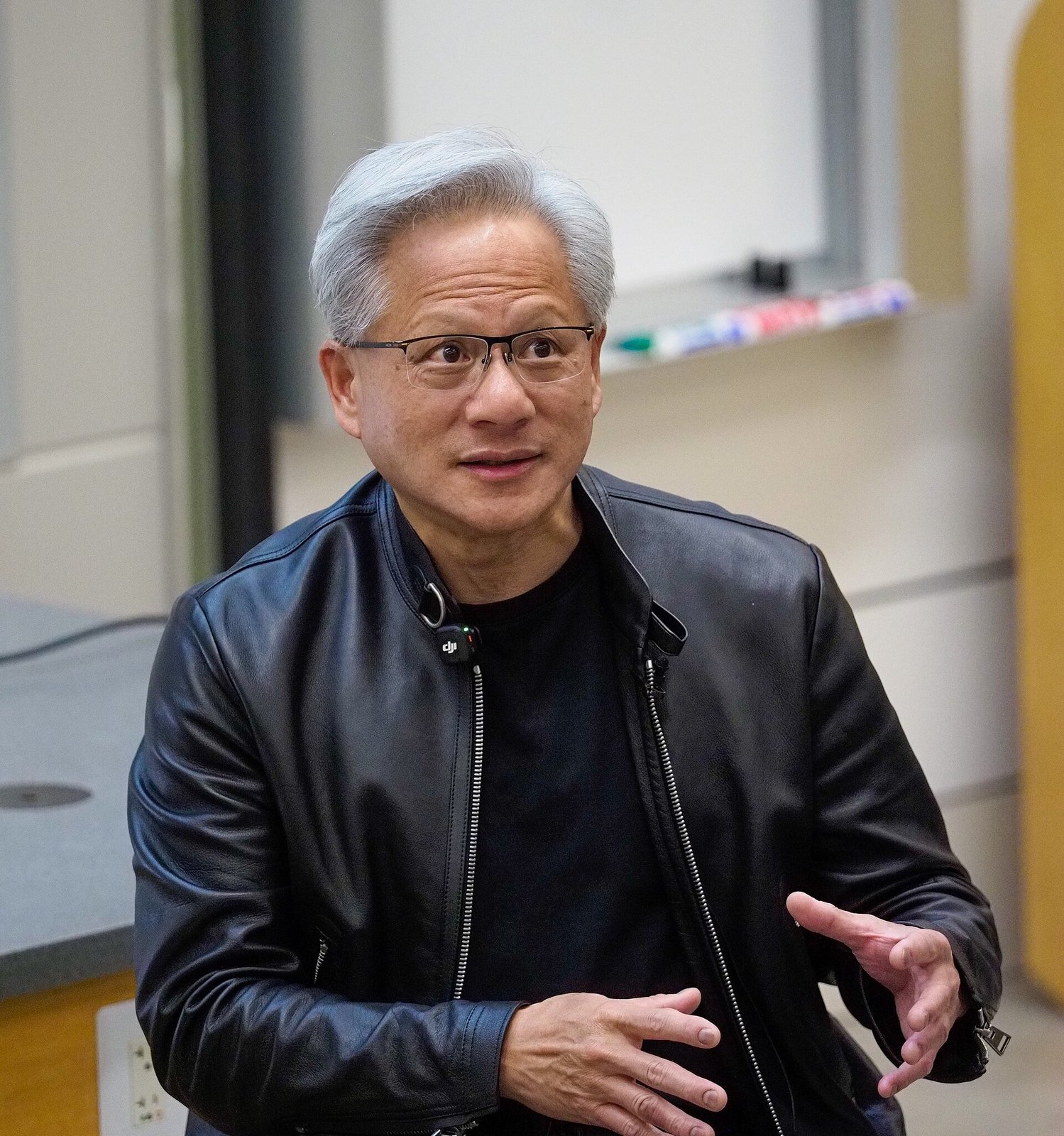 Jensen Huang at Stanford, April 2026, seven months before the fall. Thirty-three years of vision, and a single class of stock.
Why Founders Fall: A Short History of Losing Your Own Company
Founders don't usually lose control in one dramatic boardroom scene. They lose it gradually, through a series of small and individually reasonable decisions.
Act I: One share, one vote. For about sixty years the NYSE refused to list companies with dual-class shares. The idea was that voting power should track economic risk. Ford's 1956 IPO, where the family kept super-voting shares, was the famous exception. Media dynasties like the New York Times Company got a pass on the grounds of editorial independence.
Act II: Google changes the rules. In 2004, Larry Page and Sergey Brin took Google public with Class B shares carrying 10 votes each. The public bought it anyway. Facebook, LinkedIn, Snap, and Alibaba all followed. Hong Kong held out, lost Alibaba's $25 billion IPO to New York, and changed its rules in 2018. By 2021–22, about 47% of U.S. tech IPOs were dual-class.
Act III: the slow loss of your majority. This is the part nobody puts in the pitch deck. According to Carta's 2025–26 data, founders typically hold:
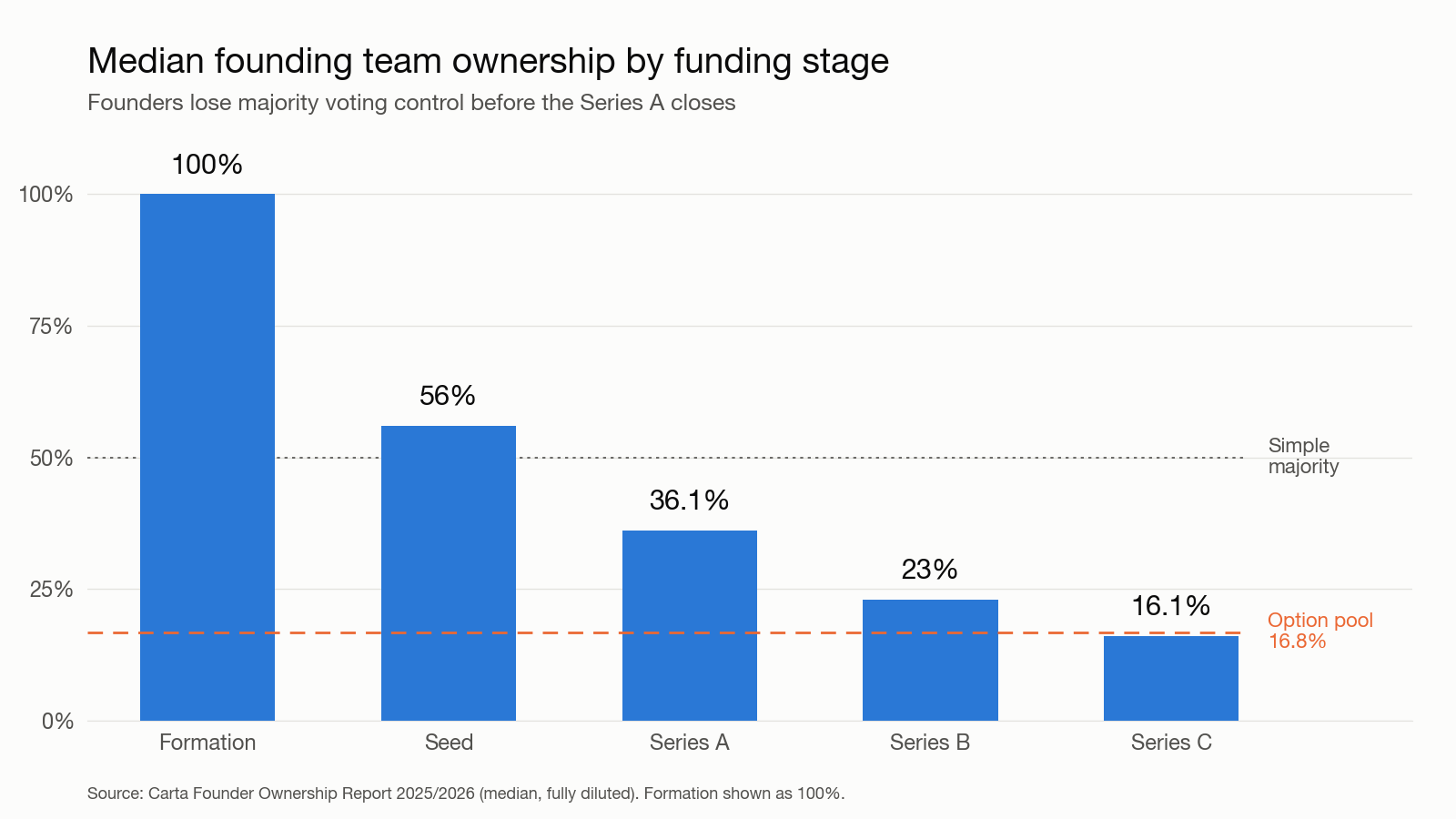 The median founding team's stake by funding stage (Carta, 2025–26). By Series C, the option pool owns more of your company than you do.
- ~56% after Seed
- ~36% after Series A (thanks, pre-money option pool)
- ~23% after Series B
- ~16% after Series C, which is less than the employee option pool
Capital intensity makes it worse. If your company works with atoms (chips, robots, biotech), you burn two to three times the cash of a SaaS company and sell more of the company at every round. Jensen is the hardware founder's cautionary tale: decades of capital-hungry growth, and nothing left to vote with when it counted.
The lesson: you don't lose control when the board votes. You lose it, one term sheet at a time, years before.
Case Study: Apple and the Prodigal Son
Every founder knows this story, and every founder assumes it couldn't happen to them.
In 1985, Steve Jobs was 30, a co-founder of Apple, and the person most responsible for its products and culture. He had no super-voting shares. The Macintosh launched to great reviews and disappointing sales. Jobs's "my way or the highway" style wore everyone out. John Sculley, the Pepsi executive Jobs had personally recruited with the famous "sugar water" pitch, moved to take away his operating authority.
Jobs tried to get Sculley removed instead. The plan leaked, the board backed Sculley, and Jobs, with no structural power at all, resigned and went off to start NeXT.
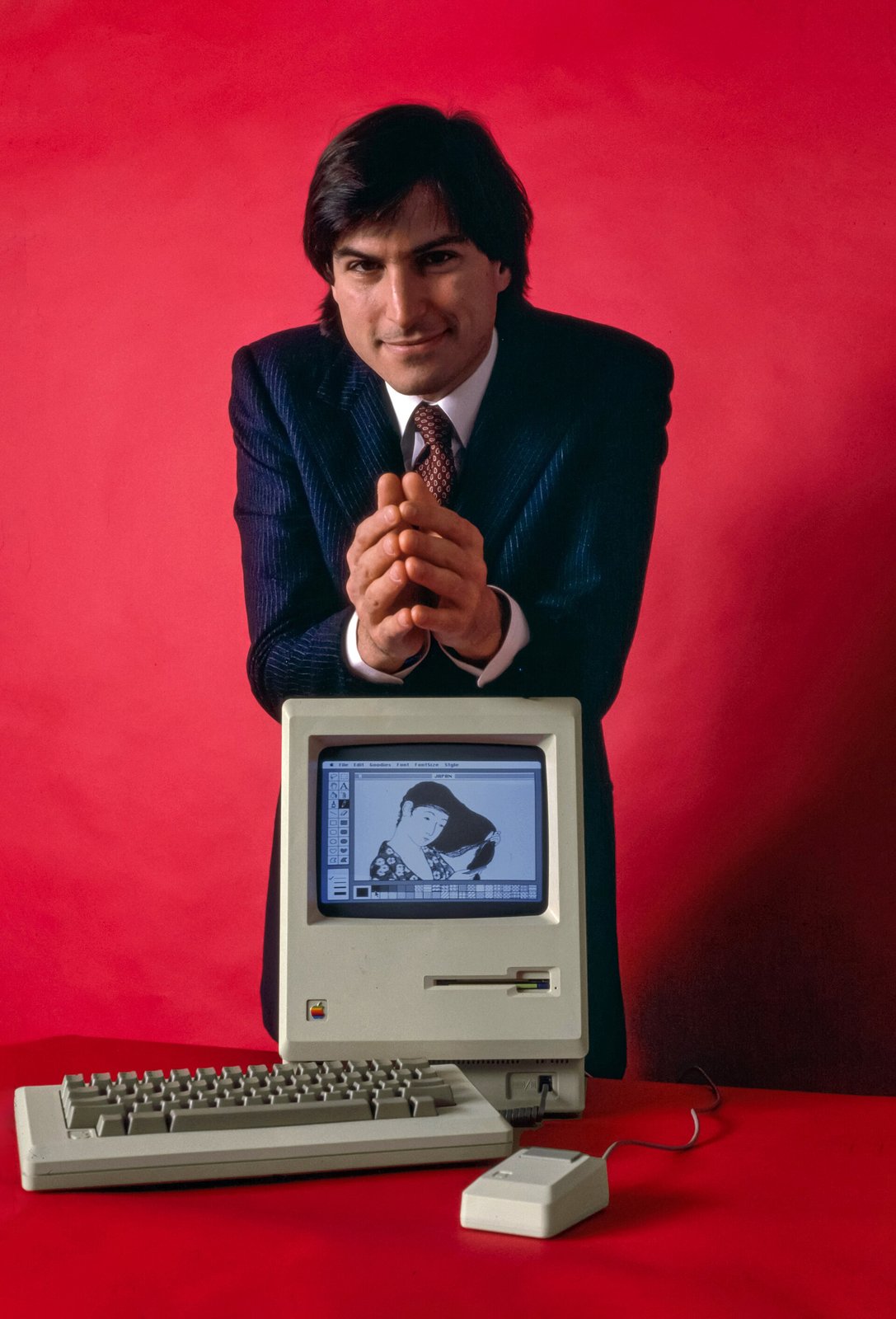 Steve Jobs with the Macintosh in January 1984. Sixteen months later, the board picked the sugar-water guy.
What followed was a twelve-year slide that brought Apple to within about 90 days of insolvency in 1997. The board, out of options, bought NeXT, mostly to get Jobs back. You know the rest: iMac, iPod, iPhone, and the most valuable company on Earth.
Dual-class advocates like to say that if Jobs had held super-voting stock, Apple would have skipped a lost decade.
Maybe. I'll give you the more uncomfortable version. The Jobs who got fired was probably not the Jobs who saved Apple. NeXT and Pixar humbled him and taught him things, and he came back a better CEO. Getting fired may have been the most valuable thing that ever happened to him, though it's hard to see it that way while it's happening.
The Counter-Lesson: WeWork, or What Happens When Nobody Can Say No
Now for the cold shower.
Adam Neumann got the thing Jobs never had: 20 votes per share. The board couldn't fire him, investors couldn't overrule him, and he ran the company accordingly.
He bought buildings personally and leased them back to WeWork. He trademarked the word "We" and had his own company pay him $5.9 million for it. (He reversed that after the public backlash, which is a bit like returning the cookie once your mom has already seen the crumbs.)
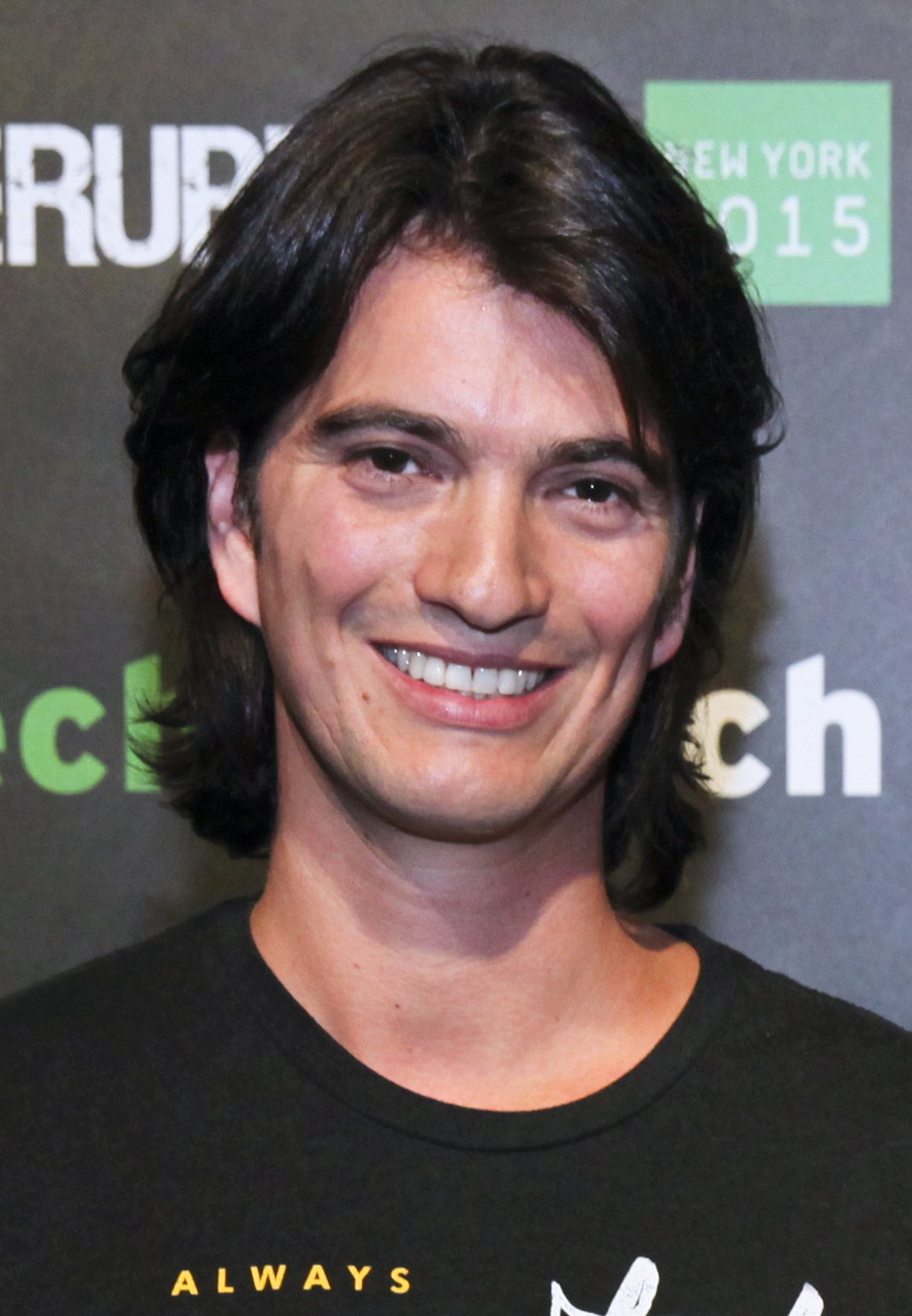 Adam Neumann: 20 votes per share and $5.9 million for a pronoun.
When the S-1 came out in August 2019, public investors saw $47 billion in lease obligations against $4 billion in committed revenue, plus governance that made Apple's 1985 board look like the Federalist Papers. The IPO collapsed and SoftBank had to fund a bailout. Neumann was out, and in 2023 the company filed for Chapter 11.
Here's the lesson I care about most. Super-voting stock does two things: it protects you from the market's panic, and it protects you from your own mistakes. The first is valuable. The second can kill the company. The same structure that would have saved 1985 Jobs from Sculley also saved Neumann from anyone who might have told him no.
The Founder's Toolkit and War Chest
So what should you actually do? Here is the playbook, roughly by stage. If you can, negotiate these terms when you have leverage, which means before you need the money.
At formation
- Founder-friendly charter from day one. Authorizing a high-vote Class B before institutional money arrives is far easier than recapitalizing later. Musk said he wanted 25% voting control at Tesla and admitted that retrofitting dual-class after the IPO is close to impossible. Don't put yourself in that position.
- Clean vesting and 83(b) elections. These are boring and they are essential.
Seed through Series B
- Board composition is the real cap table. Lock in seats elected by common stockholders. A 2-1-2 board (two founders, one independent, two VCs) holds up much better than a board where you have one seat and keep telling yourself the independent director is on your side.
- Supermajority to fire the CEO. Make your own termination without cause require a supermajority of the board. That gives you a veto over your own exit.
- Drag-along guardrails. The 2026 NVCA baseline lets a majority of preferred force a sale. Push for a dual trigger (preferred and common) and a price floor, so you can't be forced to sign a deal in which the liquidation preferences consume everything and common gets nothing.
- Series FF shares. These let you take some money off the table in a later round without giving up voting control. A founder who can pay the mortgage makes better long-term decisions.
Pre-IPO
- Dual-class with a sunset you choose. Glass Lewis and ISS now recommend voting against directors at companies that IPO without a time-based sunset. Pick your own, seven to ten years, before someone picks one for you.
- Choose your jurisdiction deliberately. Delaware's new Section 122(18) makes founder consent rights in stockholder agreements enforceable again after Moelis. Texas offers friendlier rules for controllers and has a growing business court. (See: Tesla's move after Tornetta.)
Throughout
- Character is part of your governance. No structure would have protected Jensen this week. Nvidia's code of conduct, the national-security issues, and lawmakers demanding briefings would have overridden any share class. Super-voting stock doesn't protect you from regulators, prosecutors, or your own direct reports.
The Balance: Governance as Seatbelt, Not Leash
The academics have a useful framework for this. Agency costs are the damage a founder does when nobody can stop them; that's WeWork. Principal costs are the damage investors do when they're in charge: panic, short-termism, and a buyback where an R&D budget should be. That's 1985 Apple.
Law professors Zohar Goshen and Richard Squire argue the right structure minimizes the sum of the two. A visionary founder in a 20-year bet like AI, VR, or rockets should get more insulation. A mature company with a founder who has drifted should get less.
The data supports this. Dual-class firms trade at a premium at IPO, because markets value the founder's vision. Around seven to ten years later, that premium tends to become a discount as the founder's economic stake shrinks while their votes don't.
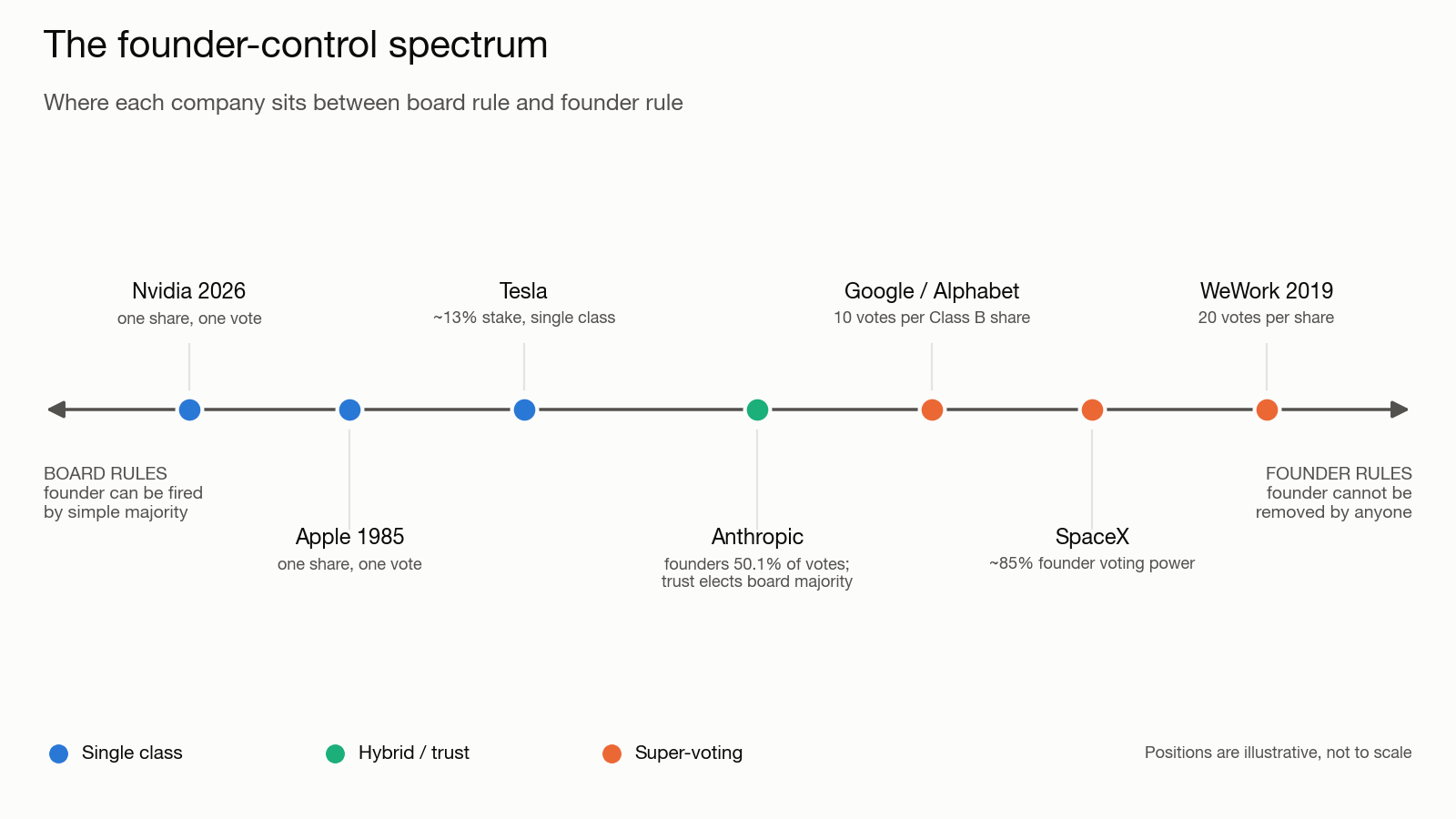 The founder-control spectrum. Stay too far left and you can be fired in a week; go too far right and nobody can stop you from walking off a cliff.
So the goal isn't maximum control. It's control that fits where your company is in its life: enough insulation to make long-term bets, with a working mechanism for someone to say "stop" if you lose your way.
Jensen had plenty of the first and none of the second, which was fine for 33 years until this week. Neumann had too much of both. Jobs had none, and it took a lost decade to fix.
A Look Into the Future
Here's what I expect over the next five years.
1. The Jensen effect on fundraising. Founders raising in 2027 will bring up Nvidia in every board-composition negotiation, and investors will bring up WeWork. Both are fair points.
2. Trust-based structures as the new middle ground. Anthropic's S-1 shows a new model. The founders hold a Class F share that gives them 50.1% of ordinary votes, while an independent Long-Term Benefit Trust with no economic stake elects a majority of the board. The founders control the shareholder vote, and the trust controls the board. OpenAI's foundation keeps exclusive power over its PBC's board even though Microsoft owns 27% of the equity. These are deliberate checks and balances in a company charter, and you'll see others copy them.
3. Sunsets become standard. Perpetual founder control is ending. Index providers, proxy advisors, and institutional investors all agree on that. Expect seven-to-ten-year sunsets to become the price of a dual-class IPO.
4. The jurisdiction wars continue. Delaware vs. Texas vs. Nevada. Your state of incorporation is now a strategic decision, not a box your lawyer checks.
5. Character as a governance mechanism. This is the uncomfortable one. As founders gain more structural protection, the remaining risks come from conduct: personal behavior, conflicts of interest, national security. Those risks don't care how many votes your shares carry.
My closing advice to every engineer-founder reading this:
Fight for control early, when it's cheap. Protect it with structure, not just goodwill. Give it an expiration date before someone else does. And above all, build a company and a character that a board would never want to fire.
Jensen Huang built one of the greatest companies in history and still lost it in a week. Your share structure can't fully protect you from yourself, so you'll have to manage that part on your own.
References
- NVIDIA Announces CEO Transition — NVIDIA Newsroom
- NVIDIA Corp Form 8-K — SEC
- Nvidia's board preparing to oust CEO Jensen Huang — CBS News
- Jensen Huang resigns from Nvidia — Entrepreneur
- Nvidia CEO Jensen Huang steps down — NPR
- Jensen Huang resigns as Nvidia CEO — The Guardian
- Why did Apple's board fire Steve Jobs in 1985? — Corporate Governance Institute
- How Ownership and Control Shaped WeWork — Stratrix
- What exactly happened to WeWork? — Corporate Governance Institute
- Founder Ownership Report 2026 — Carta
- IPO Data — Jay R. Ritter, University of Florida
- Drag-Along Provisions in Venture Deals: A 2026 Drafting Guide — Vaquill
- Principal Costs: A New Theory for Corporate Law and Governance — Goshen & Squire
- The Life-Cycle of Dual Class Firm Valuation — Cremers, Lauterbach & Pajuste
- The Life-Cycle of Dual Class Firms — Harvard Law School Forum
- Glass Lewis 2026 Benchmark Policy Guidelines
- Musk wants 25% voting control at Tesla — Investing.com
- Contract Rights and Control (DGCL §122(18)) — ECGI
- Anthropic's IPO Keeps Founders in Control — The Motley Fool
- Built to Benefit Everyone: OpenAI's Updated Structure — OpenAI
Image Credits
- Hero: NVIDIA Headquarters by Coolcaesar, Wikimedia Commons, CC BY-SA 4.0 (cropped to 16:9)
- Jensen Huang at Stanford, 2026 by Anderseidesvik, Wikimedia Commons, CC BY-SA 4.0 (cropped)
- Founder dilution chart: original illustration by the author; data from Carta Founder Ownership Report 2025/2026
- Steve Jobs and Macintosh computer, January 1984 by Bernard Gotfryd, Library of Congress, public domain
- Adam Neumann at TechCrunch Disrupt NY 2015 by TechCrunch / Max Morse, Wikimedia Commons, CC BY 2.5
- Founder-control spectrum diagram: original illustration by the author


