Balaji Srinivasan Has No Army
· 57 min read
He built a country with a currency, a curriculum, and four hundred citizens. He did not build an army. A municipal council in Johor took his flag down.
 Forest City, Johor, Malaysia: a $100 billion development with almost nobody in it. An ideal blank canvas — until it wasn't. (Jonashtand, CC BY-SA 4.0)
I. THE MAN IN THE GHOST CITY
Balaji Srinivasan, standing in a room in Forest City in the summer of 2026, had everything a country has except one thing.
He had four hundred people who had gotten on airplanes to be there. He had a campus, and beds in it, and a canteen. He had a currency that no central bank issued and a coin bounty paid out daily for shipping code before lunch. He had a curriculum. He had a gym that opened at six and never emptied, and biometric dashboards glowing green across four hundred wrists. He had a culture, a vocabulary, in-jokes an outsider could not parse. He had followers in the millions, capital in the hundreds of millions, a diplomatic corps of podcast appearances, and a five-part thread ready for every conceivable objection, delivered in that flat rapid enumerated Bay Area cadence, point one, point two, point three, like a man reading out a bill of lading for the future.
He did not have an army.
He would tell you he does not want one — that this is the entire moral innovation, the thing that separates his project from every state now on the map, all of which were founded by men who took what they wanted and wrote the deed afterward. Peaceful. Opt-in. Crowdfunded. Cloud first, land last. Nobody conquered, nobody drafted, nobody shot. And he is right that it is the point.
It is also the reason that on the morning of July 22, 2026, the Iskandar Puteri City Council came and took down his signs.
Not with tanks. Not with a naval blockade or a coup or a UN resolution or a drone. With a license. With a stamped municipal notice regarding the approved use of premises. With men on ladders and a length of tarpaulin, covering the lettering, and then unscrewing it, and then carrying it away — a two-year civilization, the physical instantiation of the most influential political theory to come out of Silicon Valley in fifty years, disassembled in about the time it takes to fly from Singapore to Kuala Lumpur.
Twenty-four hours. That is what a network state is worth against a city council.
Publicly, of course, he was fine. Publicly he was already three moves ahead, and the very same day — the same day, and this is either the most impressive or the most damning fact in this entire story, depending on what you believe a country is — he announced a five-year memorandum of understanding with the Republic of Kazakhstan's Ministry of Artificial Intelligence and Digital Development. Expedited visas. Corporate redomiciliation. A global hub for AI. Cloud first, land last, and when the land is repossessed, you simply requisition new land, in a country with more electricity and fewer opinions.
But something had been established in Johor that no thread could unestablish. The whole edifice — the Three Leviathans, the One Commandment, the network archipelago, the immutable ledger, the trustless society, the exit from the dying West — had just been informed, by a clerk, that its premises were not zoned for that.
And it had no answer. Not a weak answer. No answer — because the only reply available to a man holding a lawful work order is a man with more force behind him, and force is precisely the thing the network state has renounced, cannot purchase, and does not want.
That is not a defect in the design. That is the design. Which is the problem.
II. WHO HE IS, WHICH IS TO SAY, WHAT HE IS
 Balaji S. Srinivasan: Stanford PhD, a16z general partner, Coinbase CTO — and the most systematic theorist of leaving that the technology industry has produced. (Kristyuhorton, CC BY-SA 4.0)
You have to understand what he is, because he is not what the caricature says he is, and the caricature is what keeps getting him underestimated.
He is not a grifter. That would be easier. He is a Stanford man several times over, a former general partner at Andreessen Horowitz, a former Chief Technology Officer of Coinbase, a man who was, at one point, on a shortlist to run the Food and Drug Administration of the United States of America, which is a sentence worth sitting with for a moment given everything that came after. He has been right, publicly and expensively right, in ways that make his enemies grind their molars. He read the pandemic early. He read the debasement of institutional credibility early. He has a genuine gift — and it is a gift, not a trick — for looking at a system everyone else treats as furniture and asking why is that there, who put it there, and what happens if it is not there.
And he does not want to reform your country.
That is the thing. That is the whole thing. Every reformer in history — every suffragist, every abolitionist, every union organizer standing in the rain outside a plant gate — has believed in voice. Speak. Organize. Vote. Litigate. Persuade. Win the argument, then win the institution. It is slow, it is humiliating, it involves sitting in rooms with people you find contemptible and asking them for things.
Balaji Srinivasan believes voice is dead. Not wrong — dead. Non-functional. A vestigial organ of the industrial era, like an appendix, or a fax machine, or the House of Lords. He believes the modern democratic state is so bureaucratized, so gridlocked, so captured by its own procedural sediment that pushing on it is a category error, like trying to debug a program by shouting at the monitor.
So: exit.
The economist Albert O. Hirschman gave us the pair in 1970 — Exit, Voice, and Loyalty — and he meant them as a diagnostic, a way of understanding how people respond to decline in firms, organizations, and states. He did not mean exit as a political program. He would have been alarmed to see it become one. But that is what has happened, and Srinivasan is its most articulate advocate, and the argument has a certain brutal engineering elegance: if the system will not accept a patch, fork the repository.
And the strategic insight underneath it is almost embarrassingly simple. A person stays and fights only as long as fighting is cheaper than leaving. Make leaving cheap enough — remote work, a currency no government issues, an identity that lives on a phone, a passport you can purchase, a community you can join by clicking a link — and for more and more people, every year, the arithmetic tips the other way. That is the whole thesis. Everything else is implementation detail.
The genealogy is not hidden; it is proudly displayed, like a family crest. The direct ancestor is The Sovereign Individual, the 1997 book by James Dale Davidson and William Rees-Mogg, which predicted that the internet would flatten hierarchies, dissolve the state's monopoly on the productive class, and permit a cognitive elite to slip the leash of industrial-era taxation entirely. It is the single most influential book among a certain stratum of American technology capital — Thiel, Andreessen, Srinivasan — and it reads, thirty years on, less like prophecy than like a mood board.
But Srinivasan did something to it that its authors did not. Davidson and Rees-Mogg imagined the lone sovereign: a wealthy man, jurisdictionally amphibious, floating free. Srinivasan looked at that and saw the flaw immediately, and the flaw is that human beings are not like that. Human beings need a village. They need someone to eat dinner with, someone to bury them, a shared story about what is good.
So he swapped atomization for the Sovereign Collective. Not a man escaping a state. A tribe building one. This is the pivot from the techno-libertarianism of the 1990s to something you might call techno-communitarianism — and it is precisely this pivot that makes the network state so much more powerful, and so much more dangerous, than the offshore-trust fantasies that preceded it. A rich man with a Caymans account is a tax problem. A hundred thousand ideologically aligned people with their own currency, their own courts, their own land, and their own creation myth is a geopolitical problem.
III. THE THREE LEVIATHANS
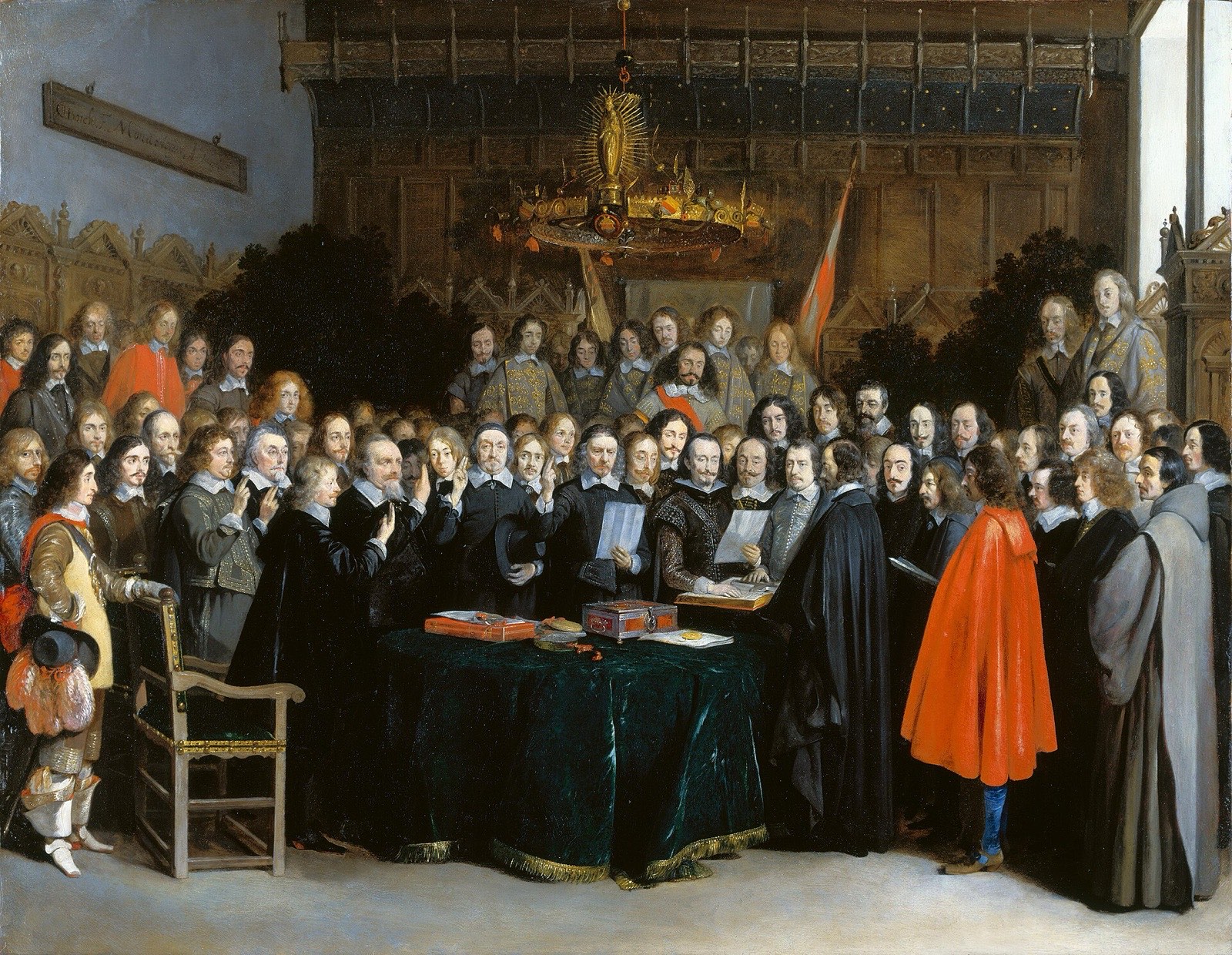 Gerard ter Borch, "The Ratification of the Treaty of Münster," 1648 — the moment sovereignty was welded to dirt. Srinivasan proposes to unweld it. (Public domain)
Here is where the theory stops being a business plan and becomes something closer to a theology.
Srinivasan's frame is a succession of Leviathans — Hobbes's word, the great artificial man, the thing that keeps you from killing your neighbor. There have been three.
God. Through the nineteenth century, the Leviathan was divine. You did not steal because an eye was upon you that did not blink and did not die and kept accounts in a ledger you could not audit. Order was purchased with cosmology.
State. Through the twentieth century, God receded and the secular state took the throne. You did not steal because men with batons and warrants and a monopoly on legitimate violence would come to your house. Order was purchased with force.
Network. And now, he says, a third. You do not steal because the mathematics will not let you. Not "will punish you." Will not let you. The blockchain does not forgive, because it cannot forgive, because forgiveness is a human faculty and there is no human in the loop.
And it is worth pausing on how total that guarantee is, because people nod at it without feeling it. Forging a cryptographic signature is not unlikely the way getting away with a burglary is unlikely. It is unlikely the way correctly guessing a single specific atom, chosen at random from every atom in the observable universe, is unlikely — and then doing it again. Not improbable. Effectively foreclosed, by arithmetic, forever. This is the emotional core of the entire ideology, and if you do not feel the pull of it you will never understand why intelligent people have given years of their lives to this. It is the promise of a social order with the reliability of a physical law. No discretion. No corrupt magistrate. No election that goes the wrong way in November and reverses everything you built. Consensus without consent.
From this falls the distinction that does more work in network state discourse than any other: political truth versus technological truth.
A political truth is true because enough people believe it. The dollar has value; that border is real; that man is president. Withdraw belief and the fact evaporates. A technological truth is true whether or not anyone believes it — the hash matches, the physics holds, the proof verifies. Srinivasan's contention is that the twenty-first century will belong to institutions built on the second kind, and that legacy states, built entirely on the first, are running on borrowed faith.
It is a genuinely profound observation. It is also, and I want to be very careful here, a sleight of hand — the most consequential one in the entire book. Because it is perfectly true that a signature verifies or it does not. It is not remotely true that whether a piece of land belongs to you is that kind of fact. The ledger can prove, with mathematical certainty, that a token was transferred. It cannot prove that the token corresponds to anything, that the sale was legitimate, that the seller had title, that the villagers who have farmed the plot for four generations were consulted, or that any of it means a thing to a court in Tegucigalpa or a city council in Johor.
The blockchain is a perfect record of a claim. It is not a claim on reality. And the entire history of what follows in this story is the history of that gap — the gap between a cryptographic proof and a man on a ladder with a screwdriver, taking your sign down.
IV. THE ONE COMMANDMENT
The legacy state, in Srinivasan's telling, is a machine for manufacturing conflict. It takes three hundred million people who agree on nothing and staples them to a landmass and demands they produce a single policy on abortion. The result is not governance. It is a permanent low-grade civil war, conducted quarterly, in prime time.
And the friction does not grow gently. It grows with every pair of groups that has to be reconciled, which means adding factions to a polity adds grievances far faster than it adds people — double the number of irreconcilable camps and you roughly quadruple the number of fights available to be had. Every functioning legacy state is a heroic, permanent act of suppression against that escalation.
The network state's answer is the One Commandment: a single moral innovation, a founding proposition, the axiom from which the culture is derived. Not a constitution with a thousand clauses. One thing. A society of people who believe sugar is poison. A society of people who believe aging is a disease to be cured. A society of people who believe encryption is a human right. Causes first, companies second.
Reduce the number of camps to one, and the friction vanishes. That is the elegant part. It is also, if you hold it up to the light at a certain angle, the part where you can see the outline of every closed community that has ever gone wrong — because a polity organized around absolute ideological alignment has no mechanism for the person who changes their mind. Legacy democracies are ugly, slow, and full of people you hate, and that is not a bug in them. That is the load-bearing wall. Pluralism is not an inefficiency that a better protocol will optimize away. It is the entire content of the thing, the hard-won and blood-bought acknowledgment that you have to live with people whose deepest commitments you find repellent, and that killing them or expelling them or building a wall around yourself is not, in fact, available.
The network state's response to that is not an argument. It is a shrug and a shipping schedule.
V. THE ROADMAP, WHICH IS A LADDER, WHICH IS A DARE
He is nothing if not operational. The definition he gives is not poetry; it is a spec:
"a highly aligned online community with a capacity for collective action that crowdfunds territory around the world and eventually gains diplomatic recognition from pre-existing states."
Read it again. Every clause is a milestone, and every milestone is a fundraise.
| Phase | What it is | What actually happens |
|---|---|---|
| 1. Startup Society | A Discord, a Telegram, a Substack. A group forms around one shared conviction. | Pure culture-building. Memes, in-jokes, a vocabulary outsiders can't parse. Alignment is proved before anything is built. |
| 2. Network Union | The crowd learns to move as one body. | An internal token. A treasury. Crowdfunding. Decentralized identity. DAO governance. The community can now do things — boycott, buy, build, lobby. |
| 3. Network Archipelago | The cloud touches down on land. | Apartments, compounds, floors of hotels, pop-up cities, bought globally and stitched together by one cryptographic login. Non-contiguous. Smart-locked. |
| 4. The Network State | Density, economy, and footprint sufficient to be acknowledged. | Formal diplomatic recognition from existing nation-states. A seat, a flag, a passport that a border guard in Frankfurt accepts without calling a supervisor. |
Note what is smuggled in at Phase 4. Every prior phase is something you can do unilaterally, with money and conviction and a good developer. Phase 4 requires permission from the very entities the entire project is designed to obsolete. It requires the King of Spain to sign the letter acknowledging the republic. It is the only step on the ladder that someone else has to take for you, and it has never once been taken.
Cloud First, Land Last
The strategic doctrine is four words: cloud first, land last.
Every previous state in human history acquired its territory the same way — with violence, or with the collapse of somebody who had used violence. Conquest, revolution, secession, imperial dissolution. Blood, and then borders, and then a map.
Srinivasan's claim is that he has found the first genuinely peaceful path to statehood: assemble the people first, in the cloud, where assembly is free; accumulate the capital; then buy the land, parcel by parcel, on the open market, at asking price, from willing sellers, with a wire transfer. No one dies. No one is annexed. It is a state built by real estate agent.
And because the resulting territory is an archipelago — a floor in Singapore, a block in Roatán, a campus in Johor, a tower in Astana — it has a strange defensive property. It is, in his phrase, easy to acquire but difficult to conquer. You cannot invade it, because there is no it. There is no capital to march on. Kill one node and the login still works everywhere else.
He extends this to what may be the single most audacious idea in the book: sovereign mergers and acquisitions. Two network states that wish to unify do not negotiate a treaty over years and ratify it in parliaments. They merge the registries. The identity systems reconcile, the smart locks receive a firmware update at 3 a.m., and by breakfast one hundred thousand people can open one hundred thousand new doors. The Louisiana Purchase as a pull request.
It is thrilling. It is genuinely, disturbingly thrilling. And every part of it that lives in the cloud works exactly as advertised.
It is the land part. It is always the land part.
VI. PRÓSPERA, OR: THE BILL FOR TWO-THIRDS OF A COUNTRY
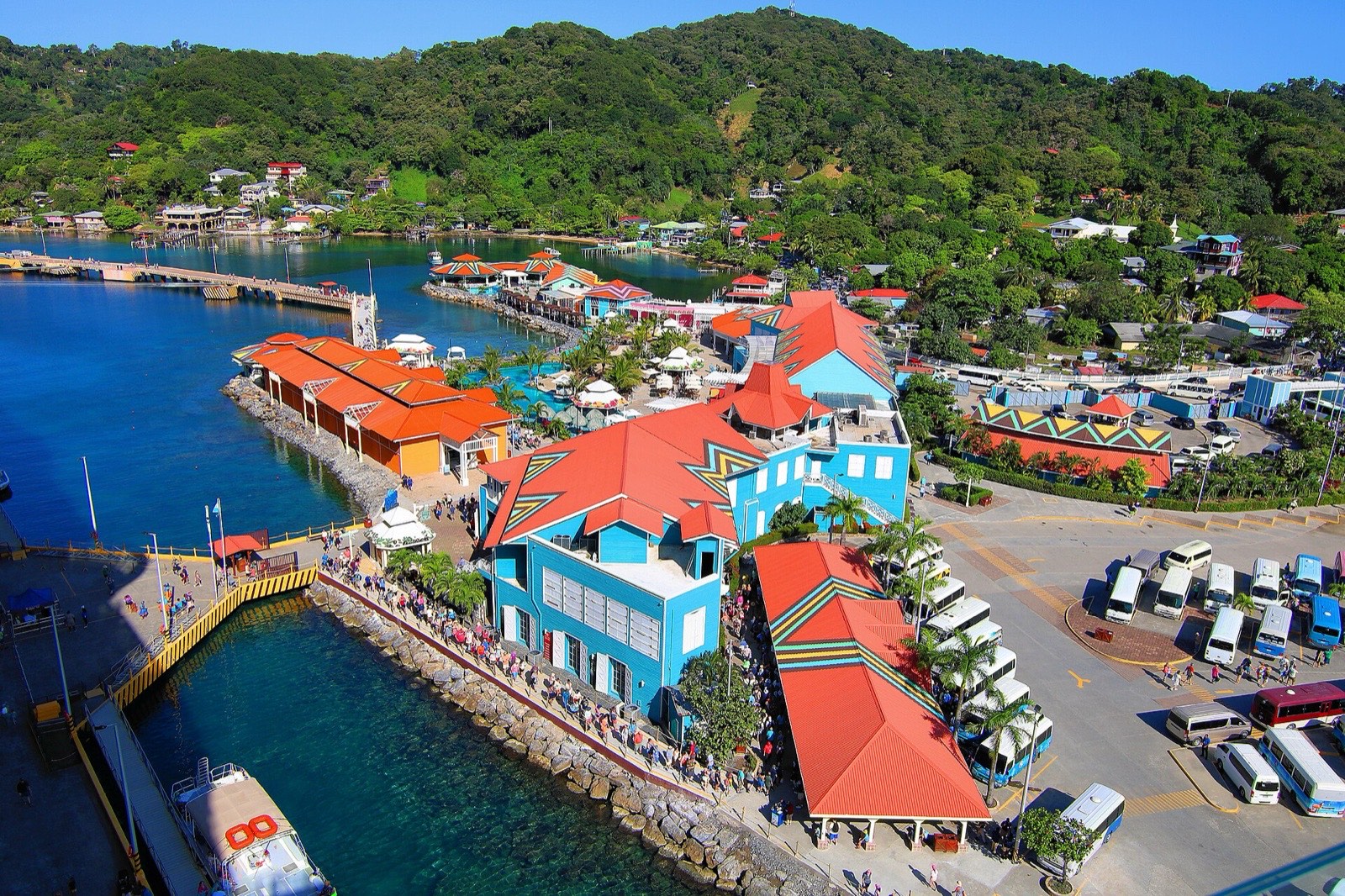 Coxen Hole, Roatán, Bay Islands, Honduras. On this island a private charter city won the right to write its own commercial code — and then sued the country for taking it back. (Larry D. Moore, CC BY 4.0)
 Xiomara Castro, President of Honduras from 2022 to 2026, campaigned on repealing the ZEDE law and won. The repeal produced a multi-billion-dollar arbitration claim against her country, and eventually her government's withdrawal from the World Bank's arbitration system altogether. (Public domain)
Go to Roatán. Fly in over that reef, that ridiculous impossible blue, the Bay Islands strung out like a dropped necklace off the Honduran coast, and land at a small airport where the air comes into the cabin thick and salt-heavy the second the door opens. Somewhere on that island, behind a boundary that is not on most maps, is Próspera: a privately administered charter city, and the closest thing the network state movement has yet produced to an actual sovereign fact.
It was built under the Honduran ZEDE law — Zonas de Empleo y Desarrollo Económico — a framework of astonishing generosity, passed to attract foreign capital, which permitted designated zones to run their own civil and commercial codes; to let businesses select their regulatory regime from a menu of approved foreign jurisdictions, so that a firm might elect to be governed by, say, Delaware corporate law while sitting in the Caribbean; to propose custom regulations; and — this is the clause that matters, this is the clause that detonates — to enjoy explicit legal immunity from expropriation.
The investors were American venture capital, crypto money, libertarian technologists. The pitch was a crypto-libertarian paradise, a physical prototype of governance-as-a-service, a place where you could run a clinical trial or a bank or a body-modification clinic without a federal agency asking you to slow down. For a certain kind of mind it was the most exciting real estate on earth.
The Hondurans, or a great many of them, saw something else. They saw a foreign enclave with its own laws carved out of their national territory by an administration that the incoming president would publicly characterize as a narco-regime. Xiomara Castro campaigned in 2021 on killing the ZEDEs. She won. In April 2022 the Honduran congress repealed the framework and declared the self-governing zones unconstitutional.
A sovereign nation, through its elected legislature, changed its mind about a law.
And Próspera sent an invoice.
Honduras Próspera Inc. filed for investor-state arbitration at the World Bank's International Centre for Settlement of Investment Disputes, alleging breaches of the Dominican Republic–Central America Free Trade Agreement. The opening demand, in the event of total loss: $10.775 billion.
Sit with that number, because the number alone means nothing until you put it next to the country. Honduras spends somewhere around $17 billion a year — on its hospitals, its schools, its roads, its police, its pensions. The opening claim was very nearly two-thirds of all of it, demanded by a corporation, before a tribunal in Washington, as compensation for a democratic decision made by Honduran voters about Honduran soil.
The claimants have since revised that number sharply downward — reporting in 2025 put it closer to $1.63 billion, which is a fifth of the original and still an enormous sum to extract from a country of ten million people. Próspera's defenders will say the first figure was a ceiling, a lawyer's opening position, never the real ask. That is true, and it is also the point. The ceiling was the size of the country.
Honduras tried the obvious defense: a 1988 domestic decree requiring foreign investors to exhaust local remedies before running to international arbitration. Go to our courts first. In a decision that moved through 2024 and was finalized in February 2025, the ICSID tribunal swatted it away — exhaustion was a question of admissibility, not jurisdiction, and in any case the requirement had never been carried into CAFTA-DR. The case proceeds; it is still being litigated today.
And Honduras did something more drastic than lose a motion. It left. On 24 February 2024 the Castro government filed to withdraw from the ICSID convention entirely, and the withdrawal took effect that August — a small earthquake in international investment law, and a sovereign state concluding that the machinery of global arbitration had become more dangerous to it than the absence of foreign capital. Then Honduran politics turned over again, as democratic politics does. Castro's successor reversed her: ratification papers were filed in July 2026, and on 16 August 2026 Honduras rejoined the very system it had fled.
Which is its own quiet commentary on both theories at once. The legacy state is so volatile that it can exit and re-enter the world's investment-arbitration regime inside thirty months. And it is so durable that it is still there, still deciding, still the thing everyone has to negotiate with.
And in Crawfish Rock, the Afro-Indigenous community that sits beside the zone, people describe land disputes they could not follow, consultations they do not remember being consulted in, and the specific vertigo of learning that the ground under your feet has become an asset class in a filing you will never read.
This is the moment to stop and be precise about what Próspera does and does not prove, because both sides get it wrong.
It is not a network state. Srinivasan did not build it and the archipelago model differs from it substantially. Próspera's defenders make a real point: a contract is a contract, investors sank capital on the strength of a legal guarantee, and if a country can void that guarantee by election then no one will ever invest in a poor country again. That is not a frivolous argument. It is the argument the entire edifice of international investment law is built on.
But here is what Próspera demonstrates, and it is devastating for the theory: when the exit society collided with the host state, it did not exit. It sued. It did not fork the repo and walk away. It reached for the oldest and heaviest instrument in the legacy world's arsenal — a treaty-based tribunal, backed by the World Bank, capable of imposing a nine-figure judgment on a sovereign — and it swung.
The network state's founding promise is that it will build a superior alternative rather than fight over the existing one. The first time the theory met a real government, it filed a claim for two-thirds of that government's budget. Voice, it turns out, is not dead. Voice is extremely alive, and extremely well-funded, and speaks fluent arbitration.
VII. PRAXIS, OR: THE FOUNDER-CEO PROBLEM, DEMONSTRATED
 Peter Thiel, an investor in Praxis and the movement's most consequential patron. "I no longer believe that freedom and democracy are compatible," he wrote in 2009. (Gage Skidmore, CC BY-SA 3.0)
If Próspera is the movement's legal crisis, Praxis is its dinner-party crisis.
Praxis is a venture-backed for-profit corporation founded by Dryden Brown and Charlie Callinan, backed by Peter Thiel among others, with the stated intention of building a Mediterranean city from nothing — a beautiful, high-classical, deliberately aesthetic city for the technological elite. Not an archipelago of rented floors. A contiguous sovereign zone, negotiated directly with a government, with columns.
Where Srinivasan is a systems engineer, Praxis is a vibe. It has courted downtown New York scenesters and party photographers and the kind of young men who describe civilizational decline over natural wine. Architectural critics, looking at its master plans, noted a curious absence — of architects, of urban planners, of sociologists, of anyone who has actually built a place where people live — and used the word techno-colonialism, the treatment of the globe as an empty canvas awaiting billionaire brushwork.
And then its chief executive melted down in public, at length, including a widely circulated tirade against Pride celebrations, and the whole thing became the thing Silicon Valley fears most, which is a bit.
Laugh, but notice the structural lesson, because it is the same lesson twice.
In a startup, founder control is a feature. It is the entire reason venture capital works. You concentrate authority in one obsessive individual, you tolerate their strangeness because their strangeness is correlated with their edge, and if they are wrong the company dies and everyone updates their LinkedIn.
In a state, if the founder is wrong, the citizens cannot update their LinkedIn. They live there. Their children live there. The mechanism the network state adopts wholesale from the startup world — decisive, unaccountable, unchecked founder authority — is precisely the mechanism that every constitutional tradition on earth spent four centuries and an ocean of blood learning to constrain. Praxis did not fail because Dryden Brown had opinions. Praxis showed what happens when a polity's diplomatic standing, land rights, and immigration status are all downstream of one man's timeline.
Which brings us back to Johor.
VIII. THE NETWORK SCHOOL: LEARN, BURN, EARN, FUN
 A commercial street in Forest City — new, immaculate, and largely empty. Into this vacancy the Network School moved four hundred people, a gym, a curriculum, and a token. (Jonashtand, CC BY-SA 4.0)
Now the main event. Now the thing he built himself.
The Network School. Not a metaphor, not a thread, not a chapter — a place, with beds and a gym and a canteen and Wi-Fi and four hundred people from everywhere in the world who had gotten on planes.
The doctrine was four words, and the four words are the most Wolfean thing in this entire story: Learn, Burn, Earn, Fun.
Learn — continuous technical education, lectures, cohorts, reading. Burn — physical training, relentless, measured, the body as a repo to be optimized, body-fat percentage as a public metric, a gym that never empties. Earn — remote income, startups, and daily cryptocurrency bounties paid out for shipping code, so that money moves through the community's own veins. Fun — community, dinners, the thing that makes a village a village.
He launched it in late 2024 as a ninety-day pop-up — a proof of concept, a beta test of civilization. It worked. It worked, which is the part critics skip past. People came. People stayed. People got fitter and richer and less lonely, which is not nothing; which is, in fact, more than most institutions currently manage for young men adrift in the developed world.
Then, in mid-2025, he bought the campus. And where he bought it is the detail that a novelist would be told to cut for being too on the nose.
Forest City. A $100 billion Chinese-developed megadevelopment in the Malaysian state of Johor, a stone's throw from Singapore across the strait — four artificial islands, towers rising out of reclaimed sand, malls, marinas, boulevards. And almost nobody in it. A famous ghost city. Occupancy so low that the corridors of luxury towers ran empty at midday, escalators moving for no one, a fountain playing in an atrium in front of shuttered retail.
For a startup society this was paradise: enormous, modern, cheap, and empty. A blank canvas. Land with no incumbents.
Except that Forest City was not empty. Forest City was a Malaysian municipality, in the state of Johor, in a nation with a Sultan and a federal government and an immigration department and a city council called the Iskandar Puteri City Council, MBIP, which issues licenses regarding the approved use of premises, and which is composed of people who live there and vote and read the news.
The network state's founding abstraction is that the host nation is infrastructure. An API. You call the endpoint marked visa, you call the endpoint marked power, you call the endpoint marked bandwidth, and the underlying implementation is somebody else's problem — a substrate, a cloud provider, a thing you do not have to think about, which is what infrastructure means.
Malaysia is not an API. Malaysia is a country, with a Palestinian solidarity politics that runs to the marrow of its public life, with no diplomatic relations with Israel whatsoever, with a social media ecosystem that can go from a rumor to a national outrage in a weekend.
And a rumor is what came. Coordinated campaigns online alleged that the Network School was quietly hosting Israeli nationals traveling on second-country passports.
Srinivasan responded the way an engineer responds to a factual allegation: by checking it. Immigration inspected. And the finding was, in the narrow technical sense, exculpatory — investigators identified no travel-document violations, nobody had forged anything, nobody had entered unlawfully.
But it was not a clean acquittal, and this is where the story gets more interesting than either side wants it to be. Malaysia's foreign minister confirmed that one participant was a dual United States–Israeli citizen who had entered on his American passport. Perfectly legal. Also, in a country that maintains no relations with Israel and generally bars Israeli passport holders, perfectly incendiary. We asked him to leave, the foreign minister said.
So the allegation was not fabricated. It was merely not a violation of anything. And that distinction — the one Srinivasan was relying on, the one that is entirely correct — turned out to weigh nothing at all.
That is the most important sentence in this article, so let me put it plainly: he was right, and it did not help him. A political truth does not require your assent, and it does not require a violation, and it does not even require the underlying claim to be damning. It requires a critical mass of other people to be exercised about it. A critical mass had been reached. Stack that on top of a genuine, boring, unglamorous administrative infraction — operating beyond the approved use of the premises — and the council had everything it needed.
The licenses were revoked. Business and advertising, both. Cease operations. The signboards came down and were covered over, and the men on the ladders were not making a statement about the Westphalian order; they were doing a job that was on a work order.
Twenty-four hours.
Two years. Four hundred people. A curriculum, a token, a culture, a gym at 6 a.m., a genuine little society with its own jokes — and the operative sovereign act was a piece of municipal paperwork executed inside a single business day.
He had already used the weapon his theory arms him with, and he had used it before the licenses went. As the controversy built through mid-July, with the campus still open, Srinivasan announced that Network School — which by his account had already sunk more than RM 100 million, some $34 million, into the Forest City campus without a ringgit of Malaysian government money — was postponing everything further until it received guarantees. On the table and now frozen: an expansion reported at around RM 500 million.
Which is, in fairness, exactly the leverage the thesis predicts capital should have. Exit is a weapon. He drew it, publicly, while he still held the ground.
It did not save the ground. The council revoked the licenses anyway, six days later.
But the people that weapon actually hit were not in the Prime Minister's office.
They were the Malaysian MSMEs — the restaurant that had staffed up for four hundred hungry twenty-eight-year-olds, the barber who had learned exactly how these particular customers wanted their fades, the laundry, the grocer, the drivers, the small operators who had reorganized their entire businesses around a wealthy foreign population that evaporated over a weekend. They did not get a memorandum of understanding with Kazakhstan. They got an empty street in a ghost city that had briefly, wonderfully, stopped being one.
That is the network state's shadow, and it is worth naming precisely: the ability to exit instantly is the ability to externalize instantly. A community that can relocate its entire civilization in a day is a community that never has to live with the consequences of anything. The barber cannot pivot to Kazakhstan.
IX. THE SAME DAY
 Astana, Kazakhstan: cheap energy, common-law financial courts, a Ministry of Artificial Intelligence, and an explicit national ambition to be the region's AI hub. (Alex J. Butler, CC BY 2.0)
July 22, 2026. Operations cease in Johor.
July 22, 2026. A five-year memorandum of understanding is announced with the Republic of Kazakhstan's Ministry of Artificial Intelligence and Digital Development: expedited visas, streamlined corporate redomiciliation, a global hub centered on artificial intelligence.
The same. Day.
Whatever else you think — and I have made clear what I think — you have to give the man this. The cloud-first thesis was tested under maximum stress and it held. The community did not dissolve when the building was taken. The identity layer, the culture, the chat, the cohort, the thing that was actually the country — none of that lived in Forest City. Forest City was a rented body. He shed it in an afternoon and grew another.
That is a real result. It falsifies the lazy criticism that the network state is only vapor.
But look at what he grew it in.
Kazakhstan is not a random destination. Kazakhstan has enormous cheap energy, a state that has organized an entire ministry around AI, a financial center operating under English common law specifically to make Western capital comfortable, and a fervent national ambition to become the region's technology hub. It offers, in other words, precisely what the previous host offered — deregulated space, official enthusiasm, low friction — with the additional feature of a political culture in which coordinated public outrage does not typically get to close things down.
The lesson the network state took from Malaysia was not we must engage more deeply with our host society.
The lesson was find a host with a quieter public.
X. THE COURT
 Vitalik Buterin, who built Zuzalu in Montenegro — the two-month pop-up village that proved a digital community can inhabit physical space and do real work. (John Phillips, CC BY 2.0)
Do not make the mistake of thinking this is a niche. The network state has a court, and the court is rich, famous, healthy, and extremely online.
| Who | What they bring | What they get |
|---|---|---|
| Vitalik Buterin | Built Zuzalu, the two-month pop-up village in Montenegro where cryptographers, longevity researchers, and synthetic biologists lived and worked together. The single best proof that a digital community can inhabit physical space and produce real work. | Intellectual legitimacy that money cannot buy — and, notably, a far more communitarian, less proprietary vision than most of his co-travelers. |
| Bryan Johnson & Andrew Huberman | The longevity constituency. A jurisdiction where experimental biotech, gene therapy, and enhancement can proceed without waiting on the FDA. | Ideal citizens: measured, disciplined, wealthy, and personally invested in a place with no drug regulator. |
| Brian Armstrong & Richard Teng | The rails. Exchange infrastructure, capital, and the credibility that positions crypto as the economic engine of exit. | A political theory that justifies their industry as a civilizational necessity rather than an asset class. |
| Ranveer Allahbadia & Nuseir Yassin | Tens of millions of followers, especially across the global South. Distribution at a scale legacy media no longer commands. | Content, and a flattering role in the future. |
| Singapore, UAE, El Salvador | Actual sovereigns, sending actual representatives. | High-net-worth technologists, capital inflows, and the prestige of being the country that said yes. |
That last row is the one that should stop you. There is something quietly hilarious, and then quietly ominous, about a movement premised on the obsolescence of the nation-state holding a conference at which nation-states compete to sponsor the tote bags.
And the constituency he is recruiting has a name, and the name is good: Dark Talent.
The brilliant Nigerian engineer who cannot get a visa. The Indian designer whose credential is worthless outside her state. The Brazilian founder who is three time zones and one passport away from the capital that would fund her. Enormous human capability, dark to the system, unlit by any institution that could deploy it — not because of any deficiency but because of the accident of which document they were issued at birth.
It is, I think, the strongest moral argument the movement has. The global passport regime is an obscenity, a caste system administered at airports, and anyone who has watched a colleague get denied a conference visa knows the particular sick feeling of it. Srinivasan sees that clearly and takes it seriously and is building something for those people, and his critics — who mostly hold the good passports — should sit with that before they open their mouths.
But hold it up to the light. To join the network state you need technical literacy, financial mobility, and ideological conformity to the One Commandment. That is a filter. It is a fine filter. It selects, from among the world's Dark Talent, the fraction who are already elite in everything but paperwork — and leaves the rest exactly where they were, in the legacy states, which now have somewhat fewer of their best people and exactly the same problems.
The network state does not abolish the caste system. It offers a small number of people a transfer to a higher caste, in exchange for alignment. Then it calls the transfer equality of opportunity.
XI. THE CASE FOR THE PROSECUTION
Let me put the charges in order, because they are not all equally strong and it is intellectually dishonest to blur them together.
One: the democratic bypass. This is the central charge and it lands. Treat a society as a startup and you get founder control — decisive, concentrated, unaccountable. In a company that is efficiency. In a polity that is unchecked power over people who cannot exercise voice, because voice has been designed out of the system as a legacy inefficiency. The network state's answer is that exit substitutes for voice: if you don't like it, leave. But exit is only a real check if leaving is genuinely cheap, and it is not cheap once you have children in the school, equity vesting in the local economy, your entire social world inside the walls, and your legal status in the host country contingent on your membership. The network state's own success makes exit expensive. At scale, the substitution fails exactly when you need it.
Two: exclusivity. Covered above. A movement whose entry requirements are capital, credentials, and creed cannot claim to be a universal liberation. What happens to the elderly, the poor, the sick, the ideologically heterodox? They stay. They stay in the state you left, which is now poorer and less capable, and they are told that this is their own fault for not opting in.
Three: techno-colonialism. Also covered, and Próspera is the exhibit. When a multi-billion-dollar collective negotiates with a developing nation, it is not two parties contracting freely. It is an asymmetry so total that the word "contract" starts to strain. The capacity to bring a claim for two-thirds of a national budget before an international tribunal is not a market transaction. It is a weapon, and the people who live in Crawfish Rock did not get a vote about whether it would be pointed at them.
Four: the vulnerable world. This one is underrated and it may end up being the one that matters. The network state's selling proposition is jurisdictional arbitrage — a place where you can do the thing the FDA, or the EU AI Act, or the biosafety committee, will not let you do. Mostly that means a supplement, a clinical trial, an unlicensed exchange. Fine. But the same door that admits an unapproved peptide admits gain-of-function work with no institutional review, autonomous weapons research with no export control, and frontier model training with no evaluation regime. Deregulated zones do not get to choose which regulations they are escaping. A globally catastrophic externality does not respect the archipelago's smart locks, and it does not stop at the border of a jurisdiction that has opted out of the concept of borders.
Five: tech Zionism. In a long 2023 podcast appearance — reported at length the following spring, and never disavowed — Srinivasan called for "something like tech Zionism" in San Francisco — a vision in which the tech-loyal would wear identifying grey shirts and hold privatized districts of the city, from which political opponents, specifically "blue" liberals, would be excluded. Police allied. Territory taken. Others barred.
Read that back slowly, and then read back the founding promise: peaceful, opt-in, non-violent, cloud first, land last, nobody gets conquered.
You cannot hold both. A movement whose theory is voluntary exit does not need uniforms and controlled districts and a list of who is banned. That is not exit. That is a faction seizing a city and issuing identification. The grey shirts are the moment the mask slips — the moment where the whole thing stops sounding like we would like to build our own thing over here, peacefully, and leave you alone and starts sounding like something with a much longer and much worse history.
Six — and this is the one he cannot engineer around, the one every other charge finally reduces to: the network state has no army.
It has a treasury, a currency, a legal apparatus, a culture, a flag if it wants one, a diplomatic corps of podcast appearances. It does not have, and by its own founding logic cannot have, a monopoly on violence in any territory. Every other polity on earth is, at bottom, a promise that somebody will come when you call. The network state's founding promise is that nobody will ever be made to come at all. It rents its physical existence from states that do. It runs on their power grid, lands on their runways, drinks their water, and holds its land at their sufferance, subject to a license that a municipal officer can revoke.
Every network state, at every moment, exists because a legacy state has not yet bothered to end it.
Johor bothered. It took a day.
XII. THE PIVOT: FROM LEDGER TO FURNACE
 Compute. In the AI era the contested asset is not the ledger but the furnace — racks, substations, cooling loops, and the megawatts to run them. (BalticServers.com, CC BY-SA 3.0)
The network state was born in 2022, and 2022 was a crypto document. The whole apparatus — the ledger, the token, the DAO, the cryptographic identity, the trustless court — presumed that the decisive technology of the century was distributed consensus.
It is not. It is artificial intelligence, and the shift changes everything about what a network state has to be.
Here is the difference, and it is physical. A blockchain is nearly weightless. A full node runs on a machine under a desk. The state's crown jewel — the ledger — is everywhere and nowhere, which is what made "cloud first, land last" coherent in the first place. You could genuinely be a country made of math.
Compute is not weightless. Compute is a building. Compute is a substation, a switchyard, a transformer with a two-year lead time, a cooling loop, a water rights negotiation, a fiber trench, and a hundred megawatts of firm power that has to come from somewhere and cannot be sharded across an archipelago of rented apartments. Frontier AI is the most territorially demanding technology since heavy industry.
Which means the network state's asset ladder has inverted. Power in this era is not a function of how many aligned people you can assemble in a chat. It is a function of three things a chat cannot supply: firm megawatts, installed silicon, and a regulator who will get out of the way. You cannot crowdfund a gigawatt out of a Telegram group. You need a state — a real one, with an energy ministry and a grid and eminent domain and a willingness to fast-track a permit.
And now go back and look at the Kazakhstan MoU, and it stops looking like an improvisation and starts looking like a thesis. Vast geography. Enormous cheap power. A government that has built a ministry around AI. Common-law courts to reassure Western capital. An explicit national desire to be the place where this happens.
The network state is becoming a vehicle for AI regulatory arbitrage.
As the United States and the European Union tighten frontier-model oversight — evaluations, compute thresholds, liability, disclosure — the arbitrage opportunity grows in exact proportion to the tightening. Somebody is going to offer sovereign safe harbor for unrestricted training runs. It will be pitched as freedom, as anti-colonial resistance to Brussels, as the right of a developing nation to industrialize on its own terms. And the pitch will be partly true, which is what makes it work.
The endpoint of "cloud first, land last" was never a village of digital nomads doing kettlebell swings at dawn. The endpoint is a jurisdiction with cheap electricity, a friendly ministry, no evaluation regime, and a data center you are not allowed to inspect.
The Engineering State
The final piece of the vision is the one that is easiest to state and hardest to survive.
Srinivasan describes the legacy order as the lawyerly state: statutes drafted at 2 a.m. by exhausted staffers, passed unread, deployed to three hundred million people with no staging environment, no test suite, no rollback, and then interpreted unpredictably by judges whose reasoning is, from a software perspective, an unversioned oral tradition.
He proposes the engineering state: law as executable code. Contracts that enforce themselves. Regulation that can be unit-tested against simulated populations before deployment. And, increasingly, AI systems as the judiciary and the bureaucracy — models mediating disputes instantly, adjudicating claims at near-zero marginal cost, driving the price of civic verification toward zero.
The critique of the lawyerly state is correct. Anyone who has read a modern omnibus bill knows it is correct. Legislation genuinely is deployed to production without testing and it genuinely does produce catastrophic unhandled exceptions in the lives of real people.
But the proposal misunderstands what a judge is for.
A judge is not a slow interpreter of ambiguous specifications. A judge is a deliberate interpreter of specifications that are ambiguous on purpose — because the legislature could not foresee the case, because reasonable people disagree, because the world produces situations no rule anticipated, and because mercy, proportion, and context are not bugs in the legal system but the reason we have humans in it at all. Discretion is not the failure mode of justice. Discretion, exercised by someone who can be appealed, removed, and held responsible, is justice's load-bearing wall.
Replace the judge with a model and you do not get a system without discretion. You get a system whose discretion is exercised by the training data, invisibly, at scale, with no appeal, no reasons you can cross-examine, and no one to hold accountable — enforced by a smart contract that cannot be persuaded, because persuasion is precisely the faculty it was designed to eliminate.
The network state's answer to the abuse of power is to build a power that cannot be argued with.
XIII. CODA: WHAT A COUNTRY IS
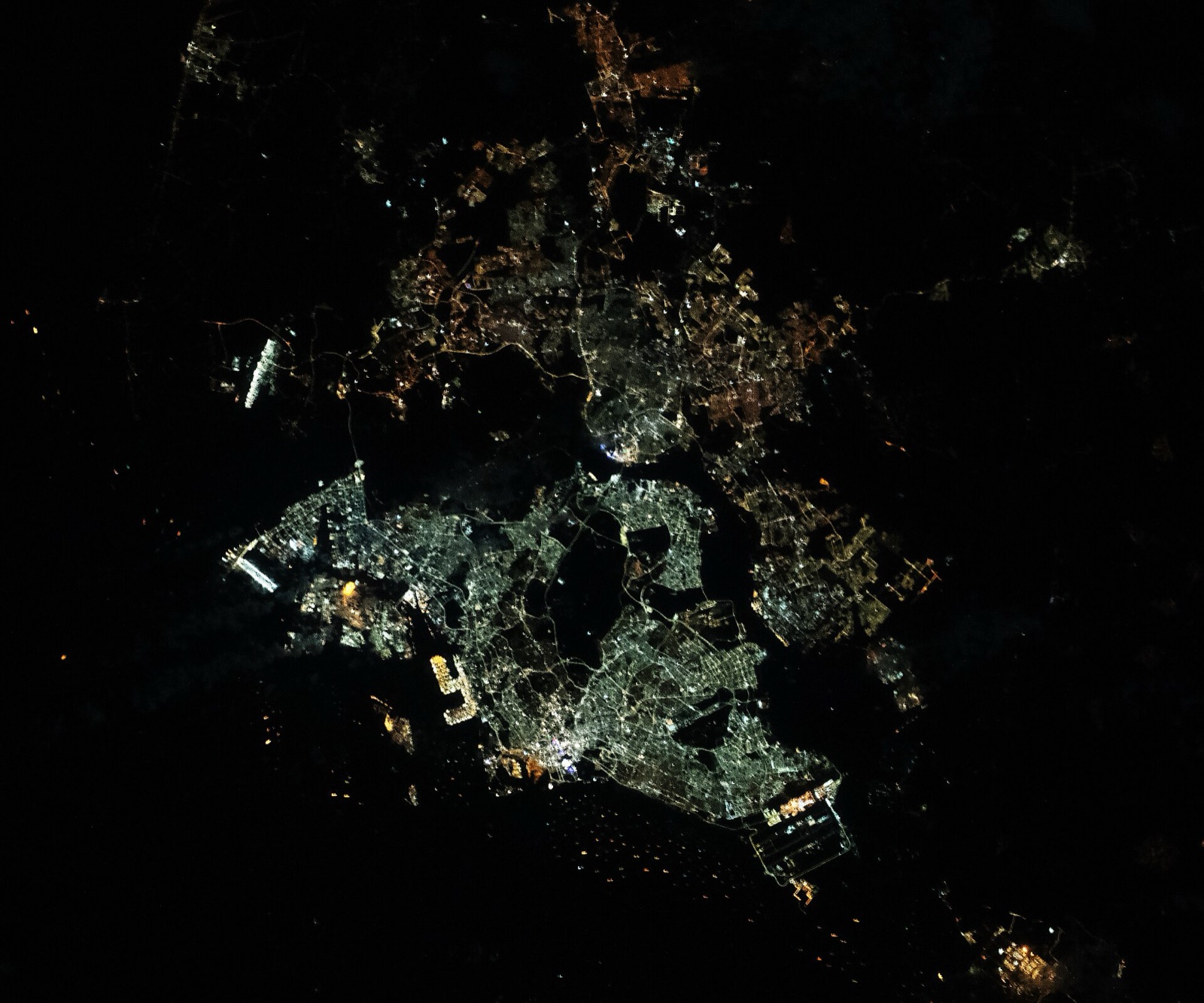 Singapore and Johor at night, from orbit. On one side of that thin dark strait, a sovereign city-state that took sixty years to build. On the other, the ghost city where a country was assembled in two years and disassembled in one day. (NASA / ISS Expedition 70, public domain)
So he is in Astana now, or he is in the cloud, which is where he actually lives and always has. The cohort continues. New people are arriving. The gym opens at six. Somewhere a bounty is paid in a currency that no central bank issues, to a young man in a country that will never give him a visa, for code that shipped before lunch.
And he still has no army.
Because here is what happened, stripped of theory: a man who has argued for a decade that the nation-state is a legacy system awaiting deprecation spent two years building his answer to it, in a city that was empty, in a country that was welcoming, with money that was inexhaustible, surrounded by people who agreed with him about everything.
And it ended not because of an argument he lost, or a rival theory that beat his, or a war, or a market crash, or a scandal.
It ended because a rumor went around, and the rumor turned out to be technically groundless and politically radioactive at the same time, and a council checked a file, and the use of the premises was not as approved.
That is the whole refutation. Not a refutation of his intelligence, which is formidable, or of his diagnosis, which is frequently right, or of his ability to make four hundred strangers into a community, which is genuinely rare and which most institutions in the developed world can no longer do at all. It is a refutation of the axiom underneath all of it — the belief that political reality is a soft, obsolete layer running on top of the hard technological one, and that a sufficiently well-engineered system can simply route around it.
It cannot. The soft layer is the substrate. The men on the ladders are the substrate. The council meeting is the substrate. The Malaysian public's forty-year commitment to Palestine, whether you find it wise or foolish, is substrate — a political truth, held by enough people, and therefore as real and as load-bearing as any hash on any chain.
Srinivasan's most brilliant idea was the distinction between political truth and technological truth. His fatal error was the conclusion he drew from it: that the second kind is stronger.
It is not. The second kind is harder — sharper, cleaner, more beautiful, and utterly brittle at the point where it meets the world. Political truth is soft the way water is soft. It has no edge at all, and it takes the canyon anyway.
He will build it again. Of course he will. He is one of the most relentless people alive, and the pitch works, and the money is there, and there will always be another empty city and another ministry that wants the prestige and another four hundred young people who are lonely and ambitious and would very much like to belong to something.
And one day, in some jurisdiction, somebody is going to succeed — is going to get the land and the power and the recognition and the seat — and on that day the network state will discover the last thing about sovereignty, which is the thing nobody in the movement has written a chapter on:
The moment your country becomes real enough to matter, somebody will want to take it from you. And then you will need an army, and a border, and a bureaucracy to raise the tax to pay for them, and courts to hear the grievances of the people you conscripted, and a way for the citizens who now hate you to say so without leaving.
And you will have reinvented, at enormous expense, in a ghost city on the far side of the world, the thing you were running from.
He has no army. It is the most admirable fact about him and the most fatal, and the two cannot be separated, because they are the same fact. A man who will not raise a force has given up the only argument that has ever finally settled a question of sovereignty. It makes him better than the men who founded every nation on the map. It also means that each thing he builds will stand exactly as long as somebody else's patience holds, and not one hour longer.
In Johor, the patience held for two years. And when it ran out it did not run out with an ultimatum, or a declaration, or a shot. It ran out with a notice concerning the approved use of the premises, and a length of tarpaulin, and men on ladders, taking the lettering down.
IMAGE CREDITS
All photographs and artworks are reproduced from Wikimedia Commons under the licenses noted. Files are stored locally in images/.
| File | Source | Creator | License |
|---|---|---|---|
01-forest-city-johor.jpg | Forest City, Johor in development (2019) | Jonashtand | CC BY-SA 4.0 |
02-balaji-srinivasan.jpg | Balaji Srinivasan | Kristyuhorton | CC BY-SA 4.0 |
03-westphalia-munster.jpg | Westfälischer Friede in Münster (1648) | Gerard ter Borch | Public domain |
04-roatan-honduras.jpg | Port of Roatán, Coxen Hole (2025) | Larry D. Moore | CC BY 4.0 |
05-xiomara-castro.jpg | Xiomara Castro (2023) | Presidencia de Colombia | Public domain |
06-peter-thiel.jpg | Peter Thiel | Gage Skidmore | CC BY-SA 3.0 |
07-forest-city-street.jpg | Commercial street of Forest City, Johor (2019) | Jonashtand | CC BY-SA 4.0 |
08-astana-kazakhstan.jpg | Astana | Alex J. Butler | CC BY 2.0 |
09-vitalik-buterin.jpg | Vitalik Buterin, TechCrunch London 2015 | John Phillips | CC BY 2.0 |
10-datacenter.jpg | BalticServers data center | BalticServers.com | CC BY-SA 3.0 |
11-johor-strait-night.jpg | Singapore and Malaysia at Night | NASA / ISS Expedition 70 | Public domain |


A note on the images: no free-licensed photographs of the Network School campus or the Network State Conference exist in the public commons, so those sections are illustrated with the places and people they concern — Forest City itself, and Vitalik Buterin, whose Zuzalu experiment is the movement's clearest precedent.
WORKS CITED
- Balaji Srinivasan — Wikipedia. https://en.wikipedia.org/wiki/Balaji_Srinivasan
- The Network State | Ian O'Byrne. https://wiobyrne.com/book-notes/the-network-state/
- The Network State by Balaji Srinivasan: Navigating the Future of Governance and Power Structures — Truflation. https://truflation.com/blog/the-network-state-by-balaji-srinivasan-navigating-the-future-of-governance-and-power-structures
- We need network societies, not network states — CIP. https://www.cip.org/blog/network-societies
- The Illusion of Tech Exit — The Republic. https://therepublicjournal.com/essays/the-illusion-of-tech-exit/
- What is a Network State? — ForkLog. https://forklog.com/en/what-is-a-network-state/
- Sovereign Nonsense — RadicalxChange. https://www.radicalxchange.org/updates/blog/sovereign-nonsense/
- The Network State (full text, PDF). https://thenetworkstate.com/book/tns.pdf
- The Sovereign Individual — Bookmarked Club. https://www.bookmarked.club/books/the-sovereign-individual
- Goodbye, the beloved country — hello, the network state. Daily Maverick. https://www.dailymaverick.co.za/article/2022-09-26-goodbye-the-beloved-country-hello-the-network-state/
- Introduction to Network State and Balaji Srinivasan's Vision — Medium. https://sbal17.medium.com/introduction-to-network-state-and-balaji-srinivasan-vision-391e7824d5b5
- The Westphalian System and State Sovereignty — Fiveable. https://fiveable.me/introduction-international-relations/unit-3/westphalian-system-state-sovereignty/study-guide/BTI01eOLi9ddi3S9
- Rethinking the Sovereign State Model — Stanford FSI. https://cddrl.fsi.stanford.edu/publications/rethinking_the_sovereign_state_model
- Westphalian system — Wikipedia. https://en.wikipedia.org/wiki/Westphalian_system
- The Network State by Balaji Srinivasan — The Rabbit Hole. https://blas.com/the-network-state/
- On Network States. https://thenetworkstate.com/on-network-states
- The Network State — Derek Sivers. https://sive.rs/book/NetworkState
- The Network State Summary — Aure's Notes. https://auresnotes.com/the-network-state-summary-balaji-srinivasan/
- The Network State — balajis.com. https://balajis.com/p/the-network-state-2021
- Network States: What is a Country but a Collection of Minds? — Nasdaq. https://www.nasdaq.com/articles/network-states%3A-what-is-a-country-but-a-collection-of-minds
- startup-to-state-staging — Balaji Wiki. https://balaji.wiki/frameworks/startup-to-state-staging
- Balaji Srinivasan on The Network State — a16z. https://a16z.com/podcast/balaji-srinivasan-on-the-network-state/
- Crypto Bros Are Trying to Bankrupt Honduras for Scuttling Their Private Cities — FPIF. https://fpif.org/crypto-bros-are-trying-to-bankrupt-honduras-for-scuttling-their-private-cities/
- Próspera — Wikipedia. https://en.wikipedia.org/wiki/Pr%C3%B3spera
- Cancellation of the ZEDE law in Honduras and international arbitration — Emerald. https://www.emerald.com/jitlp/article/24/2/101/1273898/Cancellation-of-the-ZEDE-law-in-Honduras-and
- Honduras threatens ICSID withdrawal over $11 billion 'neo-colonial' special economic zone claim — Bretton Woods Project. https://www.brettonwoodsproject.org/2023/07/honduras-threatens-icsid-withdrawal-over-11-billion-neo-colonial-special-economic-zone-claim/
- A Local Remedies Pitfall Avoided—for Now — Wolters Kluwer Arbitration Blog. https://legalblogs.wolterskluwer.com/arbitration-blog/a-local-remedies-pitfall-avoided-for-now-key-takeaways-from-honduras-prospera-inc-v-honduras/
- Honduras Próspera v. Honduras, Decision on Preliminary Objections (26 Feb 2025) — Jus Mundi. https://jusmundi.com/en/document/decision/en-honduras-prospera-inc-st-john-s-bay-development-company-llc-and-prospera-arbitration-center-llc-v-republic-of-honduras-decision-on-the-respondent-s-preliminary-objections-pursuant-to-cafta-dr-article-10-20-5-wednesday-26th-february-2025
- Prospera v. Honduras — Investment Arbitration Reporter. https://www.iareporter.com/arbitration-cases/prospera-v-honduras/
- Praxis (proposed city) — Wikipedia. https://en.wikipedia.org/wiki/Praxis_(proposed_city)
- A Peter Thiel-Linked Startup Is Courting New York Scenesters — Mother Jones. https://www.motherjones.com/politics/2023/09/praxis-society-city-dryden-brown-peter-thiel/
- The Billionaire Blueprint to Dismantle Democracy — r/Futurology. https://www.reddit.com/r/Futurology/comments/1ihafo1/the_billionaire_blueprint_to_dismantle_democracy/
- Peter Thiel-Linked Praxis Wants to Build the "Next Great City" — InsideHook. https://www.insidehook.com/internet/peter-thiel-praxis-next-great-city-greenland
- New Frontiers: Praxis and the Pitfalls of Techno-Utopias — Architectural Record. https://www.architecturalrecord.com/articles/16764-new-frontiers-praxis-and-the-pitfalls-of-techno-utopias
- Worst New Trend of 2024: Techno-Colonialism and the Network State Movement — Gizmodo. https://gizmodo.com/worst-new-trend-of-2024-techno-colonialism-and-the-network-state-movement-2000525617
- From Gay Money to 'God's Wrath': Praxis CEO Melts Down — The Nerd Reich. https://www.thenerdreich.com/from-gay-money-to-gods-wrath-praxis-ceo-melts-down/
- Balaji Srinivasan Launches "The Network School" — Medium. https://medium.com/@chaincom/balaji-srinivasan-launches-the-network-school-in-singapore-an-experimental-approach-to-education-78963a97d371
- Network States of the Internet — Network School. https://ns.com/dashboard/network-school
- What is Network School? — Kalash Vasaniya. https://www.kalashvasaniya.com/blog/what-is-network-school
- Balaji Srinivasan Launches The Network School Near Singapore — COIN TURK. https://en.coin-turk.com/balaji-srinivasan-launches-the-network-school-near-singapore/
- Indian-American entrepreneur buys island near Singapore — Economic Times. https://m.economictimes.com/news/new-updates/watch-indian-american-entrepreneur-buys-island-near-singapore-using-bitcoin-to-build-a-nation-for-techies-startup-founders/articleshow/122196235.cms
- Malaysia closes Balaji Srinivasan's Network School after 2 years — Hindustan Times. https://www.hindustantimes.com/trending/malaysia-closes-balaji-srinivasan-s-network-school-after-2-years-what-happened-101785812795980.html
- Malaysia Shuts Down Balaji Srinivasan's Network School Amid Licensing Issues — Free Press Journal. https://www.freepressjournal.in/business/malaysia-shuts-down-balaji-srinivasans-network-school-amid-licensing-issues
- Malaysia's Network School premises closed, signboards taken down — Asia News Network. https://asianews.network/malaysias-network-school-premises-closed-signboards-taken-down-and-covered/
- US investor Balaji Srinivasan's Network School in Forest City ordered to shut down — TechNode Global. https://technode.global/2026/07/22/us-investor-balaji-srinivasans-network-school-in-forest-city-ordered-to-shut-down/
- Malaysia revokes licence of tech-based 'startup society' — Bangkok Post. https://www.bangkokpost.com/world/3289399/malaysia-revokes-licence-of-techbased-startup-society
- Network School: Malaysia Shut Balaji's Campus in 24 Hours — The Runway. https://www.therunway.ventures/p/network-school
- Network School founder Balaji Srinivasan pauses Malaysian investment — r/malaysia. https://www.reddit.com/r/malaysia/comments/1uzt6k8/network_school_founder_balaji_srinivasan_pauses/
- Network School moves to Kazakhstan, leaving local businesses behind — Murray Hunter. https://murrayhunter.substack.com/p/network-school-moves-to-kazakhstan
- Balaji Srinivasan's Network School relocates to Kazakhstan — TradingView / Crypto Briefing. https://www.tradingview.com/news/cryptobriefing:d86ce1a9b094b:0-balaji-srinivasan-s-network-school-relocates-to-kazakhstan-after-malaysian-authorities-pull-the-plug/
- Network School heading to Kazakhstan after Johor operations halted — The Straits Times. https://www.straitstimes.com/asia/se-asia/network-school-heading-to-kazakhstan-after-johor-operations-halted
- Network School moves to Kazakhstan — Newswav. https://newswav.com/article/network-school-moves-to-kazakhstan-A2607_PNPQI9
- 'The Nerd Reich' tracks the unmasking of Silicon Valley's true politics — NPR. https://www.capradio.org/news/npr/story?storyid=nx-s1-5925350
- Conference — Network School. https://ns.com/conference
- Vitalik Buterin on Zuzalu: The Future of Pop-Up Cities. https://www.youtube.com/watch?v=RL2IHg-U6E8
- Popups are the new startups — balajis.com. https://balajis.com/p/popups-are-the-new-startups
- The Network School — balajis.com. https://balajis.com/p/network-school
- High-Status Social Cliques in San Francisco, 2026 — Luke Ford. https://lukeford.net/blog/?p=189538
- Metaverse and Money — Citi GPS (PDF). https://compoundmaven.com/wp-content/uploads/2022/08/Metaverse-Predictions-Citi-March-2022-Metaverse-And-Money-Decrypting-The-Future.pdf
- Balaji pivots to Kazakhstan after Network School loses Malaysia licence — crypto.news. https://crypto.news/balaji-pivots-to-kazakhstan-after-network-school-loses-malaysia-licence/